Kit Kat Fuse Explained: Ratings, Safe Rewiring and When to Fit an MCB
A kit kat fuse is the rewireable fuse in older Indian switch boards: a fixed base and a pull-out carrier bridged by fuse wire that melts when too much current flows. Below we cover kit kat fuse ratings (10A vs 16A), which fuse wire goes in, how to rewire one safely, why a fuse keeps blowing, and when to move to an MCB, with the MRPs of the fuses and MCBs we make in Mumbai.
Key takeaways
- What it is — a rewireable fuse: base, pull-out carrier and fuse wire that melts on overload or short circuit.
- Ratings — commonly 10A and 16A in homes. Our VIYONA 131 (10A) is ₹60 MRP and 132 (16A) is ₹66.
- Fuse wire — chosen by the amp rating on its packet, never above the carrier or the cable. Never use a thicker strand.
- Keeps blowing? — a fault or overload to find, not a reason to fit heavier wire.
- Upgrade — MCBs reset, show which circuit tripped and cannot be up-rated by mistake; our VIYONA 10 kA single pole MCB is ₹145 MRP.
Kit kat fuse: the short answer
A kit kat fuse is the rewireable fuse found in older Indian switch boards and main boards: a fixed base with two contacts and a pull-out carrier that holds a short length of fuse wire. When too much current flows, the wire melts and cuts the circuit, and someone has to fit new wire before the power comes back.
It got its name from the shape of the carrier, which slides out of the base like a bar from its wrapper. Electricians also call it a rewireable fuse, a fuse carrier or simply a “kitkat”.
The fuse still works when it is wired correctly and fitted with the right fuse wire. The trouble is that it is easy to get wrong: a thicker strand, a doubled wire or a piece of a cable core in place of proper fuse wire turns it into a plain link that protects nothing. That is why new wiring uses MCBs instead.
We make kit kat fuses in 10A and 16A, plus a modular version for switch boards, at our works in Marol, Andheri East, Mumbai, alongside the MCBs that replace them. This guide covers ratings, fuse wire, safe rewiring, why a fuse keeps blowing and how to move a fuse board to MCBs.
What is a kit kat fuse and how does it work?
A kit kat fuse is a rewireable cut-out made of two parts: a base fixed in the board, wired into the phase of the circuit, and a removable carrier bridged by fuse wire, so current flows through that wire and, when it exceeds the wire’s rating for long enough, heats it until it melts and opens the circuit.
The parts, from the board outward:
Base: fixed, wired in Carrier: pulls out Fuse wire: the weak link Contacts: grip the carrier
The fuse wire is deliberately the thinnest metal in the circuit. On a short circuit the current rises so fast that the wire melts almost at once. On a mild overload it takes longer, because the wire has to heat up first. Either way the fuse is a one-shot device: once the wire has gone, it stays open until it is rewired.
Unlike an MCB, a fuse has no switch and no reset. You cannot use it to turn a circuit off except by pulling the carrier, and you cannot tell which fuse has blown without pulling each one. How an MCB does the same job with a trip mechanism is covered in our MCB working principle guide, which also sets the fuse and the MCB side by side.
A kit kat fuse belongs in the phase, never the neutral. A fuse in the neutral leaves the whole circuit live after it blows, which is a shock risk that looks like a dead circuit.
| Kit kat fuse | MCB | |
|---|---|---|
| How it protects | Fuse wire melts | Mechanism trips |
| After a fault | Rewire with new fuse wire | Reset the toggle |
| Can the rating be raised by mistake | Yes, with thicker wire | No, set in the factory |
| Works as an on/off switch | No | Yes |
| Shows which circuit tripped | No, pull each carrier | Yes, toggle is down |
| What we make | 10A and 16A, plus modular V1259 | SP and DP, 6A to 63A |
| Our MRP for one circuit | ₹60 to ₹130 | From ₹145 |
Kit kat fuse rating: 10A or 16A?
A kit kat fuse rating is the largest current its base and carrier are built to carry, commonly 10A for lighting and small-socket circuits and 16A for heavier socket circuits, while larger ratings are used in main and supply boards, and the fuse wire fitted inside must never be rated above the carrier or the cable.
MRP of the kit kat fuses we make
MRPs from our current catalogue, bars to scale with ₹130 as the full bar. 131 and 132 are packed 10 to a box; V1259 is a modular 10A and 16A kit kat fuse for switch boards, packed 20 to a box.
VIYONA 131 is a 10A kit kat fuse with an MRP of ₹60, and VIYONA 132 is the 16A version at ₹66. The two look alike, so read the marking before buying a replacement and match the rating already in the board.
The rating on the carrier is a ceiling, not a target. A 16A carrier on a light circuit wired in thin cable still needs fuse wire matched to that cable, not 16A wire. And a 10A carrier is the wrong part for a circuit an electrician has rated at 16A.
The prices are low, which is part of why so many fuse boards are still in service. They are also close to the MRP of a basic MCB, which matters when you weigh repair against upgrade.
The wire is the weak link; it must be rewired after every blow.
Fit fuse wire by its amp rating, never by eye or by a thicker strand.
Never pull a carrier with the supply on; test dead before touching the base.
An MCB resets, switches and cannot be up-rated by mistake.
Which fuse wire size goes in a kit kat fuse?
The fuse wire in a kit kat fuse is chosen by its current rating, which is printed on the fuse wire packet, and it must be no higher than the rating of the carrier and no higher than the cable on that circuit can safely carry, so a light circuit takes a lower-rated wire than a 16A socket circuit.
Fuse wire is sold by amp rating, not by how thick it looks. Thicker wire takes more current to melt, which is exactly why guessing by eye is dangerous: a strand that looks only a little heavier can carry far more current than the cable behind it.
The cable is the limit. Our catalogue’s table for wire in conduit gives about:
1.5 sq mm: 13 A 2.5 sq mm: 18 A 4 sq mm: 24 A 6 sq mm: 31 A
A fuse wire rated above the cable lets that cable run hot for hours with nothing to stop it. That is the same rule as for an MCB: the protective device protects the wire. Our wire size for AC and geyser guide shows how the cable and its protection are matched.
Never use a strand pulled from a cable, two strands twisted together, copper wire of unknown rating, a nail or a pin in a fuse. Use only fuse wire of the correct rating from a marked packet.
How to replace fuse wire in a kit kat fuse safely
To replace fuse wire in a kit kat fuse safely, switch off the main switch first, pull out the blown carrier, remove the old wire, fit new fuse wire of the correct rating between the two terminal screws without stretching it, and only then push the carrier back and restore the supply.
1. Main switch off 2. Pull the carrier 3. Check for scorching 4. Fit rated wire 5. Carrier in, then power
Pulling a carrier with the main switch on means drawing an arc across the contacts if a load is running, and it puts your fingers near live metal. Switch the main off, and confirm the circuit is dead with a tester, as our how to use a line tester guide shows, before you touch the base.
Lay the new wire along the carrier’s channel, loop it clockwise under each screw so tightening pulls it in, and leave it slightly slack. A wire pulled tight or nicked by the screw can break early. If the base or carrier is cracked or blackened, do not refit it; replace the part.
If a fuse blows again as soon as the power returns, stop. That is a fault, not bad luck, and it needs a licensed electrician. Simple fuse rewiring is the limit of what a householder should attempt.
Why does a kit kat fuse keep blowing?
A kit kat fuse keeps blowing because the circuit is drawing more current than the fuse wire is rated for, from too many appliances, a short circuit or a faulty appliance, or because the fuse itself is failing, with loose contacts or a nicked wire heating up and melting below its true rating.
The pattern points to the cause:
Blows at once on restore a short circuit or a faulty appliance. Unplug everything on the circuit and call an electrician.
Blows after a while an overload: a heater, iron and kettle on one light-rated circuit. Spread the loads or have a heavier circuit added.
Blows with a warm base poor contact. A carrier that sits loose, or corroded contacts, heat the wire from outside.
Blows when it rains moisture or leakage somewhere in the wiring, which needs finding.
What a repeatedly blowing fuse never needs is thicker fuse wire. That is the single most common way an old fuse board ends up protecting nothing. An MCB board has the same problem in a different form, covered in our guide to an MCB tripping again and again, and the warning signs of a real fault are in short circuit at home.
Kit kat fuse vs MCB: should you switch?
For most homes still running on kit kat fuses, switching to MCBs is the better choice, because an MCB trips at a factory-set level that cannot be raised with thicker wire, resets with a toggle, shows which circuit has tripped, and works as an on/off switch, while the fuse depends entirely on the right wire being fitted each time.
Protecting one circuit: MRP of a fuse vs the MCBs we make
MRPs from our current catalogue, bars to scale with ₹295 as the full bar. 401 is from our VIYONA 10 kA range (6A to 32A); 133 is a 6A to 32A single pole MCB; V401 and K225 are modular Tiny Trip MCBs for a switch board.
The fuse is cheaper per circuit, but the gap is under ₹100 at MRP for a basic MCB, and the MCB box and labour usually cost more than the breakers. The full fuse-versus-MCB comparison lives in our MCB working principle guide; here the practical point is that the upgrade is rarely expensive and removes the wrong-wire risk for good.
Where are kit kat fuses still used?
Kit kat fuses are still used in older homes, shops and buildings wired before MCBs became common practice, in some main and sub boards as circuit protection, as a local cut-out in a switch board for one point, and as replacements in boards that the owner has not yet upgraded.
The most common places we see them:
Old main boards Shop and godown boards Staircase and common lights One point in a switch board Pump and outhouse circuits
In a modern board, an MCB does the same job better. But a building wired twenty or thirty years ago may have a row of fuse carriers as its only protection. That is not a reason to panic, as long as each carrier holds the right wire, the bases are sound and nothing gets warm. It is a reason to plan the change, especially before adding an AC, geyser or other heavy load.
One fuse to leave alone: the sealed fuse or cut-out before your electricity meter belongs to the supplier. If that blows, call the supplier, not an electrician, and never open it yourself.
Old fuse boards often come with old wiring. If yours also has rubber or cloth-covered cable, warm switches or frequent blown fuses, read our guide on when to rewire a house before spending on new breakers.
What is a modular kit kat fuse for a switch board?
A modular kit kat fuse is a rewireable fuse built to the same module size as modular switches and sockets, so it clips into a modular plate and protects one point locally, such as a heavy socket or a single appliance, without opening the main board.
VIZA V1259 is our modular 10A and 16A kit kat fuse at ₹130 MRP, listed with the modem jacks and blank plates in our VIZA range. It takes a slot in the switch board like any other module, so plan the plate size for it, as our modular plate sizes guide explains.
The modular MCB does the same job with a trip and a toggle. Our KEMPS Tiny Trip modular MCB page covers the K225 single pole (10A to 32A) at ₹295 MRP, and the VIZA V401 Tiny Trip single pole (6A to 32A, one module) is ₹230.
A local fuse or MCB in a switch board is extra protection, never a replacement for the MCB at the main board. The circuit cable still needs protecting from the board end. Our MCB in switch board guide covers when a local breaker is worth fitting.
How to upgrade a kit kat fuse board to MCBs
Upgrading a kit kat fuse board to MCBs means an electrician fits an MCB box with a double pole main switch and one MCB per circuit, sized to each circuit’s cable, after checking the condition of the wiring, so the job is planned around the existing cables rather than a straight swap of each fuse for a breaker.
The usual order of work:
1. Test the old wiring 2. Count the circuits 3. Choose the box 4. Size each MCB to its cable 5. Label the board
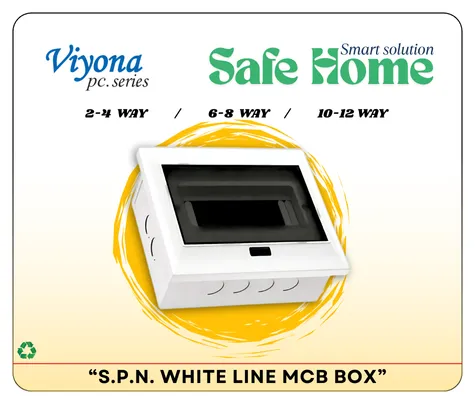
For a small fuse board, our SPN white line MCB box starts at ₹380 MRP for 2 to 4 way (371) and ₹480 for 6 to 8 way (372). For one or two circuits, the 1 and 2 way PVC surface MCB box (375) is ₹40 and the 3 and 4 way (376) ₹90.
Each circuit then takes a single pole MCB from our VIYONA 10 kA range, 6A to 32A at ₹145 MRP, and the main a 6A to 32A double pole MCB (411) at ₹350 or a 40A double pole isolator (442) at ₹230 where every circuit has its own MCB. Our MCB size calculation guide shows how each rating is worked out, and our MCB box size list gives every way-count.
This is a job for a licensed electrician, with the supply off at the main and the circuits tested dead. Do not fit a breaker larger than the old fuse wire’s safe rating just because the MCB is new: the cable has not changed.
Signs a kit kat fuse is unsafe
A kit kat fuse is unsafe when its base or carrier is cracked, scorched or discoloured, when the carrier sits loose or gets warm, when it holds anything other than the right fuse wire, or when it blows often, and any of these signs means switching off and having an electrician check that circuit.
Brown or black marks Cracked base or carrier Carrier warm to touch Thick or doubled wire Loose fit in the base Burning smell
Discolouring is heat. It comes from a loose contact or an overloaded circuit, and it gets worse each time the base heats and cools. A carrier that has to be wedged in with paper or tape is a loose contact by another name.
A fuse board does not have an RCCB’s protection against shock either, unless one has been added. Our electrical safety tips at home cover what a board should protect against, and our RCCB vs ELCB guide explains the shock-protection device. We do not make RCCBs.
Never touch a scorched or warm fuse base with the supply on. Switch off at the main, and call a licensed electrician.
FAQs
What is the rating of a kit kat fuse?
Which fuse wire is used in a 16A kit kat fuse?
Can I replace a kit kat fuse with an MCB?
Why is it called a kit kat fuse?
What is the price of a kit kat fuse?
Is a kit kat fuse safe to use?
Why buyers choose Vinayak Electricals
- Kit kat fuses, modular fuses and the MCBs that replace them, made at our works in Marol, Andheri East, Mumbai.
- VIYONA 131 (10A) at ₹60 and 132 (16A) at ₹66 MRP, plus the modular VIZA V1259 at ₹130.
- VIYONA 10 kA MCBs to IS/IEC 60898-1 under BIS licence CM/L-2544151, from ₹145 MRP.
- SPN white line and PVC surface MCB boxes for a fuse-board upgrade, from ₹40 MRP.
- MRPs published openly; sold through 500+ dealers with delivery across India.
- Manufacturing in Mumbai since 1995; ISO 9001:2015 certified.
Fuses, MCBs and boxes for the upgrade
See codes and MRPs for our VIYONA MCBs, isolators and MCB boxes, then order through a dealer or call us.
View MCBs and isolators