
RCCB vs MCB: Why Your Home Board Needs Both
RCCB vs MCB is not a choice between two breakers. An MCB switches off a circuit on sustained overload or short circuit, to protect the wire. An RCCB switches off when current leaks to earth, often through a person, at no more than 30 mA in a home RCCB. A safe home board has both. Below we compare them in plain numbers, explain 30 mA vs 100 mA, show where each sits in the DB with a drawn layout, and cover the RCBO that combines the two.
Key takeaways
- MCB — trips on sustained overload and short circuit; it protects the wire. Rated in amps.
- RCCB — trips on leakage to earth; it protects people. Rated in milliamps, 30 mA for homes.
- Both — an RCCB ignores overload and short circuit, an MCB ignores small leaks. A home needs the pair, or an RCBO.
- In the DB — main DP MCB, then a 30 mA RCCB, then one SP MCB per circuit; earth never through the RCCB.
- ⚠ We make MCBs, not RCCBs — VIYONA 10 kA MCBs from MRP ₹145; fit a BIS-licensed RCCB alongside.
RCCB vs MCB: the short answer
The difference between an RCCB and an MCB is what each one watches. An MCB watches the current in one circuit and switches it off on a sustained overload or a short circuit, so it protects the wire from overheating. An RCCB compares the current going out on the phase with the current coming back on the neutral, and switches off when the two differ by more than its setting, usually 30 mA, because the missing current is leaking to earth, possibly through a person.
So they are not rivals: a home needs both, and the RCBO is the two in one case.
Plainly: we make MCBs, isolators and MCB boxes at our works in Andheri East, Mumbai, but not RCCBs or RCBOs, and we name no RCCB brand here.
What does an MCB protect against?
An MCB protects the wiring of one circuit against two faults: a sustained overload and a short circuit. Under IS/IEC 60898-1 an MCB carries its rated current indefinitely; it trips on a sustained overload above that rating through its thermal element, and almost instantly on a short circuit through its magnetic element, set by its B or C curve.
The rating follows the wire, not the appliance. Common Indian practice: 6–10 A on 1.5 sq mm for lights and fans, 16 A on 2.5 sq mm for power sockets, 20 A on 4 sq mm for an AC or geyser. A 16 A socket on a 20 A MCB with 1.5 sq mm wire is the classic mistake: the wire can cook before the breaker ever sees a problem. Our MCB size calculation guide works through the numbers.
What an MCB cannot see is leakage. If a geyser element cracks and 50 mA starts flowing through the wet body of the tank to earth, the circuit is drawing a few amps as normal, plus a trickle the MCB has no way of noticing. To a 16 A breaker, 50 mA is nothing. Through a person, that much current can cause severe injury, cardiac arrest or death. For how it trips, see MCB working principle; for ratings room by room, which MCB for home.
An MCB is sized to protect the cable. It is not, and was never meant to be, a shock-protection device.
| MCB | RCCB | RCBO | |
|---|---|---|---|
| Protects | The wire of one circuit | People, against leakage to earth | Both |
| Trips on sustained overload | Yes | No | Yes |
| Trips on short circuit | Yes | No | Yes |
| Trips on leakage to earth | No | Yes | Yes |
| Rated in | Amps, e.g. C16 | Amps and mA, e.g. 40 A / 30 mA | Amps and mA |
| Indian standard | IS/IEC 60898-1 | IS 12640 (Part 1) | IS 12640 (Part 2) |
| Test button | No | Yes | Yes |
| Usual place in a home DB | Main switch and one per circuit | Between main and circuit MCBs | One per circuit, instead of an MCB |
| Made by Vinayak Electricals | Yes: VIYONA DIN MCBs; KEMPS and VIZA Tiny Trip | No | No |
What does an RCCB protect against?
An RCCB, a residual current circuit breaker, protects people and buildings against current leaking to earth. In a healthy circuit the current out on the phase equals the current back on the neutral. When they differ, the difference is going somewhere else: through damp insulation, a faulty appliance body, or a person. The RCCB measures that residual current and opens both poles when it crosses its rated value, the IΔn printed on its front.
For protecting people the usual figure is 30 mA. A note from the Bureau of Indian Standards describes the trip threshold as “typically 30 mA, which is well below the limit of danger for humans”. RCCBs for household use are covered by IS 12640 (Part 1), which is titled residual current operated circuit-breakers without integral overcurrent protection.
So an RCCB does not trip on overload and does not trip on a phase-to-neutral short. Each circuit behind it still needs its own MCB. And it has one blind spot worth knowing: if someone touches phase and neutral at the same time while standing insulated from earth, no current leaks, so there is nothing for the RCCB to see.
Shops often call it an ELCB; strictly that also names an older device, as RCCB vs ELCB explains.
An RCCB on its own is not a protected board. Without MCBs below it, an overloaded circuit has no protection at all.
Trips on sustained overload and short circuit, sized to the cable.
Trips on a leak to earth of 30 mA or less.
One device per circuit, so a fault darkens only that circuit.
Main DP MCB, then RCCB, then SP MCBs; earth bypasses the RCCB.
Difference between MCB and RCCB, in milliamps
The cleanest way to see the difference between an MCB and an RCCB is to put their numbers in the same unit. A 16 A MCB is a 16,000 mA device. A home RCCB is a 30 mA device. They are watching for faults more than five hundred times apart in size.
Rated residual current: the leak each RCCB setting trips on
Bars to scale against 300 mA. On the same scale a 16 A MCB’s rated current, 16,000 mA, would be about 53 times the longest bar: far off the page. Sensitivity bands as commonly classified: high (up to 30 mA) for protecting people, medium (100 mA and up) for fire protection.
The MCB’s job is amps: too much current heating a cable. The RCCB’s job is milliamps: a little current going where it should not.
On the DIN rail they look alike. Read the face: an MCB shows a curve letter and amps, for example C16. An RCCB shows its rated current in amps and its IΔn in mA, for example 40 A / 30 mA, plus a T button. If you see amps but no mA and no T, it is not an RCCB.
Quick check at the shop: an RCCB’s 40 A or 63 A is how much it can carry, not what it trips on. It trips on the mA figure.
Why does a home need both an MCB and an RCCB?
A home needs both because they guard against different accidents. Picture a 2BHK in Andheri in July. The geyser element’s insulation is failing and the circuit is wired correctly to 4 sq mm on a 20 A MCB. Someone touches the geyser body and a few tens of milliamps leak through them. The MCB sees a normal load and stays on. A 30 mA RCCB sees the imbalance and opens.
Now picture two 2,000 W heaters and a 1,000 W iron on the same 16 A socket circuit: 5,000 W ÷ 230 V ≈ 22 A. No current is leaking, so the RCCB does nothing. The 16 A MCB sees a sustained overload and trips before the 2.5 sq mm wire is damaged. It will not protect a 6 A or 10 A extension board plugged into that socket; that board can overheat well below 16 A.
There is also a rule behind this. Regulation 44 of the the CEA (Measures relating to Safety and Electric Supply) Regulations, CEA 2023 says the use of electricity in an electrical installation shall be controlled by a residual current device, and that a domestic installation shall use one with a residual operating current not exceeding 30 mA. Its one exemption, supply lines with protective devices bonded to the transformer neutral under regulation 76, does not cover an ordinary home board.
Wet areas, outdoor sockets and anything a person touches while barefoot are where a 30 mA RCCB earns its place. Mains switches and bell pushes stay away from showers whatever protection the board has.
30 mA vs 100 mA RCCB: which one for a house?
For a house, choose a 30 mA RCCB for the circuits people touch. 30 mA is the high-sensitivity rating used for protection against electric shock; 100 mA and 300 mA are medium-sensitivity ratings aimed at fire protection from leakage, not at protecting a person who touches a live part.
A 100 mA or 300 mA device typically belongs higher up in a larger installation, with 30 mA devices below it on the circuits people use. In a home, Regulation 44 of the CEA safety regulations, 2023 requires the residual current device to be 30 mA or less, so a 30 mA DP RCCB is the standard fit for a flat or bungalow.
Two other things on the label: the RCCB’s rated current, which should be at least that of the main MCB above it, for example 40 A or 63 A, and its type, the waveform it detects. If an appliance maker’s manual (an EV charger or some inverters, for example) asks for a particular RCD type, follow it. See EV charging point at home.
A 100 mA RCCB on its own does not meet the home requirement: the CEA regulations set 30 mA or less for domestic installations.
Where do the RCCB and MCBs sit in the DB?
In a typical single-phase home DB, the supply from the meter goes first to the main switch, a DP MCB; then through a 30 mA DP RCCB; then onto a busbar that feeds a row of SP MCBs, one per circuit. The neutrals of those circuits come back to a neutral bar fed from the RCCB’s neutral terminal.
DB layout: main MCB, RCCB and circuit MCBs
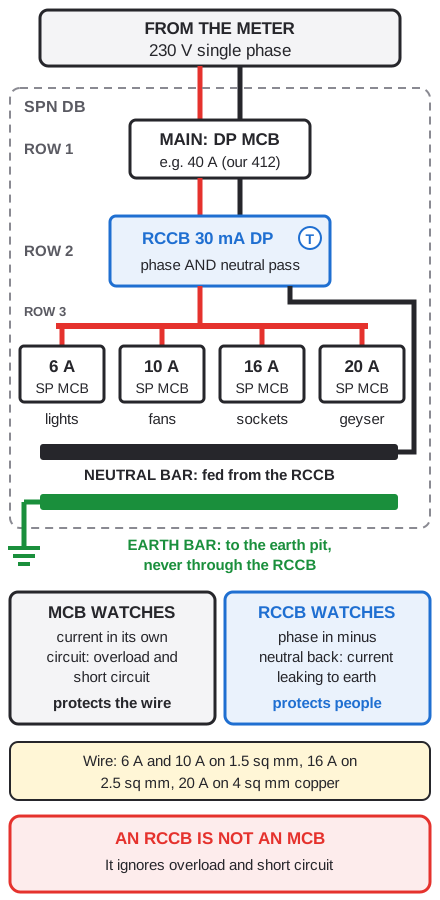
Drawn by us, simplified, for one single-phase board. Ratings are examples, not a design for your home; your electrician sizes the main and the circuits to your load and wire. Tap the diagram to open it full size.
Three rows, three jobs. Row 1, the main DP MCB, protects the whole board’s incoming cable and lets you switch off phase and neutral together. Row 2, the RCCB, watches every circuit below it for leakage. Row 3, the SP MCBs, protect each circuit’s own wire.
Two wiring rules matter. Both phase and neutral of every protected circuit must pass through the RCCB, or it measures a false imbalance. And the earth wire never passes through the RCCB; it runs straight to the earth bar and the earth pit. An isolator is not a substitute for the main MCB: it switches, it does not trip. See isolator vs MCB.
When you buy the box, count module spaces for the RCCB as well as the MCBs. Our SPN MCB box guide lists the ways and sizes.
One RCCB for the whole house, or split the board?
One 30 mA RCCB over the whole house is the simplest board and is common in flats. The trade-off is that every small leak adds up on one device. A slightly damp socket, an old geyser element and a washing machine with worn insulation can each leak a little; together they can reach the trip point, and the whole house goes dark, including the lights you need to find the fault.
A split board is a common answer for a larger home: two 30 mA RCCBs, each covering about half the circuits, for example wet-area and socket circuits on one, lights and fans on the other, so every circuit stays protected. A trip then takes out part of the house, not all of it. Which split suits your home is a decision for your licensed electrician.
If an RCCB keeps tripping, do not swap it for a less sensitive one or bypass it. It is usually telling you something true: heater elements with deteriorating insulation are a frequent cause. Our RCCB tripping again and again guide walks through finding the circuit, and washing machine giving shock covers the appliance most people suspect first.
Never bridge out or bypass an RCCB to stop nuisance trips. A tripping RCCB is the only device in the board that noticed the leak.
What is an RCBO, and when does it make sense?
An RCBO is an RCCB and an MCB in one device: a residual current operated circuit-breaker with integral overcurrent protection. It trips on leakage, on sustained overload and on short circuit. RCBOs for household use are covered by IS 12640 (Part 2), identical to IEC 61009-1, and BIS states that RCBOs sold, made or imported in India must carry the Standard Mark under a BIS licence.
The case for RCBOs is selectivity. With one RCBO per circuit, a leak on the geyser circuit trips only the geyser; the rest of the house stays on. The case against is cost: you buy a leakage device for every circuit instead of one for the group.
A middle path: a 30 mA RCCB plus MCBs for most circuits, and a 30 mA RCBO for one circuit you want on its own, such as a geyser or EV charger.
RCBO, RCCB plus MCB, or a split board: all three give leakage and overcurrent protection. They differ in how much of the house goes dark when one circuit faults.
What we make for the board, with MRPs
We make the MCB side of the board: VIYONA 10 kA breaking capacity MCBs made to IS/IEC 60898-1 under BIS licence CM/L-2544151, isolators and MCB boxes, all at our works in Mumbai. We do not make RCCBs or RCBOs; your electrician fits one from a BIS-licensed maker alongside our MCBs.
VIYONA 10 kA MCB MRPs for a home board
MRPs from our printed catalogue, per piece; sold in full boxes through dealers. Bars to scale against ₹530, rounded to 5% steps.
For the board in our diagram, a main 412 at MRP ₹435 and four 401 circuit MCBs at MRP ₹145 each come to ₹1,015 in MCBs, before the box and the RCCB. Our 372 6–8 way SPN white line MCB box is MRP ₹480; check the RCCB’s width fits the ways you buy. Double door boxes run from the 381 (4 way, MRP ₹750) to the 386 (16 way, MRP ₹1,410); for a bigger home, pick the way count that fits every MCB plus the RCCB.
For MCBs inside a switch plate, see KEMPS Tiny Trip MCB; the full range is on VIYONA MCBs and isolators.
Ask for test reports before you place an order; we share them on request.
Before you buy: a short checklist
Check these, in this order.
1. MCB ratings follow the wire: 1.5 sq mm for 6–10 A, 2.5 sq mm for 16 A, 4 sq mm for 20 A. 2. RCCB 30 mA for the circuits people touch, with a current rating at least the main MCB’s. 3. Marks: an ISI mark and the standard on the label, IS/IEC 60898-1 for an MCB, IS 12640 for an RCCB or RCBO. Our guide to comparing MCB brands shows what to read on a breaker.
4. Earthing first: an RCCB works with a sound earth; have the earth checked. 5. Space: count module ways for every device. 6. Electrician: DB work is for a licensed electrician, with the supply off at the main.
Once it is in, press the RCCB’s T button as often as its maker’s leaflet says. If it does not trip when you press it, call the electrician.
Turn off the main MCB before anyone opens the DB cover. A switched-off circuit MCB still leaves the busbar live. Even with the main off, the cable from the meter and the main’s top terminals stay live; that part is for the electrician.
FAQs
What is the difference between MCB and RCCB?
Can an RCCB replace an MCB?
Do I need an RCCB if I already have MCBs?
Which is better for a home, a 30 mA or 100 mA RCCB?
RCCB aur MCB mein kya fark hai?
Does Vinayak Electricals make RCCBs?
Why buyers choose Vinayak Electricals
- VIYONA 10 kA MCBs made to IS/IEC 60898-1 under BIS licence CM/L-2544151, SP from MRP ₹145 (401), DP from MRP ₹350 (411).
- DP MCBs up to 63 A (413, MRP ₹530) for the main switch, and isolators where a switch, not a trip, is needed.
- SPN white line MCB boxes from MRP ₹380 (371) and double door boxes from 4 way (381, MRP ₹750) to 16 way (386, MRP ₹1,410).
- Making electrical accessories since 1995, today at our works in Andheri East, Mumbai; ISO 9001:2015 certified.
- MRPs published openly in our catalogue; test reports on request before an order.
- All-India delivery through 500+ dealers and distributors, in full boxes.
MCBs and MCB boxes for your home board
See our VIYONA 10 kA MCBs and isolators, then order through a dealer or call our Mumbai works.
Vinayak Electricals is an MCB manufacturer in Mumbai, supplying dealers, electricians and contractors across India by the box. Ask us for prices and stock.
View VIYONA MCBs WhatsApp for prices Download catalogue