Electricity Supply Companies in Mumbai: Who Supplies Where, and What It Means for Your Wiring

Four electricity supply companies serve Mumbai: BEST in the island city, Adani Electricity in the suburbs and Mira Bhayandar, Tata Power with a parallel licence over much of both, and MSEDCL (Mahavitaran) in Mulund and Bhandup. Your address decides which one fits your meter and sanctions your load. Below we map who supplies where, explain single phase vs three phase and sanctioned load under Mumbai’s supply rules, and show what to tell your electrician about the main switch and DB that sit after the meter.
Key takeaways
- Four companies — BEST (Colaba to Mahim and Sion), AEML (Bandra to Dahisar, Chunabhatti to Vikhroli, Mankhurd, Mira Bhayandar), Tata Power (parallel licence), MSEDCL (Mulund, Bhandup).
- Check your bill — it names your supplier; on border streets and in Tata Power’s overlap it is the only reliable answer.
- Supply type — single phase up to 40 A; three phase up to 160 kW / 200 kVA, under MERC Supply Code 2021.
- Your side — everything after the company’s cut-out and meter is your wiring: main switch, DB, circuits.
- ⚠ Main switch — a double pole MCB (four pole on three phase), never an isolator alone.
Electricity supply companies in Mumbai: the short answer
Four electricity supply companies serve Mumbai. BEST supplies the island city, from Colaba up to Mahim and Sion. Adani Electricity Mumbai (AEML) holds the licence for the suburbs from Bandra to Dahisar, Chunabhatti to Vikhroli and Mankhurd, plus Mira Bhayandar. Tata Power holds a second, parallel licence over the city, much of the suburbs and Mira Bhayandar, so it competes with both. MSEDCL, known as Mahavitaran, supplies Mulund and Bhandup, and Thane and Navi Mumbai beyond the city.
Which one you get decides who fits your meter, who sanctions your load and whom you call in a power cut. It does not change the wiring inside your flat. That part is yours, and it is where we come in: we make the MCBs, isolators, MCB boxes and switches that sit after the meter, at our works in Marol, Andheri East.
Below: which company covers which area, single phase or three phase, sanctioned load, where the meter goes in a Mumbai building, and what to tell your electrician about the main switch and DB.
Which company supplies electricity in my area of Mumbai?
Your area decides it. Find your suburb on the sketch, then confirm against your last bill, because the company name and consumer number are printed at the top.
Mumbai electricity supply areas, approximate
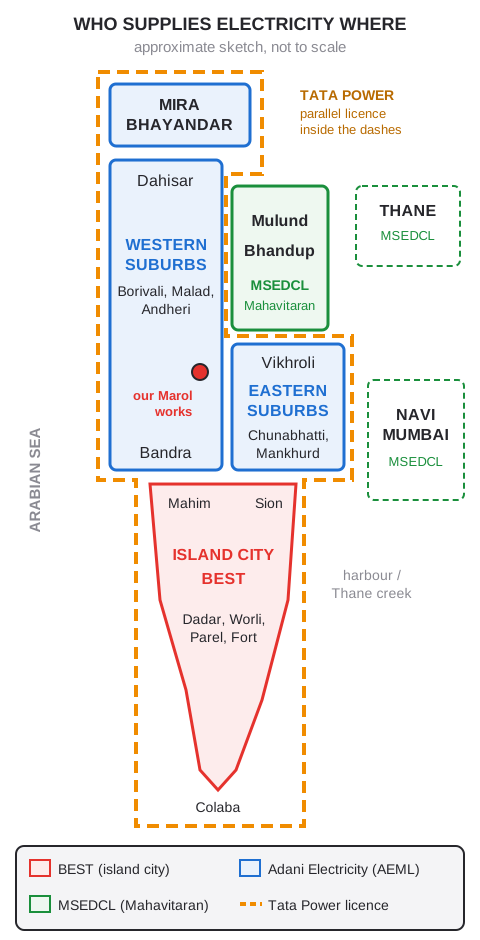
Drawn by us from the published licence descriptions; not to scale and not a boundary map. Tata Power’s licence covers the whole Mumbai district, part of the suburban district and Mira Bhayandar, and its network does not reach every street inside it. Tap the diagram to open it full size.
Island city Colaba, Fort, Worli, Parel, Dadar, Mahim and Sion: BEST, or Tata Power where its network reaches. Western suburbs Bandra to Dahisar, including Andheri, Goregaon, Malad and Borivali: AEML or Tata Power. Eastern suburbs Chunabhatti, Kurla and Ghatkopar up to Vikhroli, and Mankhurd: AEML or Tata Power. Mulund and Bhandup: MSEDCL. Mira Bhayandar: AEML or Tata Power.
Boundaries follow licence wording, not station names. On a border street, the bill is the only reliable answer.
| Company | Broad area in and around Mumbai | Good to know |
|---|---|---|
| BEST (Brihanmumbai Electric Supply and Transport Undertaking) | Island city: Colaba and Cuffe Parade up to Mahim and Sion | Municipal undertaking; about 10.8 lakh consumers (October 2026 report) |
| Adani Electricity Mumbai Ltd (AEML) | Bandra to Dahisar; Chunabhatti to Vikhroli and Mankhurd; Mira Bhayandar | Licence from 16 Aug 2011 to 15 Aug 2036 |
| Tata Power (Mumbai distribution) | Whole Mumbai district, part of the suburbs, Mira Bhayandar | Parallel licence to 15 Aug 2039; overlaps BEST and AEML |
| MSEDCL (Mahavitaran) | Mulund and Bhandup; Thane and Navi Mumbai beyond the city | State utility; has applied for a wider Mumbai licence |
| All four | Supply rules | MERC Supply Code 2021: single phase up to 40 A, three phase up to 160 kW / 200 kVA |
Two supply companies on one street: parallel licences
In large parts of Mumbai, two licensed companies may supply the same building. Tata Power’s distribution licence, granted by the Maharashtra Electricity Regulatory Commission (MERC) in August 2014 and running to August 2039, overlaps BEST’s area in the island city and AEML’s area in the suburbs.
In practice, a flat in Wadala or Andheri may be on BEST or AEML while the flat upstairs is on Tata Power. Each company runs its own meter and own service cable, and a redevelopment tower may find that one company can give it a connection sooner than the other, often because of where a substation can be built.
More changes are on the table. In June 2025 MSEDCL applied to MERC for a parallel licence across most of Mumbai; an Adani company (2022) and Torrent Power have applied for licences that cover Mulund and Bhandup; Tata Power filed its own application for a wider area in 2025; and AEML has asked to supply Dharavi as it is redeveloped. MERC’s public notices of 23 June 2025 found the Adani and Torrent applicants prima facie eligible, but we found no final order on any of these as of October 2026.
If you read that “Adani now supplies Mulund” or “MSEDCL now supplies Bandra”, check MERC’s own orders first. An application is not a licence.
Island city BEST, suburbs AEML, Mulund and Bhandup MSEDCL; Tata Power overlaps.
The supplier’s name and consumer number are on every bill.
Single phase up to 40 A; above that, three phase up to 160 kW.
Main MCB, DB and circuits after the meter are yours to get right.
How big is each Mumbai power company?
Of the three that publish Mumbai figures, AEML is the largest by consumers, BEST next, then Tata Power. The numbers below come from different reports and dates, so read them as orders of size, not a league table.
Reported consumers, Mumbai supply companies
AEML: 3.1 million, Adani release, 2023. BEST: Construction World, October 2026. Tata Power: Free Press Journal, September 2026. MSEDCL does not publish a Mumbai-only figure that we could find, so it is left out. Bars to scale against 31 lakh.
Size does not change anything at your switch board. What matters is the supply type the company gives you, the sanctioned load it agrees to, and where it puts the meter. All four follow the same MERC Supply Code 2021, so the rules below apply whichever name is on your bill.
One rule book for all four: the MERC Electricity Supply Code and Standards of Performance Regulations, 2021, in force since 25 February 2021.
Where the supply company stops and your wiring starts
The supply company’s job ends at the point of supply: the outgoing terminals of its cut-out or switchgear fixed in your premises, which in a Mumbai building usually means the meter cabin. Everything after that point is your wiring.
The Supply Code says so plainly: wiring beyond the point of supply is carried out by the consumer and must meet the Central Electricity Authority’s safety regulations. A new connection application asks for the name and licence number of the Licensed Electrical Contractor who will certify that wiring.
So the meter, the service cable and the company’s cut-out belong to the supply company. The sub-main cable up to your flat, your main switch, your DB, every circuit, switch and socket belong to you. Where the building has a bus riser to meters on upper floors, the riser itself is handed over to the supply company. If the supply company finds leakage in your internal wiring that is harmful to you, other consumers or its network, it may disconnect you, giving its reasons.
Never open, bypass or tamper with the meter or the company’s cut-out. Your electrician works only on your side of it, with your main switch off.
Single phase or three phase: what the supply company will give you
Under Mumbai’s Supply Code, a general supply up to 40 amperes is single phase, two wires at 230 to 240 V. Above that, low-voltage supply is three phase, 400 to 415 V between phases, up to a sanctioned load of 160 kW or 200 kVA. Bigger loads move to 11 kV and above.
For most flats that means single phase: one phase and neutral, a double pole main, and an SPN DB. A bungalow, a large duplex, or a home with several ACs and an EV charger may need three phase, which brings a four pole main and a TPN DB.
The code also lets a consumer who qualifies for single phase ask for three phase if it is technically feasible and the consumer bears the required expense. Our single phase vs three phase guide weighs when that is worth it; here the point is simply that the supply company decides what it can give, and your DB must match it.
Changing from single phase to three phase is not only a meter change. The main switch, the DB and how circuits are spread across the phases all change too.
Sanctioned load: the number your supply company agrees to
Sanctioned load is the load, in kW or kVA, that the supply company has agreed to supply to your premises. You state it when you apply, the company sanctions it, and it decides your supply type and, with your wiring, your main switch.
The new connection form asks for the total load applied for, in kW, and lists the use of each part of it. Our electrical load calculation guide adds it up for a 2BHK. As a rough feel: a 5 kW single-phase load draws about 22 A at 230 V (5,000 ÷ 230), comfortably inside the 40 A single-phase limit.
Single phase amps for common sanctioned loads (I = W ÷ 230)
Simple arithmetic at 230 V with a power factor of 1; real current is a little higher. Bars to scale against 39 A. The 40 A single-phase limit is from MERC Supply Code 2021, regulation 3.2.
If you add a second AC, a geyser or an EV charger, apply for additional load through the same application route. Your bill is a separate matter; see how to calculate an electricity bill.
Sanctioned load is not a wire rating. The cable and MCBs inside your flat must be sized for the real load, whatever the paper says.
Where the meter goes in a Mumbai building
In a multi-storey building the supply company places meters at ground floor, in an accessible spot, at a height where they can be read and protected from weather. A meter on another floor needs a bus riser that the consumer pays for and then hands over to the company.
That is why most Mumbai flats have a meter room in the stilt or ground floor and a long sub-main running up the duct to the flat. On the 14th floor of an Andheri tower that run can be tens of metres, and every metre adds a little voltage drop. Your electrician sizes that cable for the load and the distance, not by habit.
Two practical things follow. First, put your main switch and DB just inside the flat entrance, so you can switch off without going down to the meter room. Second, make sure your meter and your own sub-main switch in the meter room are labelled with your flat number; ask the society or the supply company to label the meter if it is not. In a monsoon fault at 2 a.m., nobody should be guessing which of forty meters is yours.
The Supply Code asks that meters sit in an easily accessible common area. A meter room that floods or is kept locked is a building problem to raise with the society.
What to tell your electrician: main switch and DB
Tell your electrician your supply type, sanctioned load and supply company. Supply type sets a double pole or four pole main and an SPN or TPN DB; your electrician then picks the main MCB rating from the real load and the sub-main cable.
Main MCBs from our VIYONA 10 kA range
Catalogue MRPs. Also: 433 four pole 63 A, MRP ₹1,035; 413 double pole 63 A, MRP ₹530. Bars to scale against ₹855.
For a single-phase flat, a double pole MCB as the main: our 411 for 6 to 32 A or 412 for 40 A, made under IS/IEC 60898-1, CM/L-2544151. An MCB carries its rated current indefinitely and trips on sustained overload above it or at once on a short circuit. For three phase, a four pole MCB, the 432 at 40 A or 433 at 63 A; our 3 pole vs 4 pole MCB guide explains why four.
The board: an SPN white line box from MRP ₹380 (371, 2–4 way) to MRP ₹950 (374, 16–18 way), or a TPN double door from MRP ₹2,620 (387, 4 way). See SPN vs TPN distribution board.
An isolator switches the supply off; it does not trip on overload or short circuit. It is never a substitute for the main MCB. See isolator vs MCB.
After the main switch: circuits, wire and earth leakage
Behind the main switch, each circuit gets its own MCB, and each MCB is chosen to protect its wire: the MCB rating must not exceed what the cable can carry.
Common Indian practice: wire size and MCB rating
Typical copper house wiring; long runs, bunched cables and hot ducts need a larger size. Bars to scale against 25 A. Your electrician confirms each circuit.
Our 401 single pole MCB, 6 to 32 A, is MRP ₹145. Never put a 16 A socket on a 20 A MCB with 1.5 sq mm wire: the wire overheats before the MCB acts. Our MCB size calculation guide works through the numbers.
Add a 30 mA RCCB for bathrooms, balconies, outdoor circuits or the whole house. We do not make RCCBs, so buy a BIS-marked one from a brand that does and leave room for it in the DB.
Work on fixed wiring is for a licensed electrician, with the main MCB off and tested dead. The supply company will not repair anything on your side of the meter.
Moving flat or changing supplier: what changes in your wiring
Very little inside the flat. If you move from one Mumbai supply company to another where both are licensed, the meter and service cable change; your DB, MCBs and circuits stay as they are. If you move house, the new flat comes with its own connection, so check its main switch and DB before you move in.
The supplier changes meter and consumer number, and its helpline becomes the one you call. The terms of switching between companies in Mumbai are set by MERC; ask the company you want to move to for its current process in writing.
A change is still a good moment to ask your electrician to check the main switch rating, the sub-main up from the meter room and the earthing. If an old flat still has a kit kat fuse as the main, that is the time to fit a double pole MCB. Our which MCB for home page covers the choice.
Keep a photo of the meter, the bill header and your DB label in your phone. It answers most questions a supply company or electrician will ask.
Power cut or tripping? Who to call
If the whole building is dark, call your supply company. If only your flat is off, check your own main switch and DB first, then call an electrician.
Whole street dark or a meter burning: the supply company’s helpline printed on your bill. Only your flat off: look at your main MCB. If it has tripped, switch off the circuit MCBs, reset the main, then turn circuits on one at a time to find the faulty one. One circuit keeps tripping: see MCB tripping again and again or, for an RCCB, RCCB tripping.
Our works are in Marol, Andheri East, inside the Bandra to Dahisar stretch, and we supply dealers across Mumbai and India. For our local dealer network see Andheri, Bandra and Borivali.
A main MCB that trips again as soon as you reset it, with every circuit off, points to a fault on the sub-main or in the DB itself. Stop resetting it and call an electrician.
FAQs
Which companies supply electricity in Mumbai?
Who supplies electricity in Andheri?
Is Mulund under Adani or MSEDCL?
Can I get a three phase connection for my flat in Mumbai?
What is sanctioned load on my electricity bill?
Who is responsible for wiring after the meter?
Why buyers choose Vinayak Electricals
- VIYONA 10 kA single, double, three and four pole MCBs for the main switch, made under BIS licence CM/L-2544151 to IS/IEC 60898-1.
- SPN white line MCB boxes from MRP ₹380 (371) and TPN double door boxes from MRP ₹2,620 (387) for single or three phase DBs.
- Double pole isolators from MRP ₹230 (442) to fit beside the main MCB, never instead of it.
- Making electrical accessories since 1995, today at our works in Marol, Andheri East; ISO 9001:2015 certified.
- MRPs published openly in our catalogue; test reports on request before an order.
- Supplied through 500+ dealers and distributors, with all-India delivery in full boxes.
MCBs and DBs for the main switch after your meter
See our VIYONA 10 kA MCBs, isolators and MCB boxes, then order through a dealer or call us.
Vinayak Electricals is a manufacturer of switches, MCBs and LED lights in Mumbai, supplying dealers, electricians and contractors across India by the box. Ask us for prices and stock.
View VIYONA MCBs WhatsApp for prices Download catalogue