Hospital Call Bell System: How a Nurse Call Bell Is Put Together

A hospital call bell system lets a patient call for help with one press: a buzzer sounds at the nurses’ station and an indicator shows which bed called. Below we explain how a nurse call bell works, the parts it needs, a call bell for elderly at home, how a bell indicator fits in, and the MRPs of the wired call bell modules we make in Mumbai.
Key takeaways
- Parts — a push at each bed and toilet, an indicator per room, a buzzer at the station, on its own MCB.
- Our indicators — VIZA V304 ₹275, VIZA Black V1290 ₹282, KEMPS K219 ₹298.
- Our buzzers — KEMPS K224 ₹230, VIZA V302 ₹243, VIZA Black V1289 ₹329.
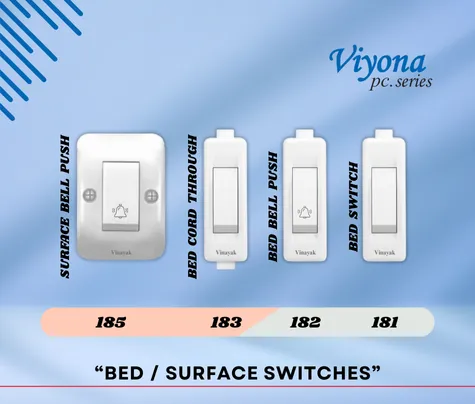
- Bed push — VIYONA 182 cord-type bed bell push at ₹38 MRP.
- Limits — our modules are wired; latching nurse call panels and wireless bells come from other makers.
Hospital call bell system: the short answer
A hospital call bell system lets a patient call a nurse by pressing a push at the bed: a buzzer sounds at the nurses’ station and an indicator lamp shows which bed or room is calling. Small nursing homes, clinics, maternity homes and old-age homes often build one from simple wired modules, and families do the same at home for an elderly or bedridden parent.
We make the parts for that wired kind of system at our works in Marol, Andheri East, Mumbai: hospital bell indicators, electronic buzzers and bell pushes in our VIZA, VIZA Black and KEMPS modular ranges, and bed bell pushes in VIYONA. Our catalogue groups the VIZA ones under the heading motor starter / hospital call bell system.
This guide explains how a nurse call bell works, the parts it needs, how many to plan for a ward, how the circuit is laid out, and what each part costs at our MRP. If you only need a door bell, our door bell for home guide is the better place to start.
How does a nurse call bell work?
A nurse call bell works as a simple circuit: the patient presses a bell push at the bed, which completes the circuit to a buzzer at the nurses’ station and to an indicator lamp showing which bed or room called; releasing the push, or a reset at the bed, ends the call.
Three things have to happen for a call to be useful: the call is made from where the patient lies, it is heard where staff are, and it is located so the nurse goes to the right bed. The buzzer does the second job and the indicator the third.
In the simplest wiring the push is a momentary contact, so the buzzer and lamp work only while it is held. Systems where the lamp stays lit until a nurse reaches the bed and cancels it use a latching relay or a dedicated nurse call panel. We do not make nurse call panels or relays; our part is the push, buzzer and indicator modules, all wired.
Decide early whether a call must stay lit until a nurse cancels it at the bed. That one choice decides whether simple modules are enough or a nurse call panel is needed.
| Part | Code | Range | MRP |
|---|---|---|---|
| Hospital bell indicator | V304 | VIZA | ₹275 |
| Hospital bell indicator | V1290 | VIZA Black | ₹282 |
| Bell indicator | K219 / K619 | KEMPS white / grey | ₹298 / ₹320 |
| Electronic buzzer, 2M | V302 | VIZA | ₹243 |
| Electronic buzzer, 2M | V1289 | VIZA Black | ₹329 |
| Electronic buzzer | K224 / K624 | KEMPS white / grey | ₹230 / ₹265 |
| Bed bell push | 182 | VIYONA | ₹38 |
| Surface bell push | 185 | VIYONA | ₹36 |
What parts make up a call bell system?
A wired call bell system is made of four parts: a bell push at each bed or toilet for the patient, an indicator at each room door or on a panel at the station, a buzzer at the nurses’ station, and the cable and switch boards that connect them, with an MCB protecting the circuit at the distribution board.
Bell push at the bed: a bed bell push on a cord, or a modular push in a board within reach. Indicator a lamp module that shows where a call came from. Buzzer the sound at the station. MCB on its own circuit, so a fault elsewhere does not take out the call bells.
Everything except the cable fits standard modular plates, so the call points match the light switches and sockets in the same ward. Our VIZA modular range carries all three modules, which keeps a ward on one plate design and one supplier.
Put the call bell circuit on its own MCB. A tripped socket circuit should never silence the patients’ bells.
A cord-type bed push the patient can press lying down.
Shows staff which room or bed has called.
One buzzer can serve several rooms with indicators.
Press every push and log the result.
What is a bell indicator?
A bell indicator is a lamp module, fitted in a switch board, that is wired with a bell push so it lights when that push is used, showing staff which bed, room or toilet has called; in a ward there is usually one per room door or a row of them on a panel at the nurses’ station.
MRP of our bell indicators
MRPs from our current catalogue and February 2026 price lists. Bar length is MRP, scaled to ₹320.
VIZA V304 is a hospital bell indicator module at ₹275 MRP. Do not confuse it with the small neon indicator built into an indicator switch, which only shows that a circuit is live; our switch with indicator guide covers that kind. A bell indicator is a separate module with its own job.
Which buzzer for the nurses’ station?
The buzzer for a nurses’ station should be loud enough to hear over a busy corridor but not so harsh it disturbs every ward, and a modular electronic buzzer that fits the station’s switch board is the usual choice; ours are the VIZA V302 at ₹243, KEMPS K224 at ₹230 and VIZA Black V1289 at ₹329 MRP.
MRP of our electronic buzzers
MRPs from our current catalogue and February 2026 price lists. Bar length is MRP, scaled to ₹329.
Both VIZA buzzers are 2-module, so plan the station board’s plate size for them. One buzzer can serve several rooms when the indicators show which one called. Our electric buzzer guide compares buzzers with door bells in detail.
Bed push: what the patient presses
The bed push should be something a patient can reach and press without sitting up: a bed bell push on a cord that lies on the bed, or a modular bell push in a bedside board at mattress height, and our VIYONA 182 bed bell push costs ₹38 MRP while the 185 surface bell push is ₹36.
Cord-type bed push the VIYONA 182 hangs on its flexible cord and can be clipped to the bedsheet, the easiest for a weak patient. Surface push the 185 screws straight onto a wall or bed frame with no box. Modular push with an indicator, such as the KEMPS K115 at ₹145, VIZA V535 at ₹93 or VIZA Black V1205 at ₹102, glows so it can be found in the dark.
All six of our bed and surface switch codes are on the VIYONA bed and surface switches page, and our bed switch guide covers the cord type in detail.
Check the cord’s length and route at the bedside. It should reach the patient’s hand without crossing the floor where a trolley or a foot can snag it.
Call bell for elderly at home
A call bell for elderly at home is the same idea scaled down: a bed bell push beside the parent’s bed wired to a buzzer in the room where the family spends most of the day, so a call is heard from the kitchen or the living room without the parent having to shout or get up.
A typical home setup at our MRP: a VIYONA 182 bed push, ₹38, a VIZA V302 buzzer, ₹243 in a plate in the living room, and the cable between them. Many families add a second push by the toilet, where falls are most common, wired to the same buzzer.
A wired bell has no batteries to die, which is the main reason families choose it over a plug-in wireless bell for someone who will rely on it every night. The wider picture, from night lighting to switch heights, is in our electrical safety for elderly at home guide.
Test a home call bell once a week by pressing it from the bed. A bell nobody has heard in a month is a bell nobody is sure of.
How is a call bell system wired?
A call bell system is wired as a small dedicated circuit: supply from its own MCB runs to each bed push, and from each push to that room’s indicator and on to the shared buzzer at the station, so every push sounds the buzzer and lights its own indicator; the exact scheme depends on the modules.
Common practice points: one MCB for the call circuit; cable runs in conduit along corridors; every push, indicator and buzzer in a box and plate, with nothing loose behind a bed; and the circuit drawn and labelled, so maintenance staff can trace a dead push later. Our switch board wiring diagram guide shows how modules connect inside a board.
Check each module’s marking for the supply it takes before planning the circuit, and keep the buzzer and indicator modules from the same range so they fit the same plates.
Switch off the MCB and test dead before connecting any module. Wiring a call bell system for a hospital, nursing home or ward is a job for a licensed electrician.
Wired or wireless call bell: which is better?
A wired call bell is better where it will be relied on every day, because it has no batteries or radio link to fail and works the same in every room, while a wireless call bell is quicker to put in and suits a temporary need, such as a parent recovering at home for a few weeks.
Wired fixed points, no batteries, matches the switch boards, needs cabling. Wireless plug-in receiver and battery push, no cabling, needs battery checks and can lose range through thick walls.
We make the wired modules only. For a hospital or nursing home being fitted out or rewired, wired is the usual choice because the cable goes in with everything else. For a rented flat where walls cannot be chased, a wireless bell from another maker may be the practical option; if so, put a reminder on the calendar to change its batteries.
Whatever you fit, the person who needs it must be able to press it lying down, in the dark, without searching.
Planning a ward or clinic: how many call points?
A ward or clinic usually needs one call push per bed, one per toilet or bathroom, one indicator per room door or a panel position per bed at the station, and at least one buzzer where staff sit, so a 4-bed room with an attached toilet needs five pushes and one indicator outside.
Worked example for a small nursing home floor, at our MRP: 8 beds with VIYONA 182 bed pushes at ₹38 is ₹304; 4 rooms with a VIZA V304 indicator each at ₹275 is ₹1,100; 1 station buzzer VIZA V302 at ₹243. The modules come to about ₹1,650 before plates, boxes, toilet pushes, cable and labour.
Our hospital wiring guide covers a different subject, the dim-and-bright lamp circuit, which is often confused with call bells.
Count toilets as beds when planning call points. A patient who slips in a bathroom needs the call bell more than one lying in bed.
Where should call bell pushes be placed?
Call bell pushes should be placed where the person can reach them from the position they are in when they need help: within arm’s reach of the pillow for a bed, and low on the wall beside the toilet for a bathroom, reachable by someone who has slipped and is on the floor.
Bed on a cord that rests on the bed, or a bedside board at about mattress height. Toilet a push within reach of the seat, and ideally a second one low near the floor. Wet zones keep pushes out of the shower spray; a damp module is a shock risk.
Indicators go above or beside each room door at a height staff can see from the corridor, and the buzzer at the station where someone always is. Our switch board height from floor guide gives common heights for bedside boards.
Never fit an ordinary modular push inside a shower area. Keep electrical points out of the spray zone, as your electrician will advise.
Testing and looking after a call bell system
A call bell system should be tested from every push on a fixed schedule, with someone at the station confirming the buzzer and the right indicator each time, because a dead push looks exactly like a working one until a patient needs it.
A short routine that works: Weekly press every push and check the buzzer and indicator. Monthly check bed cords for cuts, kinks and loose entries. Yearly have an electrician check terminals, boxes and the MCB.
Replace a cracked push or a frayed cord the same day; both modules are cheap, and our VIYONA 182 bed push is ₹38. Keep two or three spares on the floor. Our home electrical maintenance checklist has a wider routine for the rest of the building.
Log each test with the date and the result. In a nursing home, a test log is also what an inspector will ask to see.
FAQs
How does a hospital call bell system work?
What is a nurse call bell?
What is the price of a hospital bell indicator?
Which call bell is best for an elderly person at home?
How many call bell points does a hospital room need?
Do you make wireless nurse call systems?
Why buyers choose Vinayak Electricals
- Hospital bell indicators, buzzers and bell pushes made at our works in Marol, Andheri East, Mumbai.
- Call bell modules in VIZA, VIZA Black and KEMPS, so a ward matches its switch boards.
- VIYONA 182 cord-type bed bell push at ₹38 MRP, with the full bed and surface switch family.
- The ward’s other points from one catalogue: switches, sockets, night lamps and MCBs.
- MRPs published openly; sold through 500+ dealers with delivery across India.
- Manufacturing in Mumbai since 1995; ISO 9001:2015 certified.
Call bell modules for wards and homes
See the VIZA modular range with the V304 hospital bell indicator and V302 buzzer, then order through a dealer or call us.
View VIZA modular