Isolator Switch: Which Pole Count, Which Rating, and What It Costs
Key takeaways
- An isolator switches a board or machine off; it never trips on overload or short circuit.
- Double pole (L + N) for single phase: 442 40A ₹230, 443 63A ₹290.
- Three pole (R Y B) for three phase motors: 452 ₹370, 453 ₹400.
- Four pole (R Y B N) for TPN boards: 461 ₹480, 462 ₹530.
- Rate it at least as high as the device protecting the cable that feeds it.
What is an isolator switch?
An isolator switch is a DIN rail switch that cuts the supply to a board or a machine so that it can be worked on safely. It looks like an MCB, sits in the same distribution board, and has a lever that opens all its poles at once. The difference is that it never trips by itself. It does not protect anything against overload or short circuit; it only gives a clear, deliberate OFF.
We make isolators in 40A and 63A, in double pole, three pole and four pole, under our VIYONA brand at our works in Marol, Andheri East, Mumbai. That is six codes, from ₹230 to ₹530 MRP.
Double, three and four pole isolators
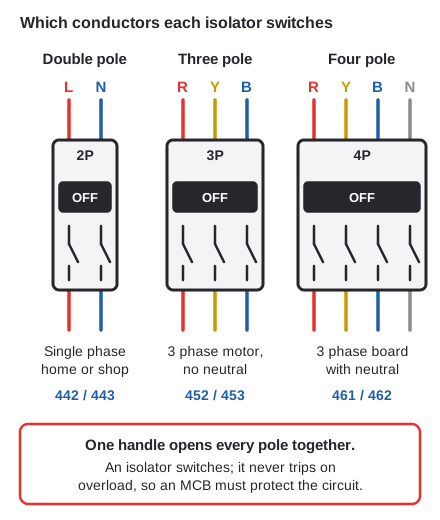
Drawn by us, not to scale. Contacts shown open. Codes are our VIYONA isolators: 40A first, then 63A.
Our isolator switches: all six codes
Every isolator we make comes in two current ratings, 40A and 63A, and three pole counts. These are printed MRPs from our current catalogue:
VIYONA isolator MRP by poles and rating
Printed MRPs from our current catalogue. Packed 6 per box (double pole), 4 (three pole) and 3 (four pole). Bars to scale.
Going from 40A to 63A costs only ₹30 to ₹60 more at the same pole count. The full range is on our VIYONA isolator product page and the VIYONA MCBs and isolators page.
| Code | Poles | Rating | MRP | Per box | Typical use |
|---|---|---|---|---|---|
| 442 | Double pole | 40A | ₹230 | 6 | Single phase main |
| 443 | Double pole | 63A | ₹290 | 6 | Single phase main |
| 452 | Three pole | 40A | ₹370 | 4 | 3 phase motor |
| 453 | Three pole | 63A | ₹400 | 4 | 3 phase motor |
| 461 | Four pole | 40A | ₹480 | 3 | TPN board main |
| 462 | Four pole | 63A | ₹530 | 3 | TPN board main |
Isolator vs MCB: the one-line difference
An MCB switches and protects: it trips on overload and short circuit. An isolator only switches. That is why they appear together in a DB: the isolator as the main OFF for the whole board, the MCBs below it protecting each circuit.
The price reflects it. Our 40A double pole isolator (442) is ₹230; our 40A double pole MCB (VIYONA 412) is ₹435. The two do different jobs, so the isolator is not a cheaper MCB. It belongs as the main only where the cable feeding the board is already protected upstream, by the electricity company’s cut-out or a breaker at the meter, and every circuit below has its own MCB. Where the main itself must protect that cable, fit a DP MCB.
The full comparison, with symbols and how to tell them apart on the rail, is in our isolator vs MCB guide.
An isolator must never be the only device on a circuit. If nothing upstream or downstream can trip, a fault will burn the wire before anything opens.
Single phase main: 442 at ₹230, 443 at ₹290.
Three phase motors with no neutral: 452 and 453.
TPN board main, neutral included: 461 and 462.
An isolator only switches; MCBs protect the circuits.
Double pole isolator: single phase homes and shops
A double pole isolator switches phase and neutral together. It is a common main switch for a single phase flat, shop or office DB where the incoming cable is protected at the meter, sitting at the incoming end with an RCCB and the outgoing MCBs below it.
Choose 442 (40A, ₹230) or 443 (63A, ₹290). The isolator rating should be at least that of the protective device feeding it, which for a home is usually the electricity company’s cut-out or a breaker at the meter.
Double pole isolators also make good local switches for a sub-board in a kitchen, a terrace room or a shop at the front of a house: the person working on that board can cut it without walking to the main DB. Our SPN MCB box page covers the boxes they fit.
A 442 (₹230) as the main is complete only with protection upstream at the meter and an MCB on every circuit below. Without that upstream protection, the main must be a DP MCB such as VIYONA 412 (40A, ₹435).
Three pole isolator: three phase machines
A three pole isolator switches the three phases, R, Y and B, and leaves the neutral alone. It suits three phase loads that have no neutral connection at all, such as a three phase motor for a borewell, a lift, a compressor or a workshop machine.
Our three pole isolators are 452 (40A, ₹370) and 453 (63A, ₹400). Mounted beside the machine or at its starter, the isolator lets a mechanic make the machine dead right where he is working.
A motor also needs its own protection, normally an MCB of the right curve or a motor starter; our motor starter guide covers pumps.
Fit the isolator where the person working on the machine can see it. A switch two floors away in a locked room does not stop a colleague from closing it while a pump is being opened.
Do not use a three pole isolator as the main of a board that has single phase circuits. Those circuits need the neutral, and it should be isolated too.
Four pole isolator: three phase boards (TPN)
A four pole isolator switches all three phases and the neutral. It is the main switch for a three phase distribution board, the TPN board found in larger homes, bungalows, shops and offices on a three phase supply.
Our four pole isolators are 461 (40A, ₹480) and 462 (63A, ₹530). Both fit at the incoming end of our TPN double door boards, from the 4 way TPN at ₹2,620.
The TPN MCB box page sizes the board, and our 3 pole vs 4 pole guide explains why a TPN main isolates the neutral.
On a TPN board, the four pole isolator is the device that makes the whole board dead with one lever, neutral included.
40A or 63A: which rating?
The isolator’s rating is the current it can carry continuously while closed. It must be at least the rating of the fuse or breaker that protects the cable feeding it, so that the isolator is never the weakest part of the path.
- 40A: most single phase flats, small shops and sub-boards
- 63A: larger single phase homes, three phase boards, and any board fed through a 63A breaker
Two worked examples. A 2BHK on a single phase supply, with a 32A double pole MCB at the meter, takes a 40A double pole isolator in the flat’s DB: 40 is above 32, so the isolator is never the weak point. A bungalow on three phase, fed through a 63A four pole breaker, takes a 63A four pole isolator in its TPN board, because a 40A isolator there would be smaller than the breaker protecting it.
Because the step costs so little, from ₹30 at three pole to ₹60 at double pole, many electricians fit 63A as standard on a new board. Our MCB for home guide shows where the main sits in a typical flat.
A bigger isolator does not let a home draw more power. The limit is set by the supply, the meter cable and the breaker that protects it.
How to use an isolator safely
An isolator is built to make a circuit dead, not to break a heavy running load as a matter of routine. The safe order of work:
- Switch off the loads or their MCBs first
- Open the isolator: one lever, every pole
- Prove the circuit dead with a tester before touching anything
- Tag the isolator with a clear notice so no one closes it while you work
The last step matters most in shops, offices and housing societies, where someone else may walk up to the board.
Our home electrical maintenance checklist covers the routine checks on a DB.
An isolator in the OFF position does not make the incoming side safe. The terminals that bring supply into the isolator stay live until the supply is cut at the meter.
Mistakes people make with isolators
Most isolator mistakes come from treating it as a breaker, or from choosing the wrong pole count:
- Isolator, no MCB: nothing trips on a fault.
- 3 pole on a TPN board: the neutral stays connected.
- 40A behind a 63A breaker: the isolator becomes the weakest link.
- Switching heavy load off: switch loads off first.
If a board trips and the main is an isolator, the trip came from an MCB or an RCCB below it, never from the isolator. Our RCCB tripping guide and the MCB tripping guide trace the cause.
Isolator price and boxes
Our isolators run from ₹230 (442, 40A double pole) to ₹530 (462, 63A four pole). They are packed 6 per box for double pole, 4 for three pole and 3 for four pole, and sold in full boxes only through dealers. A box of six 442s is ₹1,380 at MRP.
Size the box as outgoing circuits + 2 ways for the isolator + 2 for the RCCB + 2 spare. For a 1BHK with five outgoing circuits that is 11 ways: a 10–12 way SPN box (373, ₹620) if its printed way count includes the main. With a 442 isolator that comes to ₹850 at MRP before the RCCB and MCBs. Every isolator and breaker we make is in our MCB price list.
Where the isolator sits in the board
In a home or shop DB the isolator is the first device after the incoming cable. Reading the rail from the incoming end, a typical single phase board runs:
- Isolator, double pole: the main OFF
- RCCB: trips on leakage to earth, protecting people
- MCBs: one per circuit, protecting the wires
- Neutral link and earth bar
Each pole of an isolator usually takes one way of the rail, so a double pole isolator takes two ways and a four pole isolator four. Count them when ordering the box, along with the RCCB and two spare ways, and check whether the box’s printed way count includes the main, or the last outgoing circuit has nowhere to go.
Our DB box vs MCB box guide explains the parts of a board, and the double door MCB box page covers the double door boards that suit a shop or office.
Leave the isolator lever visible and labelled MAIN. In an emergency, whoever reaches the board first should not have to guess.
Where we supply
Everything on this page is made at our works in Marol, Andheri East, Mumbai, and sold through dealers across Maharashtra and in many other states. See where we supply in Maharashtra and how we supply the rest of India. Orders placed through our office are delivered all over India, in full boxes only.
FAQs
What is an isolator switch used for?
What is the difference between an isolator and an MCB?
Which isolator for a single phase home?
What is a four pole isolator used for?
Should I choose a 40A or 63A isolator?
Can an isolator switch be turned off under load?
Why buyers choose Vinayak Electricals
- Made in our own works at Marol, Andheri East, Mumbai, since 1995.
- VIYONA 10 kA MCBs (codes 401 to 433) made under BIS licence CM/L-2544151 to IS/IEC 60898-1.
- Switches, sockets, MCBs, boxes, regulators and LED lights from one maker.
- Printed MRPs, published code by code in our catalogue.
- Warranty of 5 to 10 years by product.
- Dealers and distributors across Maharashtra and in many states, with delivery all over India.
Building a DB?
Tell us the supply and the circuits, and we will quote the isolator, MCBs and box, by the box.
Contact us