Lens Flood Lights: When a Narrow Beam Beats a Wide One
Key takeaways
- In general, lens optics give a defined, often narrower beam; flat glass gives a wider one. Ours are listed as lens models.
- A narrow-beam lens wins for distance: building fronts, signboards, tall poles. Normal wins close to the light: compounds, parking, gates.
- Our lens codes: 1092 50W ₹1,450, 1093 100W ₹1,950, 1094 200W ₹5,200, the same MRP as the standard ones.
- There is no 30W lens; our catalogue does not print beam angles, so ask before a facade job.
- A lens moves light; it does not add any.
What is a lens flood light?
A lens flood light is, in general, an LED flood light with a small clear lens moulded over each LED, instead of one flat sheet of glass across the front. Each lens shapes the light its LED gives off into a defined beam, usually narrower than flat glass gives. In general the lenses only change where the light goes; they do not add light.
Where the beam is narrower, it reaches further and lands more concentrated, at the cost of covering a smaller patch from the same height. That makes a narrow-beam lens flood light the tool for distance: a tall building front lit from the ground, a signboard seen from across a road, a ground lit from a high pole. A normal flood light, with its wider beam, is the tool for an area close to the light.
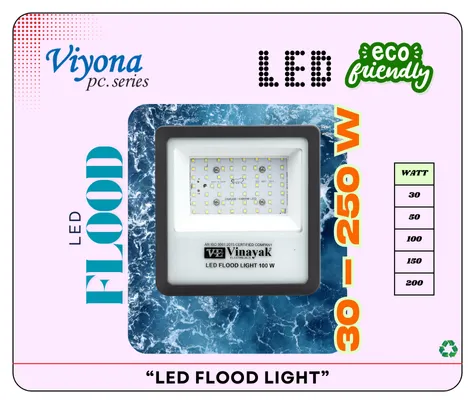
We make VIYONA LED lens flood lights at 50W, 100W and 200W at our works in Marol, Andheri East, Mumbai, at exactly the same MRP as our standard flood lights of the same wattage. Our catalogue lists them as lens models but does not print their beam angle. So the choice is about the beam, not the bill.
How a lens changes the beam
In general, behind flat glass each LED spreads its light in a wide cone, so a normal flood light throws a wide, soft patch. A lens over each LED bends that cone inward, so a lens flood light usually throws a narrower, brighter patch.
Normal and lens flood light from the same height
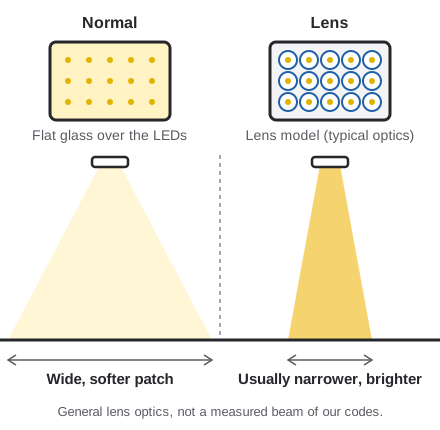
Drawn by us, not to scale. Same watts, same height: the lens only moves light; it does not make more. General lens optics, not the measured beam of our codes.
The lens adds no light. The same lumens land on a smaller area, so that area is brighter, and anything outside it gets less.
| Normal flood light | Lens flood light | |
|---|---|---|
| Front | One flat glass | Lens optics (lens model) |
| Beam | Usually wide | Usually narrower; ask the angle |
| Best for | Areas close to the light | Distance, facades, signs, tall poles |
| Our wattages | 30W, 50W, 100W, 200W | 50W, 100W, 200W |
| Our MRP | ₹1,100 to ₹5,200 | Same as standard at each wattage |
Lens vs normal: when each one wins
- Lens: building front lit from the ground or a nearby roof.
- Lens: signboard or hoarding from more than a few metres away.
- Lens: ground or turf lit from a tall pole or roof edge.
- Normal: compound, parking or yard with the light on the wall above it.
- Normal: gate, terrace or porch close to the light.
- Either: a warehouse yard; choose by the distance from light to far edge.
A simple test: if the area starts right under the light and is about as deep as the light is high, or a few times deeper, a normal flood light covers it evenly. If the area you need to light starts far from the light, or is a tall surface, a lens version puts the light where you want it and wastes less on the near ground.
Choosing the wrong one shows at once. A lens flood light on a low compound wall leaves a bright oval with dark sides; a normal flood light aimed at the top of a five-storey building washes the ground floor and leaves the top dim.
Usually a narrower beam; ask for the angle.
Facades, signs and tall poles.
Each lens code costs the same as its standard twin.
Get the beam angle for the exact code.
Our lens flood lights and MRP
These are the printed MRPs from our current catalogue. Each lens code has a standard twin at the same price.
Lens flood light MRP (same as standard)
Printed MRPs from our current catalogue. Bars to scale. Standard twins: 1091, 1089 and 1087.
There is no 30W lens in our range; at 30W the 1086 is a standard flood light only. All three lens codes pack 10 per box. Our flood light manufacturer page lists the whole range from 10W, and the outdoor price list sets it beside our street lights.
Beam angle: the number to ask for
A flood light’s beam is described by its beam angle: the width of the cone of light, in degrees. As common practice, normal flood lights with flat glass are around 100 to 120 degrees, and lens flood lights are made in narrower beams such as 30, 60 or 90 degrees.
Our printed catalogue does not state the beam angle of our lens or standard flood lights, so we do not quote one here. Ask us or your dealer for the beam angle of the exact code before you design a building-front or high-pole job around it.
A lens flood light of the wrong beam angle is a wasted climb. For a facade or a sign, get the beam angle in writing against the code you are buying.
How wide is the patch? Some geometry
The width of the lit patch at a given distance follows from the beam angle: width = 2 × distance × tan(half the angle). At 10 metres from the light:
Patch width at 10 m, by beam angle
Our arithmetic from the formula above, for illustration; it is not the measured beam of any of our codes.
The same light squeezed into a 60 degree patch lands on roughly one ninth the area of a 120 degree patch, so it can be several times brighter there, less what the lenses lose. That is why a narrow-beam lens fitting lights the top of a tall building that a wide fitting cannot reach well, provided the code you buy really has a narrow beam.
Typical lens jobs
- Building front: fittings on the ground or a lower roof, aimed up the face.
- Hoarding or sign: light from below or across the road, aimed at the board only.
- Box-cricket or turf: fittings on tall poles at the edges, aimed across.
- Tall warehouse: lens fittings high on the walls, aimed down the aisles.
- Long yard: lens fittings for the far end, normal for the near end.
In each case the light has a long way to travel, or a defined target to hit. For aiming, wiring and sealing, follow our flood light installation guide; a lens fitting needs more care in aiming, because a few degrees moves a narrow patch a long way.
Facade and pole jobs are work at height on a mains circuit. Isolate at the MCB, test dead, and use a proper platform with a second person. Protect every outdoor flood light circuit with an RCCB (30 mA earth-leakage breaker) as well as its MCB.
Which wattage in lens?
Pick the wattage for the distance and the size of the target, then the lens for the shape of the beam. As a rough guide:
- 50W lens (1092): a signboard or a narrow building front lit from close below; see our 50 watt flood light page.
- 100W lens (1093): a four- to six-storey front or the far half of a yard; see the 100 watt flood light page.
- 200W lens (1094): a high pole over open ground, or a tall facade from far back.
Two lens fittings of a lower wattage aimed at two halves of a target often give a more even result than one large one aimed at the middle, and they cost less: two 100W lens fittings are ₹3,900 against ₹5,200 for one 200W lens fitting at MRP.
Aiming a lens flood light
A narrow beam is unforgiving. Tilt a wide flood light a few degrees too far and its patch shifts a little; tilt a lens fitting the same amount and its bright patch can slide off the sign or past the top of the building. So aim lens fittings after dark, with one person at the fitting and one standing back where the result will be seen.
- Facade: aim the centre of the beam about two thirds of the way up the face, then check the top.
- Sign: aim at the middle of the board; stop the beam spilling over its top edge into the sky.
- Turf or ground: aim across to the far side, with the near side covered by the spread.
- Lock it: tighten the angle bolt fully; wind and vibration move a loose fitting.
Mark the final angle on the bracket with a paint pen. When the fitting is serviced or replaced, it can go back to exactly the same aim without a second night on the ladder.
Common mistakes with lens flood lights
- Lens on a low wall: a bright oval in the middle of a compound and dark corners.
- No beam angle asked: a fitting too narrow for the sign, or too wide for the facade.
- Aimed at eye level: a narrow beam is intense; keep it off roads and windows.
- One big fitting: one 200W lens aimed at the middle leaves the ends of a long front dim.
- Standard and lens mixed up: the boxes look alike; check the code on the carton before fitting.
Each of these is avoided by thinking about distance first: how far the light must travel, and how big the target is when it gets there. If that answer is “not far, and big”, a normal flood light is the better buy at the same price. For lighting around a house, where distances are short, see our guide to outdoor lights for home.
Mixing lens and normal on one site
Many sites need both. A factory might use normal flood lights on the building walls for the yard right below them, and lens fittings on the roof edge aimed at the far boundary and the gate. A society might use a normal flood light for the parking and a lens fitting to light the name board on the building front.
Because each lens code costs the same as its standard twin, the mix does not change the bill. What it does change is the order: write lens or standard against every line, since a 100W of one looks much like the other in the box until the code is read.
Keep a note of which fitting went where. When a fitting fails years later, its replacement must have the same beam, or the patch it lit will change.
Same MRP, different optics: a lens fitting where the light must travel, a normal one where it lands close. Mix freely, but label every order line.
Where we supply
Every fitting on this page is made at our works in Marol, Andheri East, Mumbai, and sold through dealers across Maharashtra and in many other states. See where we supply in Maharashtra and how we supply the rest of India. Orders placed through our office are delivered all over India, in full boxes only.
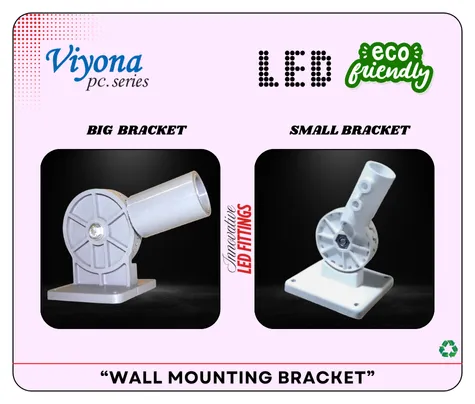
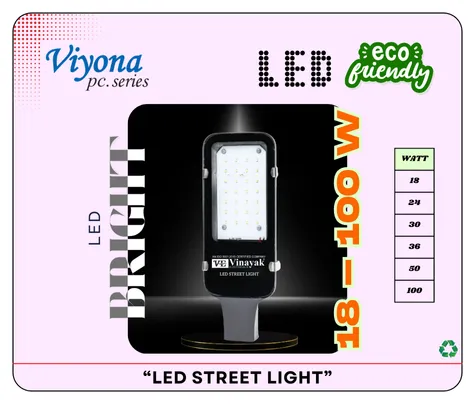
From our catalogue: LED flood lights, standard and lens, wall mounting brackets and LED street lights.
For the whole range, see VIYONA LED lights and our LED light price list.
FAQs
What is a lens flood light?
What is the difference between a lens and a normal flood light?
Is a lens flood light brighter?
What is the price of a lens flood light?
Which flood light is best for a building front?
What beam angle do your lens flood lights have?
Why buyers choose Vinayak Electricals
- Made in our own works at Marol, Andheri East, Mumbai, since 1995.
- ISO 9001:2015 certified; switches, MCBs, boxes and LED lights from one maker.
- Printed MRPs, code by code, in our current catalogue: no hidden list.
- Spare LED drivers and wall brackets listed alongside the fittings.
- Warranty of 5 to 10 years by product.
- Dealers and distributors across Maharashtra and in many states; delivery all over India for office orders.
Lighting a facade, sign or ground?
Send the target size, mounting point and distance; we will suggest lens or standard.
Contact us