What a Modular Switch Manufacturing Plant Costs to Set Up in India

One published report puts a 10,000-a-day modular switch manufacturing plant at about ₹387 lakh total capital investment, with ₹36 lakh of that in plant and machinery. A government-hosted report for a basic, non-modular switch unit comes to ₹23.18 lakh for 1,500 a day, which is not a guide to a modular range. What the reports leave out, the moulds for a full range, proper testing and working capital, matters as much as the machines.
Key takeaways
- Cost — about ₹387 lakh for a 10,000-a-day modular plant in one published report; a basic non-modular unit is ₹23 lakh, a different thing.
- Machines — injection moulding, dryer, press with press tools, assembly fixtures and test equipment.
- Moulds — each part shape needs its own mould or cavity, so mould count grows with the range.
- Licence — switches need BIS certification to IS 3854:2023; ₹1,000 to apply, one to four months on average.
- Or sell — becoming a dealer for a licensed range avoids mould, licence and lab costs.
Modular switch manufacturing plant cost: the short answer
A modular switch manufacturing plant making 10,000 pieces a day costs about ₹387 lakh in total capital investment, according to the one published report for modular electrical switches we could find; its size depends on daily output, the number of moulds the range needs and how much testing is done in-house. A government-hosted report for a basic, non-modular switch unit comes to ₹23.18 lakh for about 1,500 switches a day, but that is a different, simpler plant.
Alongside the machines, budget for the lines the reports leave out: the moulds for each body, rocker and plate shape in a range, the testing a BIS licence under IS 3854:2023 needs, and the working capital that sits in stock and unpaid bills before the first dealer pays you.
We make switches ourselves, at our Marol works in Andheri East, Mumbai, and have made electrical accessories since 1995. We don’t publish our own plant figures, so every cost below comes from a named, published report.
The two published plant-cost reports, side by side
The two reports measure different plants: one is a modular electrical switch plant at ₹387 lakh total capital investment and 10,000 pieces a day, the other a basic electric switch unit at ₹23.18 lakh and 1,500 pieces a day, so they are not the low and high end of the same thing.
Total investment in two published switch plant reports
Modular figure: Entrepreneur India (NIIR) project page, total capital investment, report date not stated. Basic unit: pre-feasibility report on UP’s MSME portal, project cost with land and building rented. The short bar is drawn at a 10% minimum; the true ratio is about 6%.
The modular report lists ₹36 lakh of plant and machinery inside its ₹387 lakh, and names polycarbonate and phenol formaldehyde resin as raw materials. All plant and machinery is ₹36 lakh of ₹387 lakh, about 9%; the rest of the breakdown is not published.
The basic unit report is fully visible: ₹15 lakh plant and machinery, ₹7.43 lakh working capital, 15 kW of power, 5 to 8 people on one shift and 2,500 to 3,000 sq ft on rent. It allows polycarbonate or Bakelite bodies and describes a simple switch, not a modular range.
Do not budget a modular plant from the ₹23.18 lakh figure. It leaves out the many moulds and the testing a modular range under IS 3854 needs.
| Item | Basic switch unit report (UP MSME) | Modular switches report (Entrepreneur India) |
|---|---|---|
| Product | Electric switch, polycarbonate or Bakelite | Modular electrical switches |
| Capacity | About 1,500 per day, one shift | 10,000 per day |
| Plant and machinery | ₹15 lakh | ₹36 lakh |
| Working capital | ₹7.43 lakh | Not shown |
| Total | ₹23.18 lakh project cost | ₹387 lakh total capital investment |
| Land and building | Rented, 2,500 to 3,000 sq ft | Not shown |
| Power and people | 15 kW, 5 to 8 people | Not shown |
| Standard cited | IS 3854:1988 (out of date) | Not shown |
The manufacturing process in brief
A modular switch is made on two tracks: plastic granules are moulded into the body, rocker and plate, and metal strip is pressed into terminals and contact parts; the two are assembled with a spring, then tested, inspected and packed.
Every step needs a machine or a station: a dryer and injection moulding machines for the plastic, a power press with press tools for the metal, assembly benches with fixtures, a test lab, and space for inspection and packing. The modular switch guide explains the parts of a switch if you are new to the format.
For how we make ours, see our factory production page, which follows our own line stage by stage. Our own line runs through five quality checks: raw material selection, in-house manufacturing, assembly with checkpoints, functional and safety testing and final inspection.
A new plant needs quality checks at each of those five points, not only at the end. A fault caught at raw material costs a bag of granules; caught after installation, it costs a wall.
More designs mean more moulds; price them design by design.
Switches are under mandatory certification to IS 3854:2023.
Licences need testing capability, not a multimeter and hand tools.
Stock and dealer credit tie up cash before sales come in.
What machines does a modular switch plant need?
A modular switch plant needs injection moulding machines, a granule dryer, steel moulds, a power press with press tools, assembly benches and fixtures, test equipment for routine and type tests, and a three-phase power supply to run them.
Plant and machinery in the published basic switch unit report
From the UP MSME pre-feasibility report for a basic electric switch unit: ₹15 lakh in all. The three short bars are drawn at the 5% minimum; they are 1 to 4% of the machine’s cost.
Injection moulding machines are rated by clamping tonnage, the force that holds the mould shut while plastic is injected. A common rule of thumb is 4 to 5 tons per square inch of the part’s projected area, and switch parts are small, so a plant usually runs several modest machines rather than one large one.
The report budgets ₹20,000 for testing equipment and tools: a multimeter, hand tools and basic instruments. Its own process section describes a switch testing machine for life and endurance tests, which that sum cannot buy. Neither matches the testing capability BIS expects of a licensee, and it is the line a real modular budget changes most.
Get machine quotations for your own part sizes. Tonnage, shot size and the number of cavities in each mould decide the machine, not the product name.
Why mould count grows with a modular range
Mould count grows with a modular range because a range is many parts, not one: each new body, rocker, socket or plate shape generally needs its own mould or mould insert, so the mould count grows with the catalogue while the machine count need not.
Look at any modular price list and count the parts. Our own catalogue shows the KEMPS range alone in several series, PEONY, DAISY, ORCHID, ASTER and VINCA among them, with switches in white and grey at 10AX, 20AX and 32AX DP. A 1-way PEONY K101 is ₹65 MRP; the K116 32AX DP switch with indicator is ₹360. Plates run from 1M upwards, and ORCHID alone comes in white, K-grey, metallic and texture, from ₹102 for the K301.
Moulds are typically made of hardened or pre-hardened steel, which costs more to build and lasts longer than aluminium. A worn or damaged mould often shows as flash, a thin fin of plastic past the edge where the mould halves meet. Sink marks, shallow dents over thick sections, usually point to the process settings or the part design rather than the mould. Each mould also needs upkeep, which is why plants keep a tool room.
The basic unit report allows ₹50,000 for moulds, enough for one simple design. A modular range needs many more moulds than that; price them design by design.
Raw materials, in general terms
A modular switch plant buys plastic granules, usually polycarbonate, for bodies, rockers and plates, and copper-alloy and steel parts for terminals, contacts, springs and screws, with contact points that are commonly a silver alloy; together these are the largest running cost.
Polycarbonate is tough against knocks and made in flame-retardant grades. Some switches use urea or phenolic (Bakelite) mouldings instead; our polycarbonate vs urea guide compares them. Polycarbonate attracts moisture from the air, and wet granules can hydrolyse in the barrel, which weakens the part. Resins that hydrolyse, polycarbonate among them, are typically dried to below 0.02% moisture before moulding, to the resin maker’s settings.
The basic unit report lists metal parts as brass, copper and steel. One switch maker’s datasheet lists silver-alloy contact points on silver-plated copper-alloy parts, and contact strips that have to flex are often a springy copper alloy such as phosphor bronze.
Year-one costs in the basic switch unit report
From the UP MSME report, year one at 60% capacity, against sales of ₹69.26 lakh. Bars to scale against ₹40.50 lakh, rounded to 5% steps.
Raw material is about 58% of that report’s first-year sales. Small buyers pay higher prices for raw material, a weakness the report names itself.
The BIS (ISI) licence for switches: fees and timelines
A BIS licence for switches takes an online application with a ₹1,000 fee, an inspection fee of ₹7,000 per man-day, proof of manufacturing infrastructure, process control and testing capability, and then an annual licence fee of ₹1,000 plus a marking fee for the product.
Average time for BIS to grant a product licence
From the BIS product certification FAQ: averages only; queries, inspection dates or unpaid fees add delay. Bars to scale.
Under Option 2 you apply with a recent test report from a BIS or BIS-recognised laboratory. The first licence runs for up to 2 years and only for the varieties named in it; renewals run up to 5 years. After that come surprise surveillance inspections, where BIS witnesses tests in the factory and draws ISI-marked samples for independent testing.
BIS lists switches under IS 3854 as QCO notified and implemented since 2003, so an unlicensed switch cannot be sold legally. Ours are made under CM/L-7567794. The fake ISI mark guide shows how buyers check a licence number.
Fees and times here are BIS’s published figures as checked in October 2026. The marking fee is set per product in the BIS scheme; check it before you budget.
IS 3854:2023: what changed, and why testing costs money
IS 3854:2023, the third revision of the Indian Standard for switches, replaced the 1997 edition, with 21 August 2024 as the last date for running both, and it added and changed tests, so a new plant must design and test to the 2023 text from day one.
IS 3854 for switches: how long each version has run
From the BIS circular of 17 January 2024. Bars to scale in years.
The BIS circular lists the changes: motor and lamp load switches added to the scope, extra marking, requirements for 13 A and 45 A switches and pilot lights, a new self-ballasted lamp load test, and changed electric strength, pendulum hammer and enclosure tests. The BIS product manual was revised at the same time, including additions of test equipment.
The basic unit report still cites IS 3854:1988, two editions out of date. That alone tells you to treat its testing line as a placeholder.
Budget for test equipment and outside lab reports as a real line. Without them there is no licence, and without a licence there is no legal sale.
A typical plant layout, drawn
A typical modular switch plant is laid out as a flow: raw material store, then a moulding bay and a press shop side by side, then assembly, a test lab, final inspection, packing and dispatch, with a tool room beside the press shop to look after moulds and press tools.
Typical modular switch manufacturing plant layout
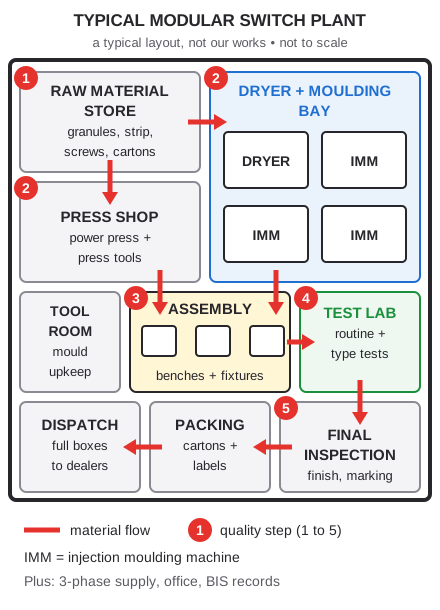
A typical layout, drawn by us and simplified; not to scale and not a plan of our works. Machines shown are common industry practice. Red numbers mark where five quality steps sit. Tap to open full size.
The basic unit report also lists the paperwork around the building: GST, a fire NOC, a pollution NOC if applicable, Udyam registration, BIS certification and, optionally, a trademark. Plan the three-phase supply early; the report sizes 15 kW for its small unit.
Keep the flow one-way. A layout where finished boxes cross the moulding bay invites mixed lots and wrong codes in cartons.
Working capital: the money that sits in stock
Working capital is the cash tied up in raw material, finished stock and unpaid dealer bills before sales pay it back; the basic switch unit report puts it at ₹7.43 lakh, about a third of its ₹23.18 lakh project cost.
In that report’s first-year balance sheet, ₹5.49 lakh sits as stock in hand and ₹3.69 lakh as money owed by buyers. First-year sales at 60% capacity are ₹69.26 lakh, and net profit is ₹3.89 lakh before tax, or ₹3.82 lakh after tax, a 5.51% net margin. The term loan runs 60 months with a six-month moratorium.
A modular range needs more, not less. Each design comes in colours and ratings, plates come in sizes and finishes, and dealers expect a complete range in stock. Our own products are sold only in full boxes, such as 20 per box for the K101 and 30 per box for the VIZA MIRCHI V1215 at MRP ₹62, so a dealer’s opening stock is counted in boxes, not pieces.
Thin working capital is the weakness the basic report itself names. Cash runs out in stock and credit long before the machines wear out.
Make or sell: should you build a plant?
If you want to sell switches rather than make them, the quickest route is to become a dealer for a licensed range: the moulds, BIS licence, test lab and stock are already paid for. A new brand of your own is a different matter: it needs its own BIS cover for that brand name, whether you make or source the product.
Building means moulds for every part, a licence for every variety, testing to IS 3854:2023 and stock for a full range. Selling an established range means a licensed range that already carries its maker’s ISI mark and CM/L number, published MRPs, and test reports on request before you order.
Our dealers stock KEMPS, VIZA and VIYONA. Dealer support varies by region and market: banners, display boards for the modular ranges, marketing material and training among them. Read how to become a dealer or distributor, what an electrical dealership costs and how dealer margins work before you decide.
A BIS licence belongs to the manufacturer that holds it, for the brands it covers. A dealer sells under the maker’s licence; a new brand name needs its own.
How we make ours, in Mumbai
We make our KEMPS and VIZA modular switches and plates at our only works, at KBM Compound, Marol Maroshi Road, Andheri East, Mumbai, where everything we make is manufactured in-house, under an ISO 9001:2015 quality system.
We have made electrical accessories since 1995, across 2000+ products, and supply 500+ dealers and distributors across India. Our switches carry ISI licence CM/L-7567794 under IS 3854, and our modular plates are UV-protected, do not turn yellow, and carry a 5-year warranty.
See the line on our factory production page, the checks on our quality control page, and the factory videos. Every code and MRP is in the e-catalogue, and the ranges are on our KEMPS modular and VIZA modular pages.
We sell in full boxes through dealers, never single pieces and never online. Call, WhatsApp or contact us for your nearest dealer.
FAQs
What machines does a modular switch plant need?
How much does a modular switch manufacturing plant cost?
Is a BIS licence compulsory for switches?
How long does a BIS licence for switches take?
How much working capital does a switch unit need?
Should a new brand make switches or buy them from a manufacturer?
Why buyers choose Vinayak Electricals
- KEMPS and VIZA modular switches made in-house at our Mumbai works; making electrical accessories since 1995.
- Switches made under ISI licence CM/L-7567794 to IS 3854.
- ISO 9001:2015 certified, with a five-step quality process from raw material selection to final inspection.
- Modular plates UV-protected, non-yellowing, with a 5-year warranty.
- MRPs published openly in our catalogue; test reports on request before an order.
- All-India delivery through 500+ dealers and distributors, in full boxes.
Sell a licensed modular range instead of building one
Become a Vinayak Electricals dealer for KEMPS, VIZA and VIYONA, or ask us for test reports before your first order.
Vinayak Electricals is a modular switch manufacturer in Mumbai, supplying dealers, electricians and contractors across India by the box. Ask us for prices and stock.
Become a dealer WhatsApp for prices Download catalogue