How Big Is India's Electrical Switches Market, and Where Is It Going?
How big is the India electrical switches market, and where is it heading? Published reports put it at roughly USD 0.63 to 1.06 billion in 2025, growing about 8 to 9% a year, with modular switches taking around two thirds of the value. Below we set the named reports side by side, explain why they disagree, and show who buys switches and sockets in India, how they reach a wall, which BIS rules apply, and where makers like us fit.
Key takeaways
- Size — USD 629 million to USD 1,057 million in 2025, across four named reports (IMARC, Ken, TechSci, Credence).
- Growth — 7.76% to 8.90% a year to 2031–2034; Ken counts about 222 million switches sold in 2025.
- Modular — about 67–68% of value today; Ken forecasts 79% by 2031.
- Rules — switches need BIS licence to IS 3854 : 2023, sockets to IS 1293 : 2019, with the ISI mark.
- Buy — check the licence, compare like with like, and buy a range your dealer stocks in depth.
India electrical switches market: the short answer
The India electrical switches market was worth somewhere between about USD 630 million and USD 1.06 billion in 2025, depending on whose report you read, and the four published estimates we checked expect it to grow by about 8 to 9% a year to the early 2030s. Modular switches already make up about two thirds of the money spent.
Those are switch figures. Add sockets, plates, boxes and the rest of the wiring accessories on a switch board and the number gets bigger, but no two reports draw that boundary in the same place, so be careful when someone quotes you one headline number.
We are a part of this market ourselves. We have made electrical accessories since 1995, under the KEMPS, VIZA and VIYONA names; our only site today is our works in Marol, Andheri East, Mumbai. So this page is written from a factory floor, not a research desk: what the reports say, where they disagree, who actually buys switches in India, how a switch gets from a factory to your wall, and which rules decide what may be sold.
How big is the electrical switches market in India?
Four named research firms put the India electrical switches market at USD 629 million to USD 1,057 million for 2025, with forecasts of USD 1.26 billion to USD 1.86 billion by 2031 to 2034. The spread is wide, but the growth rates agree closely: 7.76% to 8.90% a year.
Published estimates of India’s electrical switches market, 2025 (USD million)
From each publisher’s public summary (Credence press release July 2026; TechSci May 2025; IMARC updated September 2026; Ken Research 2026–2031 edition). Bars to scale against 1,056.9, rounded to 5%. Sources listed below the article.
Note the years differ: TechSci’s figure comes from a May 2025 edition, the others from 2026 editions, and each uses its own exchange-rate and price assumptions.
The growth rates are the more useful number. IMARC: 7.76% a year to 2034, Credence: 8.36% to 2032, TechSci: 8.75% to 2031 and Ken Research: 8.90% to 2031. Ken also counts units: about 222 million switches in 2025, rising to about 316 million by 2031.
Every one of these figures is a paid report’s estimate, not a government count, and we found no official sales figure for switches. Quote the publisher and year with any number you use.
| Publisher (edition) | 2025 value | Forecast | Growth a year |
|---|---|---|---|
| IMARC Group (Sept 2026) | USD 629.4 million | USD 1,258.1 million by 2034 | 7.76% (2026–2034) |
| TechSci Research (May 2025) | USD 0.83 billion | USD 1.38 billion by 2031 | 8.75% |
| Ken Research (2026–2031) | USD 832 million | USD 1,388 million by 2031 | 8.90% (2025–2031) |
| Credence Research (July 2026) | USD 1,056.93 million | USD 1,864.83 million by 2032 | 8.36% (2026–2032) |
Why the market reports disagree so much
The reports disagree mainly because they measure different things: some count switches only, some add sockets, some include smart and touch switches, and each sets its own base year and price assumptions, so their totals cannot be compared directly.
Read the scope line before the headline. Credence splits its market into modular, conventional, smart, touch and push button types, and four price bands from economy to luxury/designer. IMARC and TechSci split by modular vs non-modular and by switch type: one-way, two-way, bell push, dimmer or regulator, motor starter.
One IMARC report on “switches and sockets” gives USD 224.6 billion for 2025. That is roughly 350 times the same publisher’s switch-only figure, and it does not fit with the switch-only estimates above, so we leave it out of our range.
If a figure looks far out of line with the others, check its scope and units before repeating it. A misplaced “billion” is the most common way a market number goes wrong.
The history of the switch explains how the product itself got here; this page sticks to the money and the trade.
Switches only, or switches and sockets? Totals differ by that alone.
About two thirds of value today, more by 2031 in Ken’s forecast.
IS 3854 for switches and IS 1293 for sockets are mandatory.
Retail stores carry over half of switch sales by value.
Modular vs conventional switches: where the money goes
Modular switches take about two thirds of switch sales by value in India today: IMARC puts the modular share at 68.4% for 2025 and Ken Research at 67%, and Ken expects it to reach 79% by 2031. Conventional, non-modular switches likely keep a larger share of units than of value, because they cost far less each; the summaries we read do not split units by type.
Share of India’s switch market by value
Revenue shares from IMARC (September 2026 update) and Ken Research (2026–2031 edition). Bars to scale, rounded to 5%.
A modular switch clips into a frame behind a separate cover plate, so you choose the switch, the plate size, from 1M upwards and the finish separately. A conventional switch sits in a one-piece board or plate. Our modular vs normal switch guide explains the practical differences.
Our own range shows both sides. KEMPS and VIZA are modular. VIYONA is conventional: switches, sockets, holders, regulators and MCBs for one-piece boards. Value share is not unit share: a ₹22 conventional switch and a ₹65 modular one count once each in a unit count, but very differently in rupees.
If your walls are open for a renovation, that is the cheapest moment to move to modular, because modular switches need their own boxes behind the plate.
Premium vs mass market: what a switch costs
Across our own ranges, a basic one-way switch runs from MRP ₹22 (VIYONA 101) to MRP ₹70 (KEMPS K501), and the price mainly reflects the system and the finish rather than the electrical rating; a 6 A conventional switch and a 10 A modular switch do the same job on a light circuit.
Catalogue MRP of a one-way switch across our own ranges
MRPs from our printed catalogue. Bars to scale against ₹70, rounded to 5%. A modular switch also needs a plate and box, priced separately.
That ladder is the market in miniature. The mass segment buys on price per point: a full flat of conventional switches costs little. The mid segment buys modular white. The premium segment buys a coloured switch plus a designer plate.
Ratings climb the ladder too. Our KEMPS Peony K106 20AX one-way is MRP ₹107 and the K116 32AX DP switch with indicator is MRP ₹360, for geysers and ACs. Our switch and socket ratings guide shows which rating each appliance needs.
Compare MRPs only between like items: same module size, same rating, same finish. Comparing a 1M white switch with a 2M grey one tells you nothing.
Who buys switches in India?
Switches in India are bought mainly for homes, by homeowners, electricians and builders, with offices, shops, hotels, hospitals and factories making up the non-residential side; the West of India, which includes Maharashtra and Gujarat, is the largest region in both reports that publish a regional split.
IMARC puts West India at 30.8% of the market in 2025; Credence puts it at 35.48%. Both put North and South next. Credence lists end users as residential, commercial, industrial, institutional and infrastructure; none of the summaries we read publishes a residential share.
How switches are sold in India, 2025 (share of value)
IMARC, September 2026 update. Online is the fastest-growing channel in that report, at about 12.3% a year. Bars rounded to 5%.
The person paying is often not the person choosing. IMARC notes that licensed electricians and contractors influence purchases. In a 2BHK being redone in Andheri, the family may pick the plate colour while the electrician suggests the brand at the shop counter. In a new tower, a builder’s purchase team picks one range for every flat.
Retail stores still carry well over half of switch sales in IMARC’s estimate. The shop counter matters more than any website.
How a switch reaches your wall: the value chain
Most switches in India travel from the manufacturer to a regional distributor, then to a dealer’s shop, then to the electrician who fits them in a home; larger projects take a shorter route, with a builder or contractor ordering a whole bill of quantities through a dealer or distributor.
From factory to switch board: the Indian switch trade
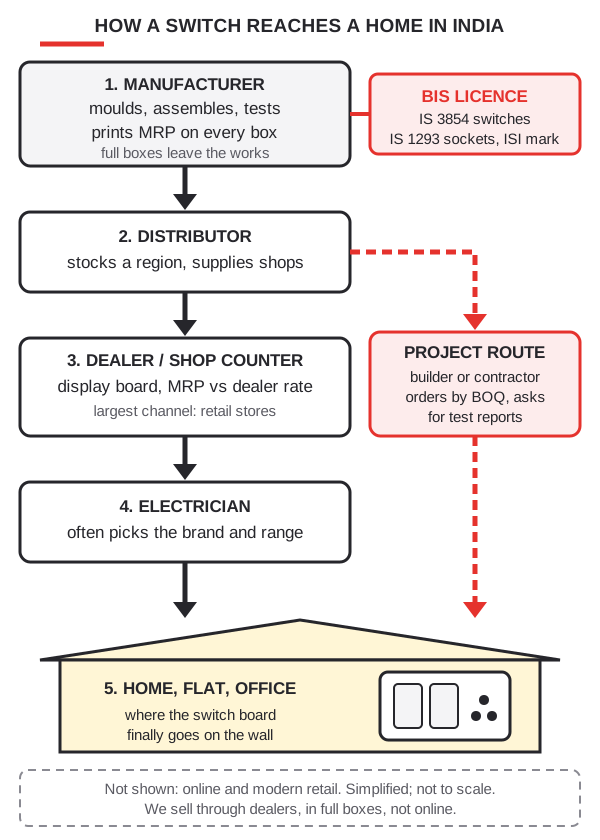
Drawn by us, simplified and not to scale. Online and modern retail are left out. Tap the diagram to open it full size.
Each step adds a margin and a service. The distributor holds stock for a region. The dealer gives credit to electricians and shows the range on a display board. The electrician carries the warranty question back to the shop if something fails. Our electrical dealer margins page explains how the MRP is shared out.
At our end, we sell in full boxes only, never single pieces, and we do not sell online. A home buys through a dealer; a builder can call us for test reports before an order. If you want to sit in the middle of this chain, see how to become a distributor.
A shorter chain is not automatically cheaper. A good dealer carries stock, credit and replacements, which is what keeps a site running.
BIS rules: what may legally be sold
Switches and socket-outlets for homes in India are under mandatory BIS certification: switches must meet IS 3854 and plugs and sockets IS 1293, and each must carry the ISI mark with a valid licence number, so an unmarked switch or socket should not be on a shop shelf at all.
Both standards were updated recently. BIS revised the switch standard to IS 3854 : 2023; its January 2024 circular gave existing licensees until 21 August 2024 to change over, adding motor load and lamp load switches and new tests. The socket standard is IS 1293 : 2019; Amendment 2, which added a 6 A two-pin socket type, had to be in force by 26 September 2024. BIS counted 489 licences for plugs and sockets in May 2024.
Our own marks, stated exactly: switches under ISI IS 3854 CM/L-7567794, MCBs under IS/IEC 60898-1 CM/L-2544151. We also hold an IS 1293 licence for sockets.
A fake ISI mark is the cheapest thing a counterfeiter can print. Check the CM/L number on the BIS website before a bulk order; our guide on how to spot a fake ISI mark shows how.
Trends: smart switches, USB charging and online buying
The trends the reports name are the steady shift to modular, a fast-growing but still smaller smart switch segment, and more buying online; alongside them, India’s move to USB Type-C as the common charging port is changing what people want on a switch board.
Smart switches. Ken Research puts smart and connected switches at 16% of revenue in 2025, rising to 34% by 2031. IMARC describes the smart segment growing at about 15–18% a year from a smaller base. We do not make smart or touch switches; our smart switches guide explains what they need, such as a neutral wire.
USB on the board. In January 2023 BIS notified standards for USB Type-C charging ports, with the aim of one common charger for phones, laptops and other devices. Our catalogue lists USB charger modules such as KEMPS K207 USB charger socket, MRP ₹750 and VIZA V305 2 A USB charger, MRP ₹650. Neither is printed as Type-C. See USB and Type-C sockets for a switch board before you choose one.
Online. IMARC has online at 11.4% of switch sales, the fastest-growing channel. Most switches are still fitted by an electrician, which is why the counter still counts.
A smart or USB module still sits on a 230 V circuit. Fitting it is fixed-wiring work for a licensed electrician, with the MCB switched off first.
The brands in India’s switch market
The national brands the published reports name most often include Havells, Legrand, Schneider Electric, Anchor by Panasonic, GM Modular, Goldmedal, Polycab, RR Kabel, Wipro, Great White, ABB and Finolex, alongside many regional manufacturers that the reports do not list.
That list is in no order, and we make no claims about any of them. It is simply the names that recur across the Credence, Ken Research and IMARC summaries.
Below the national names sit hundreds of Indian manufacturers who sell regionally or through their own dealer networks. BIS counted 489 plug and socket licences in May 2024, a hint at how many makers there are, though one company can hold several licences.
If you are choosing between brands, our switch brands in India page compares who makes what, and how to choose a modular switch brand gives a checklist: ISI licence, spares available locally, plate range that will still exist in five years.
A brand that your local dealer stocks in depth is worth more to you than one that only looks good in a showroom.
Where Indian manufacturers like us fit
Indian manufacturers such as Vinayak Electricals fit into the market by making switches, sockets and plates in-house, selling through a dealer network at printed MRPs, and covering both modular and conventional buyers; we have made electrical accessories since 1995, and today everything we manufacture comes from one works in Marol, Andheri East, Mumbai.
The facts, plainly. One site: our works and head office at Marol, Andheri East. 2000+ products; everything we manufacture is made in-house at our Mumbai works (our VIYONA wire is a traded line, made for us by a partner). 500+ dealers and distributors and all-India delivery. ISO 9001:2015 certified. Three names: KEMPS and VIZA modular, VIYONA conventional, plus LED lights.
What that means for a buyer: plates with a 5-year warranty that are UV-protected and do not turn yellow, warranty of 5 to 10 years depending on the product, and returns within 15 days in the same condition. Our five-step quality process runs from raw material to final inspection.
What we are not: we do not make smart switches, RCCBs or wire (our VIYONA wire is made for us by a partner). We are one of many Indian makers in the market described above, not a national giant.
Every MRP on this page comes from our printed e-catalogue. Ask a dealer for the current rate.
What this market means for your next purchase
For a homeowner, the growth of the switch market mostly means more choice in modular finishes and USB modules, so the useful habits are to check the ISI licence, compare MRPs only between like items, and buy a range your local dealer stocks in depth.
Homeowner: decide modular or conventional first, then the finish. A 2BHK on a budget can use conventional VIYONA switches; a renovation where the walls are open is the time to go modular.
Electrician or contractor: standardise on one range per site so spares match, and keep the test reports with the handover file.
Dealer: the reports point to modular and smart switches growing fastest, and to online as the fastest-growing channel. Ask any maker for display boards, training and scheme support; ours vary by region and include the VINAYAK KONNECT loyalty programme.
Browse our full range on products, or contact us for a dealer near you.
Whatever you buy, have a licensed electrician fit it, with the circuit’s MCB switched off first.
FAQs
What is the size of the electrical switches market in India?
How fast is the electrical switches market growing in India?
What share of switches sold in India are modular?
Is ISI mark compulsory for switches and sockets in India?
Which are the main switch brands in India?
Does Vinayak Electricals sell switches online?
Why buyers choose Vinayak Electricals
- Making electrical accessories since 1995; today everything we manufacture comes from our one works in Marol, Andheri East, Mumbai. ISO 9001:2015 certified.
- Switches under ISI licence IS 3854 CM/L-7567794; MCBs under IS/IEC 60898-1 CM/L-2544151; an IS 1293 licence for sockets.
- Modular (KEMPS, VIZA) and conventional (VIYONA) ranges, from a ₹22 MRP VIYONA 101 switch upwards.
- Plates UV-protected, do not turn yellow, with a 5-year warranty; products 5 to 10 years by line.
- MRPs printed openly in our catalogue, and test reports on request before an order.
- 500+ dealers and distributors and all-India delivery, in full boxes.
Switches and sockets made in Mumbai
See our KEMPS, VIZA and VIYONA ranges with printed MRPs, then buy through a dealer or call us.
Vinayak Electricals is a socket manufacturer in Mumbai, supplying dealers, electricians and contractors across India by the box. Ask us for prices and stock.
View our products WhatsApp for prices Download catalogue