What Are Switches Made Of? PC, Urea and Porcelain Compared
Polycarbonate vs urea switch is a choice between two plastics: polycarbonate (PC) is a tough thermoplastic that resists knocks, and urea is a hard thermoset that does not soften with heat but can crack. Below we explain what switches are made of, where each plastic and porcelain base fit, what fire retardant really means, what the brass and contacts inside do, and the MRPs of the urea, PC and porcelain versions we make in Mumbai.
Key takeaways
- Polycarbonate (PC) — tough thermoplastic; resists knocks; suits modular switches. Handled often
- Urea — hard thermoset; does not soften with heat; can crack if struck. Heavy combined units
- Porcelain base — ceramic under the contacts of heavy sockets and switches.
- Fire retardant — a matter of grade and tests; a genuine ISI mark is the better guide.
- Our MRPs — VIYONA 5 in 1: urea 163 ₹230, PC 161 ₹250; VIZA V263 porcelain ₹160.
Polycarbonate vs urea switch: the short answer
Polycarbonate and urea are the two plastics most often used for the bodies of switches and sockets in India. Polycarbonate, usually shortened to PC, is a tough thermoplastic that resists knocks and can be moulded in thin, clean shapes. Urea, short for urea formaldehyde, is a hard thermoset that does not soften with heat but can crack if it is struck or over-tightened.
Neither is simply better. PC suits modular switches, plates and fittings that get handled, knocked and clipped in and out. Urea suits heavy combined units and sockets where rigidity and heat resistance matter more than impact strength. A third material, porcelain, sits under the contacts of some heavy sockets and switches.
We use all three. Our VIYONA range is our PC series, and our catalogue lists VIYONA switch socket combined units in both urea and PC, alongside VIZA switches and sockets with a porcelain base. This guide compares the materials, explains what “fire retardant” means, looks inside at the brass and contacts, and gives the MRP of each version we make.
What are switches made of?
A switch is made of an insulating plastic body and rocker, metal current-carrying parts inside, such as contacts, springs and screw terminals, and, on a modular board, a separate plate and frame; the plastic keeps you away from the live parts and the metal carries the current from one wire to the other.
The parts, from front to back:
Rocker: plastic Body: PC or urea Contacts: metal Spring: metal Terminals: brass or similar Plate: plastic or metal finish
The body material decides how the switch handles knocks, heat and tracking (current creeping across a dirty or damp surface). The metal parts decide how well it carries current and how long the contacts last. A well-made switch needs both to be right.
How a switch body is moulded and finished is shown in our modular switch manufacturing process page.
The plate is the part you see, but it carries no current. Judge a switch by the module behind it.
| Polycarbonate (PC) | Urea | Porcelain base | |
|---|---|---|---|
| Type | Thermoplastic | Thermoset | Ceramic |
| Impact strength | High | Lower, can crack | Low, brittle |
| With heat | Softens at very high heat | Does not soften, chars | Does not soften or burn |
| Typical use | Modular switches, plates, holders | Combined units, sockets | Heavy sockets and switches |
| Our example | VIYONA 161 5 in 1 | VIYONA 163 5 in 1 | VIZA V263 16A socket |
| MRP | ₹250 | ₹230 | ₹160 |
What is a polycarbonate switch?
A polycarbonate switch is a switch whose body and rocker are moulded from polycarbonate, a clear-to-white engineering thermoplastic known for high impact strength, good electrical insulation and dimensional stability, which is why it is widely used for modular switches, sockets, plates and lamp holders that are handled and clipped often.
What PC does well:
Resists knocks Thin, precise moulding Good insulation Flame-retardant grades exist
What to watch: as a thermoplastic, PC softens at very high heat, so a badly loose terminal that runs hot can deform the body. That is a wiring fault, not a material one, but PC shows it sooner than urea.
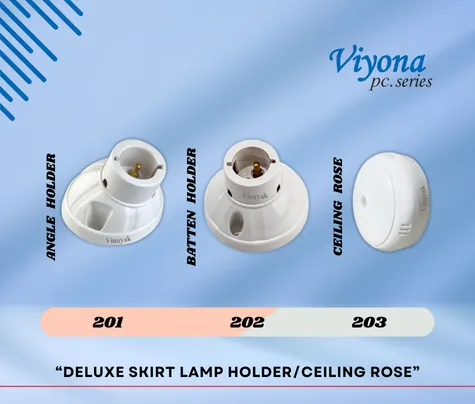
Our VIYONA range is our PC series. Our printed catalogue describes it as crafted from the highest-quality polycarbonate, and lists our VIYONA polycarbonate angle and batten holders at ₹26 MRP each, with the 2 part ceiling rose at ₹28.
A PC switch that has gone brown or soft around one terminal is reporting a loose, overheating connection. Switch off and have it checked.
Resists knocks; suits modular switches that are handled and clipped.
A thermoset that does not soften; hard but can crack if struck.
Holds contacts on heavy points; does not burn or track.
Contacts, springs and terminals carry the current, not the plastic.
What is a urea switch?
A urea switch is one moulded from urea formaldehyde, a thermosetting plastic that sets permanently when it is pressed hot, so it does not melt or soften when it heats up, has a hard, glossy, scratch-resistant surface and resists arcing, though it is more brittle than polycarbonate and can crack under a sharp blow.
What urea does well:
Does not soften with heat Hard, glossy surface Resists arcing Rigid under heavy plugs
What to watch:
Can crack if struck Over-tight screws crack lugs
Because it stays rigid, urea is a common choice for combined switch socket units, where a heavy plug is pushed in and pulled out daily. Our catalogue lists the VIYONA 159 3 in 1 universal switch socket combined in urea at ₹150 MRP, and the 160 with junction box at ₹175.
Tighten the fixing screws of a urea unit until snug, not until they bite. Cracked lugs are the most common urea failure we see.
Polycarbonate vs urea: which is better?
Polycarbonate is better where a switch or socket will be handled, knocked or clipped in and out, as on a modular board, and urea is better where rigidity and heat resistance matter most, as in a heavy combined switch socket unit, so the right material depends on the fitting and where it sits, not on a single ranking.
Side by side, as general material behaviour:
Impact: PC wins Heat, no softening: urea wins Surface hardness: urea Thin modular shapes: PC Brittleness: urea
For most homes, the difference you will notice is not the material but the build quality: wall thickness, how firmly the terminals are held, and whether the contacts grip. A thick, well-moulded unit in either plastic outlasts a thin one in the other.
Our guide to choosing a modular switch brand lists the checks that matter at the counter, including the licence number and the contacts.
Ask for the material on the bill or the box. Our catalogue names it on the products where we offer a choice: urea, PC or porcelain base.
Which switch material is fire retardant?
Both polycarbonate and urea can be made in fire-retardant grades, and what makes a switch fire retardant is the grade of plastic and the tests it passes, not the name of the plastic alone; a good switch body resists catching fire and stops burning once the heat source is removed.
In general terms:
Urea: chars, does not drip PC: self-extinguishing grades Porcelain: does not burn
Indian standards for switches and sockets include heat-resistance tests on the insulating parts, and products carrying a genuine ISI mark have been made under a BIS licence for that standard. That mark is a better guide than a label that just says “FR”. Our IS code list for electrical products gives the standard for each product, and our fake ISI mark guide shows how to check one.
We do not publish flammability ratings for our switch bodies in our catalogue, so we do not quote one here.
Fire at a switch almost always starts at a loose or overloaded connection, not in the plastic. Tight terminals and the right rating matter more than the material.
Where does a porcelain base fit in?
A porcelain base is a ceramic block that holds the contacts and terminals of some heavier switches and sockets, used because porcelain does not soften, char or track under heat, which makes it a traditional choice for 16A sockets and heavy points, while the visible front stays plastic for looks and safety.
VIZA porcelain base vs PC: MRP of matching items
MRPs from our current catalogue (white line), bars to scale with ₹160 as the full bar. Piano switches are standard VIZA modular switches.
Porcelain adds ₹10 to ₹39 on these pairs. It is worth it on a 16A socket that runs a heater or geyser for hours. Socket choices are covered in our 6A vs 16A socket guide.
Brass contacts: what is inside the switch?
Inside a switch, the parts that carry current are metal: the screw terminals and fixed contacts are commonly brass or a copper alloy, the moving contact is often backed by a phosphor bronze spring, and some switches add a silver alloy contact tip, because these metals conduct well and resist wear each time the switch is pressed.
What each metal does, as general practice:
Brass terminals: hold the wire Spring: keeps pressure Silver tip: resists arcing
The plastic body and the metal parts fail differently. A weak spring gives a soft, uncertain click. Worn contacts crackle and heat. A loose terminal browns the plastic around it. All three are reasons to replace the switch.
Our catalogue does not print the contact or terminal metal for each switch, so we do not claim one here; ask us for a specific code. Where brass is named, it is on the VIYONA square box: the 197 with brass is ₹16 MRP and the 196 without brass ₹12.
Never file, bend or clean switch contacts to revive a switch. Replace the module; it costs less than the risk.
Urea vs polycarbonate price: what does each cost?
In our VIYONA range, a urea 5 in 1 switch socket combined unit costs a little less than the polycarbonate one: the 163 in urea is ₹230 MRP against ₹250 for the 161 in PC, and with a junction box the urea 164 is ₹275 against ₹300 for the PC 162.
VIYONA switch socket combined units by material
MRPs from our current printed catalogue, bars to scale with ₹300 as the full bar. Materials as named in the catalogue.
The ₹20 to ₹25 gap is small. Choose by where the unit goes: a kitchen or workshop point that is knocked suits PC. Our VIYONA 5 in 1 range lists both, and the universal socket guide explains 3 in 1 and 5 in 1.
How can you tell what a switch is made of?
The easiest way to tell what a switch is made of is to read the product name on the bill, box or catalogue, where makers who offer a choice name it as urea, PC or porcelain base, because the finished plastics look similar on the wall and a visual guess is unreliable.
Clues, as general practice:
Urea: hard, glossy, heavy PC: slightly flexible, tough Porcelain: white ceramic block
Do not test a material by scratching, heating or striking a fitted switch. Read the code instead. In our catalogue, codes carry the material where it matters: 159, 160, 163, 164 urea, 161, 162 PC, and VIZA V117 to V120A porcelain base.
If a fitting is already in the wall, switch off the MCB and test dead before taking a plate off to read the module. Our guide to replacing a switch explains how.
A switch with no maker, no rating and no certification mark tells you nothing about its material. Buy coded, marked products.
Which material should you choose for each place?
As a general guide, choose polycarbonate modular switches for living areas and bedrooms where boards are handled and changed, urea or porcelain-base units for heavy combined points that carry a plug most of the day, and keep every switch, whatever its material, out of splash zones and away from steam.
By location:
Bedroom, living: PC modular Kitchen: urea or porcelain Heater socket: porcelain Workshop, garage: PC Bathroom: outside the wet zone
Material is one factor among several. Rating, the socket shutter and the quality of the wiring behind matter as much. For heavy points, see our kitchen electrical points guide.
Any switch or socket that gets wet should be replaced, whatever it is made of, and the circuit checked by a licensed electrician.
FAQs
Is a polycarbonate switch better than urea?
What material are modular switches made of?
Is urea fire retardant?
Do switches have brass contacts?
What is the price difference between urea and PC switch sockets?
What does porcelain base mean on a socket?
Why buyers choose Vinayak Electricals
- Urea, PC and porcelain-base versions named in our catalogue, so you know what you are buying.
- VIYONA, our PC series, from switches to polycarbonate holders at ₹26 MRP.
- VIYONA 5 in 1 combined units in urea from ₹230 and PC from ₹250.
- VIZA porcelain-base 16A socket at ₹160 and porcelain-base switches from ₹95.
- Made at our works in Marol, Andheri East, Mumbai, since 1995; ISO 9001:2015 certified.
- Sold through 500+ dealers with delivery across India.
Urea, PC and porcelain, all coded
See our VIYONA switch socket units and VIZA porcelain-base range with materials and MRPs, then order through a dealer or call us.
View VIYONA switches