The 30W LED Street Light: Height, Spacing and Cost
Key takeaways
- Pole height: about 6 to 8 m for 30W, most often around 7 m.
- Spacing: about 3 times the height, so 18 to 24 m; closer at gates and turns.
- Price: ₹1,200 MRP for both 1073 and 1097; 36W is only ₹40 more, 24W ₹300 to ₹550 less.
- A 200 m road at 21 m spacing takes 11 fittings: ₹13,200 at MRP, fittings only.
- Each draws about 0.13 A; spare driver 1044 (30W to 36W) is ₹360.
30 watt LED street light: the short answer
A 30 watt LED street light is the common choice for a housing society road, a colony lane or a campus drive about 5 to 7 metres wide. As a starting point it goes on a pole about 6 to 8 metres tall, with poles roughly 18 to 24 metres apart, about three times the mounting height. It draws about 0.13 A at 230 V, so a long row of them puts very little load on a circuit.
Our 30W street light comes in two series at the same printed MRP of ₹1,200: the standard 1073 and the Ultra Prime 1097. Both are VIYONA LED fittings made at our works in Marol, Andheri East, Mumbai, packed 10 per box.
This page sticks to what is specific to 30W: the height and spacing that suit it, the roads it fits and the ones it does not, what a road of it costs, how to wire a run, and when to step down to 24W or up to 36W. The general rules for every wattage are in our street light pole height and spacing guide.
Pole height for a 30W street light
A 30W fitting is usually mounted at 6 to 8 metres, most often around 7 m. Lower than about 5 m, a 30W gives a bright pool under each pole and glare into first-floor windows; higher than about 8 m, its light spreads too thin for a society road and the gaps between poles go dim.
Two 30W street lights on 7 m poles
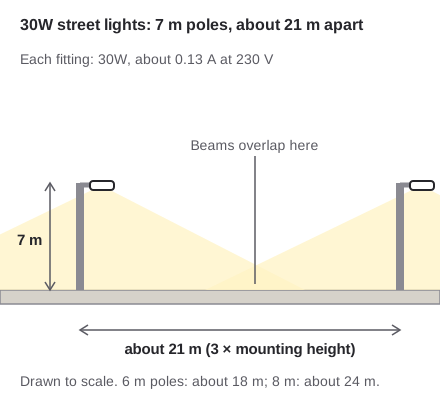
Drawn by us to scale, as a rule of thumb, not a lux calculation. A public road should be designed by a lighting engineer to IS 1944.
On a wall bracket along a compound wall the fitting is lower, often 4 to 5 m; there, step down to 18W or 24W unless the road is wide.
| Pole height | Spacing (3 x height) | Road, poles one side | Fittings per 200 m |
|---|---|---|---|
| 6 m | about 18 m | up to about 6 m wide | 13 |
| 7 m | about 21 m | up to about 7 m wide | 11 |
| 8 m | about 24 m | up to about 8 m wide | 10 |
Spacing between 30W poles
The common rule of thumb is spacing of about 3 × mounting height. For 30W fittings that gives:
- 6 m pole: about 18 m apart.
- 7 m pole: about 21 m apart.
- 8 m pole: about 24 m apart.
Go closer where even light matters: at the society gate, a speed breaker, a turn, the parking entry and the children’s play area. Stretch spacing toward four times the height only on a quiet back lane, and expect visible dark patches between poles if you do.
The beams should overlap roughly halfway between poles, as in the diagram. If you stand midway at night and cannot read a car number plate, the spacing is too wide for 30W. Our pole height and spacing guide covers single-side, staggered and opposite layouts in full.
The usual pole height for a 30W fitting.
About three times the mounting height.
Standard 1073 or Ultra Prime 1097.
Spare for 30W to 36W at ₹360.
Which roads suit 30W
- Society internal road, 5 to 7 m wide, poles on one side.
- Colony lane with houses on both sides and light traffic.
- Campus or factory drive used by cars and two-wheelers.
- Narrow lane or footpath: 18W to 24W is usually enough.
- Main road 9 m and wider: 50W to 100W on taller poles.
A useful check: with poles on one side only, the road should be no wider than about the mounting height. A 7 m wide road on 7 m poles works single-sided with 30W. A wider road needs poles on both sides, staggered, or a higher wattage on taller poles.
For a road where you are not sure, light one stretch first, look at it at night, and only then order the rest. A society committee will find that a much easier decision than one made from a drawing.
30W street light price
Both of our 30W codes are printed at ₹1,200. Here they are against their neighbours either side:
30W and the wattages either side, MRP
Printed MRPs from our current catalogue. Bars to scale. Poles, arms, cable and labour are extra.
Two things stand out. Going from 30W to 36W costs only ₹40 more per fitting. Going down to 24W saves ₹300 in the standard series and ₹550 with the Ultra Prime 1079. Our street light price list has the full range.
30W, 24W or 36W?
Step down or up from 30W on these signs:
- Choose 24W: road under about 5 m, poles 5 to 6 m, or a wall-bracket run along the compound.
- Stay at 30W: road 5 to 7 m, poles 6 to 8 m, spacing around 18 to 24 m.
- Choose 36W: road a little wider than the pole height, poles at the wide end of the spacing, or a busy gate area.
- Go higher: main road, truck yard, wide junction: 50W or 100W.
Because the 36W costs so little more, contractors often use it at the gate and at junctions, with 30W along the straight. Keep one series across the road so every fitting matches. For 18W, 24W and the whole range in both series, see our LED street light manufacturer page.
How many 30W lights for a road, and the cost
Divide the road length by the spacing, round up, and add one for the end. On a closed loop there is no end pole, so the fittings equal the gaps. With 7 m poles at about 21 m:
- 200 m road: 10 gaps, 11 fittings, ₹13,200 at MRP.
- 500 m straight road: 24 gaps, 25 fittings, ₹30,000 at MRP.
- Spare drivers: two 1044 at ₹360 each, ₹720.
Those figures are the fittings only. The poles and arms, foundations, cable, junctions and labour come from your contractor and usually cost far more than the lights. We supply the fittings in boxes of 10, so 11 fittings means two boxes; the spare nine are useful for the gate, parking and future replacements.
Count the extra fittings for the gate, turns and parking before ordering. A count made from the road length alone always comes out short.
Wiring a run of 30W lights
Each 30W fitting draws about 0.13 A at 230 V. A run of 25 draws about 750 W, or about 3.3 A, so the load is small. On a long run, the voltage drop along the cable decides the cable size more than the load does; your electrician sizes it for the length.
- Own MCB and RCCB: give the street lights their own circuit at the main board, protected by an MCB and an RCCB (30 mA earth-leakage breaker).
- Timer or sensor: switch the whole circuit, not each light.
- Earth: connect the earth to every metal fitting and pole.
- Junction at pole foot: in a sealed box, never taped in the open.
Our guide to the 6 amp MCB explains how a small lighting circuit is protected.
Running cost of a 30W street light
At about 12 hours a night, one 30W fitting uses 0.36 units (kWh) a night, about 131 units a year. The 200 m road above, with 11 fittings, uses about 1,445 units a year.
That is the case for a dusk-to-dawn sensor or timer: a street light left on through a bright morning adds up across a whole road. It is also the case for not over-specifying. Stepping a 25-light road down from 30W to 24W saves about 657 units a year, if the road is narrow enough for 24W.
Multiply the units by your tariff to get the bill; society common-area tariffs differ from home ones, so take the rate from your own bill rather than from a rule of thumb.
A 30W LED street light on a timer is one of the cheapest things a society runs. The money is in the poles and cable, not the power.
Mistakes people make with 30W street lights
- Too low: a 30W on a 4 m bracket glares into windows; use 18W to 24W there.
- Too far apart: stretching 7 m poles to 30 m leaves dark gaps a 30W cannot fill.
- Tilted up: tilting the fitting to “throw further” sends light into eyes and windows.
- Taped joints: the joint at the pole foot must be in a sealed box.
- No timer: lights left burning into the morning waste units every day.
Most of these come from treating the watts as the fix for a layout problem. If a stretch is dark, first check the spacing and the mounting height, then the tilt, and only then think of a bigger fitting. A 30W at the right height and spacing lights a society road well; a 50W in the wrong place still leaves dark patches and adds glare.
The other common mistake is ordering by the road length alone and forgetting the extras: a fitting over the gate, one at each turn, one at the parking entry. Walk the road with the plan before ordering, and look at where people actually walk at night.
Spare driver and upkeep
The spare driver for our 30W street lights is the 1044, listed for 30W to 36W at ₹360. Our catalogue prints IS 15885 (Part 2/Sec 13) and registration R-71026310 in its driver section; ask us for the registration of the 1044. When a fitting goes dark or flickers after some years, the driver is the usual cause, and changing it costs much less than a new ₹1,200 fitting.
Clean the covers once a year, before the monsoon, and check each pole-foot junction for water. A cracked cover lets in rain, a common cause of early failure. Our catalogue does not print an IP rating for the street lights; see IP ratings for lights for what to ask.
Where we supply
Every fitting on this page is made at our works in Marol, Andheri East, Mumbai, and sold through dealers across Maharashtra and in many other states. See where we supply in Maharashtra and how we supply the rest of India. Orders placed through our office are delivered all over India, in full boxes only.
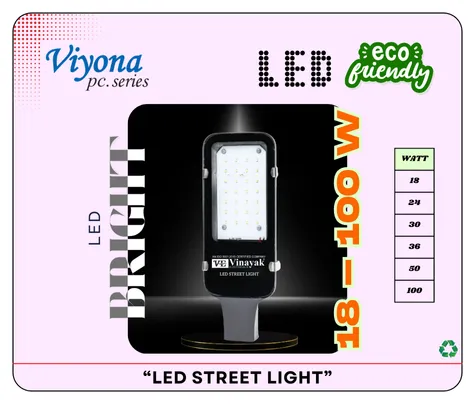
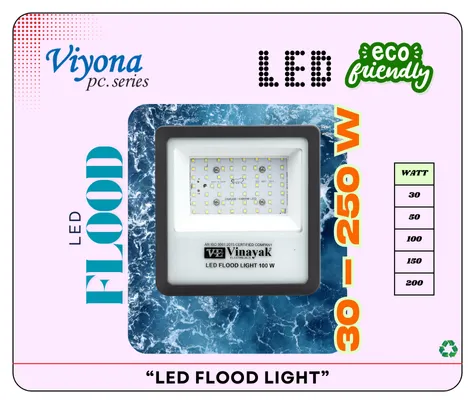
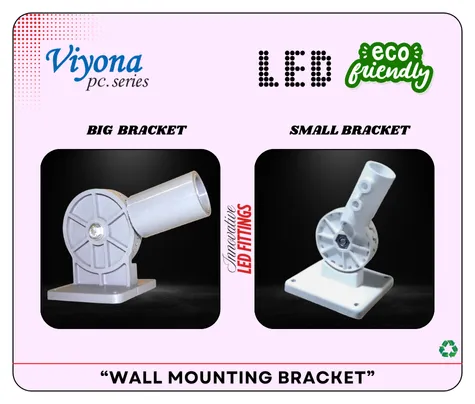
From our catalogue: LED street lights, LED flood lights and wall mounting brackets.
For the whole range, see VIYONA LED lights and our LED light price list.
FAQs
What is the right pole height for a 30 watt LED street light?
What spacing should 30W street light poles have?
What is the price of a 30 watt LED street light?
How many 30W street lights do I need for 200 metres?
Is 30W enough for a society road?
How much power does a 30W street light use?
Why buyers choose Vinayak Electricals
- Made in our own works at Marol, Andheri East, Mumbai, since 1995.
- ISO 9001:2015 certified; switches, MCBs, boxes and LED lights from one maker.
- Printed MRPs, code by code, in our current catalogue: no hidden list.
- Spare LED drivers and wall brackets listed alongside the fittings.
- Warranty of 5 to 10 years by product.
- Dealers and distributors across Maharashtra and in many states; delivery all over India for office orders.
Lighting a society road?
Send the road length and pole height; we will suggest the wattage and quote in boxes of 10.
Contact us