Which Downlight Size Do You Need? Inches, Holes and Wattage
Downlight size is usually quoted in inches, such as 3 inch or 4 inch, but that figure can mean the face, the hole or just a trade name, so the size that matters for fitting is the cut-out the body drops into and the depth it needs above the ceiling. Below we explain how downlight sizes are measured, 3 inch vs 4 inch, cut-out and depth, watts by size, how far apart to space them, and the three down lights we make in Mumbai.
Key takeaways
- Inches are a description — 3 inch or 4 inch may mean the face or the hole. Measure the actual fitting before cutting.
- 3 inch vs 4 inch — smaller for accent and narrow spaces, larger for general light in a room.
- Cut-out — take it from the carton or the fitting itself, cut slightly small and trim.
- Spacing — a common starting point in homes is roughly 1 to 1.5 m between downlights, about half that from walls.
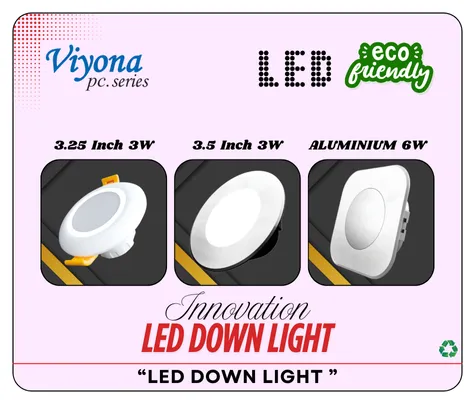
- Ours — 1010 3.25 inch 3W at ₹100, 1011 3.5 inch 5W at ₹135, 1012 aluminium body 6W at ₹160 MRP.
Downlight size: the short answer
A downlight’s size is commonly described in inches, from about 2.5 inch for small accent fittings to 6 inch and larger for general room lighting, with 3 to 4 inch the most common for homes. But the inch figure on a box or in a shop is a description, not a cutting template: some makers mean the face, some the hole, and some the size of the light source.
For fitting, three numbers matter. The cut-out is the hole in the false ceiling that the body drops into. The face, or trim, is the visible ring, a little wider than the hole so it covers the cut edge. The depth is how much space the body and clips need above the ceiling board. Get those three from the carton or from the actual fitting before the ceiling contractor cuts anything.
Size and wattage go together loosely. Small downlights usually carry a few watts and are used in groups or for accent; larger ones carry more and can light a room on their own. We make three down lights at our works in Marol, Andheri East, Mumbai: a 3.25 inch 3W, a 3.5 inch 5W and an aluminium-bodied 6W. For larger ceiling lights, panels take over, and our panel guides cover those sizes.
How is downlight size measured?
Downlight size is measured three ways that are easy to mix up: the face diameter, which is the visible outer ring; the cut-out, which is the hole in the ceiling; and the depth of the body above the ceiling, so a fitting sold as 4 inch may have a face of about 4 inches and a smaller hole, or the reverse.
What each number tells you:
Face or trim what you see from below. Cut-out the hole you cut, the number that must be right. Depth the gap needed above the ceiling board. Inch in the name a trade description.
Our catalogue names two down lights by inch: the 1010 at 3.25 inch and the 1011 at 3.5 inch. As with most fittings in the trade, the inch figure is how the product is described; ask your dealer to show you the fitting and measure the body before the ceiling is cut. Our LED panel light size guide explains the same three measurements for panels.
Never cut a ceiling from the inch figure in a product name. Measure the body of the actual fitting you will install.
| Size in name | In mm (approx.) | Common watts | Typical use | Our model |
|---|---|---|---|---|
| 2.5 inch | 64 mm | 3W to 5W | Accent, wardrobe, niche | None |
| 3 to 3.25 inch | 76 to 83 mm | 3W to 5W | Passage, ceiling band | 1010, 3W, ₹100 |
| 3.5 inch | 89 mm | 5W to 9W | Bedroom ring, kitchen | 1011, 5W, ₹135 |
| 4 inch | 102 mm | 5W to 9W | General room light | None |
| 6 inch | 152 mm | 12W to 15W | Room light; panel territory | See our panels |
What are the common downlight sizes?
The common downlight sizes in homes are about 2.5, 3, 3.5 and 4 inch for small and medium fittings, and 6 inch and above for larger ones, which in millimetres is roughly 64, 76, 89, 102 and 152 mm, though the actual cut-out of a fitting sold under each size varies by maker.
Common downlight sizes in millimetres
Our arithmetic at 1 inch = 25.4 mm, bars to scale with 152 mm as the full bar. This converts the size in the name; it is not a cut-out figure.
Use the conversion to compare sizes, not to cut. A 6 inch downlight is close in face size to a small panel; at that point a panel or a downlight is a choice of look as much as light.
The inch figure is a name. Cut the hole from the actual fitting.
Smaller for accent and passages; larger for general room light.
A common starting point in homes, half that from the walls.
Test dead before removing or fitting any downlight.
3 inch vs 4 inch downlight: which is better?
A 3 inch downlight is better for accent light, narrow spaces such as passages and wardrobe fronts, and rows of small lights in a false ceiling, while a 4 inch downlight is better for general light in a bedroom or living room, because the larger body usually carries more wattage and spreads light wider.
How they compare in common practice:
3 inch: accent, passage 4 inch: room light 3 inch: more fittings 4 inch: fewer holes
For the same total light, 3 inch fittings mean more holes and more wiring, but they can look neater in a narrow ceiling band or a cove. A 4 inch fitting lights more floor per hole. In a typical bedroom, a ring of small downlights in the ceiling band plus one central panel is a common layout; in a passage, a line of 3 inch lights works well.
Our down lights sit at the small end: 3.25 inch and 3.5 inch, at 3W and 5W. For the main light in a room, pair them with a panel, or see our how many lights in a room guide to count fittings by lux.
Mixing sizes is fine. Use one size per row or band so the ceiling looks deliberate, not patched.
What is the cut-out size for a downlight?
The cut-out size for a downlight is the hole the body drops into, slightly smaller than the face so the trim covers the cut edge, and it must come from the carton or from measuring the body of the actual fitting, because downlights sold under the same inch size often need different holes.
How to get it right:
1. Read the carton 2. Measure the body 3. Check the clips 4. Cut small, then trim
Measure the body, the part that goes through the ceiling, at its widest point, not the face. Check that the spring clips have room to open above the board. Then cut a test hole in an offcut, or cut slightly small and enlarge. A hole cut too large cannot be fixed without a patch or a bigger trim.
Our price list does not print cut-out sizes, so we do not give one here; measure the fitting from your dealer before cutting. The same method for panels, and the reasons cut-outs differ between series, are in our LED panel light size guide. Buy all the downlights for one ceiling from one batch so every hole matches.
How deep a ceiling gap does a downlight need?
A downlight needs enough clear depth above the ceiling board for its body, its clips and its driver or wiring to sit without being squeezed, which for slim LED downlights is usually small but varies by model, so check the gap between the board and the slab or ducting before choosing a fitting.
Three things share that gap: the body of the light, the driver or connector, and the cable loop that lets you lower the fitting later. Slim LED downlights need little depth; deep reflector fittings and some spotlights need much more.
Where the false ceiling is close to the slab, beams or AC ducting, measure before buying. A fitting forced into too little space presses on its driver and wiring, which traps heat and shortens its life. Leave a little air around the driver; do not bury it in insulation.
Our 1012 has an aluminium body, as its name in our catalogue says; metal bodies help carry heat away from the LEDs. Whatever the fitting, the LED driver is the part most likely to need reaching later, so keep it where a hand can find it.
Leave enough slack in the cable to lower each downlight a hand’s length below the ceiling. Servicing is much easier later.
Which downlight wattage for which size?
As a rough guide, small 2.5 to 3 inch downlights commonly carry about 3W to 5W, 3.5 to 4 inch about 5W to 9W, and 6 inch fittings about 12W to 15W, though the light a fitting gives depends on its efficiency and lens, so compare lumens where the box states them.
By size, as commonly seen in the trade:
2.5–3 inch: 3–5W 3.5–4 inch: 5–9W 6 inch: 12–15W
Our down lights follow this pattern: 3W at 3.25 inch and 5W at 3.5 inch, plus the 6W aluminium body 1012. Watts tell you power, not brightness. Two 5W fittings can give different light, so if the carton gives lumens, compare those; our lumens to watts guide explains how.
For general light in a room, more small fittings at a few watts each spread light more evenly than one bright one, but cost more in holes and wiring. A few watts per fitting also keeps the running cost low: ten 5W downlights use 50W, about the same as a single old tube light and choke.
How far apart should downlights be?
A common starting point in homes with ceilings of about 2.7 to 3 metres is to space downlights roughly 1 to 1.5 metres apart, and about half that distance from the walls, closer for small low-watt fittings and wider for larger, brighter ones, so the pools of light overlap without dark gaps.
Rules of thumb that help:
1–1.5 m apart Half that from walls Closer for 3W Align with furniture
Draw the room on paper, mark the bed, sofa, wardrobe and kitchen counter, then place lights where people work and walk, not just in a neat grid. Avoid putting a downlight directly over the pillow, where it shines into eyes. Over a counter, set lights slightly in front of the person so they do not stand in their own shadow.
To count fittings from the room size and the lux you want, use our how many lights in a room guide; it works through downlights and panels per room.
Wire downlights in two groups on separate switches: one for everyday light, one for full brightness. It costs a switch and saves power every evening.
Round or square downlight: does the shape matter?
The shape of a downlight changes the look of the ceiling, not the light: round downlights suit most ceilings and circular coves, square ones suit rooms with straight lines, square tiles or rectangular false-ceiling bands, and the hole must match the shape, so decide before the ceiling is cut.
Our down lights are listed in our catalogue as square and round, so you can match either style. Points to decide early:
One shape per room Square needs straight cuts Match panels to downlights
A square hole is harder to cut neatly than a round one; it needs a straight edge and careful corners. If the main panel in a room is square, square downlights around it look deliberate; if it is round, use round. Colour and finish matter too: a white trim disappears into a white ceiling.
For room-by-room ideas, see our design ideas guide, which pairs lights with switch board layouts.
Changing shape later means changing the hole. Agree round or square with the ceiling contractor before the first cut.
Which down lights do we make, and at what MRP?
We make three LED down lights at our works in Marol, Andheri East, Mumbai: the 1010 at 3.25 inch and 3W for ₹100, the 1011 at 3.5 inch and 5W for ₹135, and the 1012 with an aluminium body at 6W for ₹160 MRP, each in square and round and sold in boxes of 10.
MRP of our LED down lights
MRPs from our current catalogue, bars to scale with ₹160 as the full bar. Pack of 10.
VIYONA LED 1011 is a 3.5 inch 5W LED down light with an MRP of ₹135. Our down lights are listed in our catalogue to IS 10322 (Part 5/Sec 2) under BIS registration R-71026476. Per watt the 1012 is the best value at under ₹27 a watt. See them on our LED down light page.
How do you replace a downlight and match the old hole?
To replace a downlight, switch off the MCB and test dead, pull the old fitting down against its clips, disconnect it, measure the existing hole, then choose a new fitting whose cut-out matches that hole, because a new fitting with a smaller face will leave a gap and one with a larger body will not go in.
Step by step:
1. MCB off, test dead 2. Ease the fitting down 3. Note the wiring 4. Measure the hole 5. Match cut-out and depth 6. Connect, push up, test
Take the old fitting to the shop; it is the easiest way to match. If the new hole must be bigger, enlarge it carefully; if smaller, a wider trim or a filler ring may cover the gap. The switch must break the phase, as our phase, neutral and earth guide explains.
A like-for-like swap is simple. New points or new wiring in the ceiling are jobs for a licensed electrician.
Switch off the MCB and confirm the circuit is dead with a tester before touching any ceiling wiring. If unsure, call a licensed electrician.
FAQs
What size downlight is best for a bedroom?
What is the difference between a 3 inch and 4 inch downlight?
How do I measure a downlight cut-out?
How many downlights do I need for a 10x10 room?
Are square and round downlights the same size?
What is the price of your LED down lights?
Why buyers choose Vinayak Electricals
- Three LED down lights made at our works in Marol, Andheri East, Mumbai, in square and round.
- Down lights listed to IS 10322 (Part 5/Sec 2) under BIS registration R-71026476.
- Down lights from ₹100 MRP, and panels from the same catalogue for the main room light.
- Spare panel drivers sold separately, so a fitting can be repaired rather than replaced.
- MRPs published openly; sold through 500+ dealers with delivery across India.
- Manufacturing in Mumbai since 1995; ISO 9001:2015 certified.
LED down lights in square and round
See our 3W, 5W and 6W down lights with codes and MRPs, then order through a dealer or call us.
View LED down lights