
Key takeaways
- Where — beside the bed on the side you get up, then the bedroom side of the bathroom door; add the room door for children or elderly parents.
- Height — roughly 300 to 450 mm from the floor, below the mattress top, pointed down.
- Colour — dim and warm; sleep researchers favour amber or red-orange near the floor over white or blue.
- Switching — a 2-way pair at the bedside and door, or always on in an elderly parent’s room.
- Cost — our VIZA V412 is MRP ₹380; two points with plates, boxes and 2-way switches come to about ₹1,294.
On this page 12 sections + FAQs
Foot light for bedroom: the short answer
A foot light for the bedroom is a small LED light set low in the wall, roughly 300 to 450 mm above the floor, beside the bed and along the path to the bathroom door, so you can get up at night and see the floor without switching on the ceiling light or waking the person next to you.
In most Indian bedrooms two foot lights do the job: one beside the bed on the side you get up from, and one on the bedroom side of the bathroom door. Keep the light low, dim and warm-looking, pointed at the floor rather than at the bed.
We make three 4-module modular foot lights in our VIZA range at our works in Marol, Mumbai. This guide covers the bedroom only. For stairs, corridors and the general basics, see our foot light guide for stairs and homes.
Where should a foot light go in a bedroom?
A bedroom foot light goes where your feet go at night: next to the bed on the side you get out, on the bedroom side of the bathroom door, and, if the room needs it, by the room door and the wardrobe. Light the route, not the room.
Picture a 2BHK in Andheri at 3 a.m. The route runs from the edge of the bed to the bathroom door, sometimes on to the room door. Each point on it is a candidate:
- F1 beside the bed lights the floor where you put your feet down. The most useful one.
- F2 bathroom door on the bedroom wall, outside the bathroom, so you see the door and the threshold step.
- F3 room door for a parent walking to a child’s room, or to the kitchen.
- F4 wardrobe if one of you dresses in the dark for an early shift.
Bedroom foot light layout: plan and side view
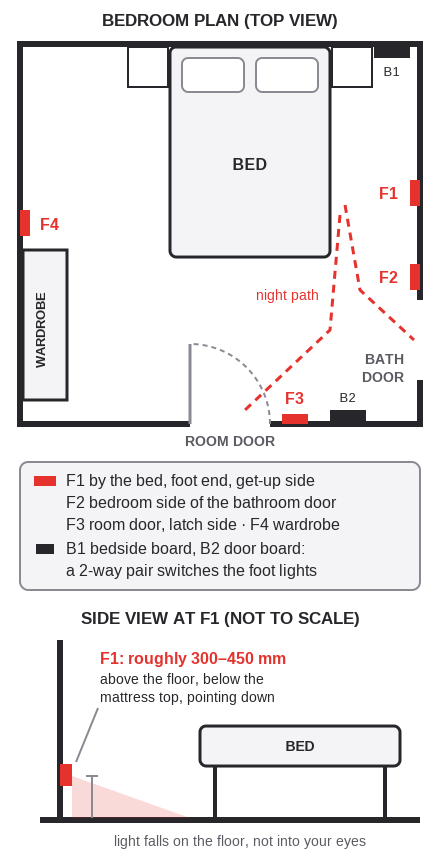
Drawn by us, not to scale. F1 and F2 matter most; F3 and F4 are optional.
The bathroom light stays inside the bathroom. A foot light for the bedroom sits on the bedroom wall, never inside the wet area by a shower or tap. Plan these points with the rest of the room’s switches and sockets; our bedroom electrical points guide lists everything else that goes on those walls.
Start with F1 and F2. Walk the route in the dark once before the wall is chased.
| Point | Where | Suggested height | Switching | Priority |
|---|---|---|---|---|
| F1 bedside | Low on the wall beside the bed, towards the foot end, on the side you get up | 300 to 450 mm, below mattress top | Bedside board or 2-way | First |
| F2 bathroom door | Bedroom wall beside the bathroom door | Same as F1 | Same switch as F1 | First |
| F3 room door | Inside the room, near the door | Same as F1 | Door board or 2-way | Child or elderly room |
| F4 wardrobe | Beside the wardrobe | Same as F1 | Same switch, or its own | Optional |
| Not here | Inside the shower or wet area | Not applicable | Not applicable | Never |
Which side of the bed should the foot light be on?
Put the foot light on the side of the bed you get out from, at the end nearest the bathroom. If you both get up at night, fit one on each side; if only one of you does, one light on that side keeps the other side darker.
Three things decide the side:
- Who gets up — a new mother, someone on medication, an early riser. Their side gets the light.
- The route — the side facing the bathroom door gives the shortest lit path.
- The sleeper’s face — a light near the pillow end on the other person’s side will be in their eyeline. Set it low on the wall beside the bed, towards the foot end, away from the pillows.
A bed against one wall leaves only one side free. Then one foot light on the open side, plus one at the bathroom door, covers the room. With a cot beside the bed, light the side you reach the cot from.
Check the bed’s final position before the wall is chased. A foot light hidden behind a bedside table or a side drawer unit lights nothing.
Light the floor on the side you get up from, then the bathroom door.
Roughly 300 to 450 mm from the floor, pointed down, out of the sleeper’s eyes.
Sleep researchers advise dim amber or red-orange light near the floor over white or blue.
Switch from the bed and the door, or leave it on all night for an elderly parent.
Foot light height from the floor in a bedroom
A practical height for a bedroom foot light is roughly 300 to 450 mm above the finished floor, measured to the centre of the module. There is no rule that fixes one number; what matters is that the light sits low enough to wash the floor and below the top of the mattress, so it does not shine into the face of anyone lying down.
Some practical checks at the wall:
- Below mattress top — measure your bed. A low platform bed may push the light towards the lower end of the range.
- Above the skirting — keep the plate clear of the skirting tile and of the floor mop’s reach.
- Same height on the route — F1, F2 and F3 at one height look planned and give an even line of light.
The bedside switch board sits much higher, at hand height from the bed. Our switch board height chart gives that figure for every room, so you can mark both on the wall at the same time.
Lie on the bed with the light on before the plate is screwed tight. If you can see the glowing face from the pillow, it is too high or in the wrong place.
Warm, cool or coloured: which foot light colour suits sleep?
For a bedroom, choose a foot light that is dim and warm-looking, not bright white or blue. Harvard Health advises using dim red lights for night lights, because red light is less likely to shift the body clock and suppress melatonin, and notes that even dim light can have an effect.
A small 2022 Northwestern University study had people sleep one night in about 100 lux of room light and another in about 3 lux. In the brighter room their heart rate during sleep was higher and their insulin resistance the next morning was higher. The researchers’ tips: if you need a light at night, keep it dim and closer to the floor, and choose amber or red-orange over white or blue.
Light levels in the research, lux
Harvard Health: 8 lux is about twice a night light. 100 and 3 lux: the two Northwestern study conditions. Bars to scale against 100 lux.
That is what a foot light is: low and pointed at the floor. Our catalogue lists the V412 as “every colour premium”; ask us which light colours are available when you send an enquiry, and pick the warmest one for a bedroom.
These are small studies, not proof that any foot light colour improves sleep. Dim, low and out of the eyes is the safe rule.
How to switch a bedroom foot light: bed, door or always on
A bedroom foot light can be switched in three ways: left on all night from one switch, switched from the bedside board, or switched from both the bedside and the room door with a 2-way pair. For most couples, a 2-way pair is the easiest to live with.
- One switch at the door — cheapest, but you walk into a dark room to reach it.
- One switch at the bedside — you turn it on before you stand up.
- 2-way: bedside + door — on as you come in, off once you are in bed, and back on from the pillow at night.
- Always on — suits an elderly parent who should never have to find a switch; set the switch at the door so nobody turns it off by mistake.
All the foot lights in one room can share one switched feed. A 2-way connection takes two 2-way switches with two traveller wires between them, run in conduit; our 2-way switch wiring diagram shows it step by step. In our VIZA PIANO range the V102 10 A 2-way switch is MRP ₹81; the matt black and silver grey list has the V1202 at MRP ₹90.
Switching is fixed wiring. Turn off the bedroom’s MCB first and have a licensed electrician make the connections; the switch must break the phase, not the neutral.
How much electricity does a bedroom foot light use in a month?
Very little. Units are watts × hours ÷ 1,000, so a foot light drawing 1 W for a 9-hour night uses 0.009 units a night and 0.27 units in a 30-night month. Our catalogue does not print a wattage for our foot lights, so read the figure on the module; the sums below use example wattages.
Units a month, one light on 9 hours a night for 30 nights
Worked: 9 W × 9 h × 30 = 2,430 Wh = 2.43 units; 3 W = 810 Wh; 1 W = 270 Wh; 0.5 W = 135 Wh. The 3 W and 1 W rows are examples, not ratings of our foot lights. Bars to scale against 2.43 units.
For two foot lights at 1 W, that is 0.54 units a month. At an assumed ₹10 a unit (check your own bill), that is about ₹5.40 a month, or about ₹65 a year. At 3 W each, two lights use 1.62 units, about ₹16.20 a month. A 9 W lamp left on instead uses 2.43 units, about ₹24.30. Our night lamp guide runs the same sums for a 0.5 W lamp against a zero watt bulb.
Buy a bedroom foot light for placement and light colour, not for watts.
Foot lights in a child’s bedroom
In a child’s bedroom, a foot light lets a parent check on the child, or a child walk to the bathroom, without a bright light coming on. Put one beside the child’s bed on the open side and one by the room door, so the parent coming in has light from the first step.
The height a foot light needs is also the height a toddler’s hands reach. So:
- Plate always fitted — never leave a module running without its plate, even for a week after shifting.
- Screwed tight — the plate and frame fixed firmly to a proper box, not resting on loose wires.
- Low sockets too — any socket at that height should have a shutter; see our socket shutter guide.
For a child who wants a light on all night, use the always-on option with the switch at the door, out of small hands’ reach. Keep it dim and low, following the sleep advice above.
Do not put a foot light behind a cot or a toy shelf where it will be covered. A covered light is dark, and things stacked against a plate get pushed into it.
Foot lights in an elderly parent’s bedroom
For an elderly parent, a foot light on the route from bed to bathroom is one of the simplest changes you can make. The WHO estimates about 842,000 deaths from falls worldwide in 2023, about 71% of them among people aged 60 and over. A CDC home safety checklist asks whether the path from the bed to the bathroom is dark and suggests a night-light; MedlinePlus advises good lighting on the path from the bedroom to the bathroom.
How we would set the room up:
- Always on at night — no switch to find in the dark. The 2-way pair still lets a carer turn it off.
- F1 + F2 + F3 — bed, bathroom door and room door, so the whole route is lit.
- Even height — the same height on every light, so the floor looks evenly lit.
- Bedside board in reach — the main light switch reachable from the bed as well.
Our electrical safety guide for elderly people covers the rest of the house: switch heights, sockets, and the bathroom.
A foot light helps, but it does not replace medical advice on falls. Loose rugs, wires across the floor and a wet bathroom floor matter as much as the light.
Bedroom foot light design: matching your switch boards
A foot light looks best matching the room’s switch boards. All three of our foot lights are 4-module, so each fits a 4-module plate and box, in the same plate series and finish as your bedside and door boards.
Our 4-module foot lights, MRP per piece
MRPs from our printed catalogue. Packed 10 to a box for V411 and V412, 5 to a box for V1314. Bars to scale against ₹485.
Choosing a look:
- White room — the V412 on a white 4-module plate such as CHERRY V1154, MRP ₹98.
- Dark or wooden headboard — the V1314, listed with our matt black and silver grey range, on a dark plate such as EBONY matt black V1344, MRP ₹160.
- ROYAL boards — the V411 ROYAL foot light, with a ROYAL 4-module plate V1324, MRP ₹175.
Our plates are UV-protected, do not turn yellow and carry a 5-year warranty. If you are unsure what a 4-module plate looks like on your wall, see modular plate sizes explained or the plate size calculator. Photos are on our VIZA Royal foot lights page.
One series across the room’s boards and foot lights looks planned. Mixing finishes on one wall looks like a repair.
What two bedroom foot lights cost: a worked example
Two foot lights for a bedroom, at F1 and F2, with plates, boxes and a 2-way switch pair, come to about ₹1,294 at our catalogue MRPs, before wire and the electrician’s charge.
- V412 foot light ₹380 + CHERRY 4M plate V1154 ₹98 + 4M concealed box V614 ₹88 = ₹566 per light
- Two lights: ₹566 × 2 = ₹1,132
- Two V102 2-way switches: ₹81 × 2 = ₹162
- Total: ₹1,132 + ₹162 = ₹1,294
The 2-way switches go into module space on the boards you already have, so check that the bedside and door boards have a free module each. On a finished wall with no chase, a surface option such as our 4-way surface gang box V644 (MRP ₹115, white) avoids breaking the plaster; ask us to confirm it suits your foot light before you buy.
We sell in full boxes only, never single pieces. Anyone, homeowners included, can buy direct from us: send us an enquiry or visit the Mumbai office. Or buy through one of our 500+ dealers across India.
These are MRPs. Your dealer’s price may differ, and wire, labour and wall repair are extra.
Fitting a bedroom foot light safely
A foot light is wired like any other light point: a phase and neutral from the room’s lighting circuit reach a 4-module box low in the wall, through its switch. Fitting it means chasing the wall, running conduit and making connections, which is work for a licensed electrician.
- MCB off first — switch off the bedroom’s lighting circuit at the board and check it is dead.
- Lighting circuit — take the feed from the lights circuit, commonly 1.5 sq mm wire on a 6 to 10 A MCB, not from a socket circuit.
- Conduit, not clips — no bare single-core wire clipped to the wall.
Our full price list, with every module, plate and box code, is in our e-catalogue. Warranty varies by product; the office confirms it for any code, and returns are accepted within 15 days in the same condition.
Never fit a foot light inside the shower or wet area of the bathroom. Keep it on the bedroom wall, outside the bathroom door.
FAQs
Where should a foot light be placed in a bedroom?
Beside the bed on the side you get up from, and on the bedroom side of the bathroom door. Add one by the room door in a child’s or elderly parent’s room, and one by the wardrobe if someone dresses in the dark.
What is the height of a foot light from the floor in a bedroom?
Roughly 300 to 450 mm above the finished floor, to the centre of the module. Keep it below the top of the mattress so it does not shine into the eyes of someone lying down. There is no single fixed rule.
Which colour foot light is best for a bedroom?
A dim, warm-looking light. Harvard Health advises dim red light for night lights, and Northwestern sleep researchers suggest amber or red-orange light near the floor over white or blue. Ask us which colours our foot lights come in.
How much electricity does a foot light use?
Very little. At an example 1 W for 9 hours a night, one foot light uses 0.27 units a month. Our catalogue does not print a wattage for our foot lights, so read the module’s own marking.
Can a bedroom foot light be switched from the bed and the door?
Yes. Two 2-way switches, one on the bedside board and one at the door, let you turn the foot lights on or off from either place. A licensed electrician should do the wiring with the MCB off.
What is the price of a bedroom foot light?
Our VIZA 4-module foot lights are MRP ₹380 (V412), ₹460 (V1314) and ₹485 (V411 ROYAL). With a 4-module plate and box, one V412 point comes to about ₹566 at MRP, before wire and labour.
Why buyers choose Vinayak Electricals
- Three 4-module VIZA foot lights: V412 (MRP ₹380), V1314 (₹460) and V411 ROYAL (₹485).
- Plates, boxes and 2-way switches from the same catalogue, so the bedside board and the foot lights match.
- Modular plates that are UV-protected, do not turn yellow and carry a 5-year warranty.
- Making electrical accessories in Mumbai for 30+ years; ISO 9001:2015 certified.
- MRPs published openly in our printed catalogue.
- 500+ dealers and distributors and all-India delivery, in full boxes.
Published 26 Nov 2026
Who designed it & wrote this
@Team of:
Gaurang Parmar
Fractional C-Suite Executive
STRATEGIC SOLUTIONS


