Cable Clips: Which Size for Which Cable, and Price
Key takeaways
- Clip size = the cable’s outside diameter, not the sq mm printed on it.
- Single-core house wire has no sheath: run it in casing or conduit, never in clips.
- LAN and TV coaxial cables commonly need 6 to 7 mm; three-core flexible cables 8 to 10 mm.
- Twelve VIYONA sizes, 4 mm (531, ₹35 MRP) to 20 mm (542, ₹205 MRP), packed 100 to a box.
- Clips suit single TV, data and bell cables; run power in casing or conduit.
What a cable clip is for
A cable clip is the small U-shaped plastic clip, with a nail through its top, that holds a single cable flat against a wall, a ceiling or a wooden batten. It is what keeps a TV cable running neatly along a skirting, a LAN cable along a ceiling edge, a bell wire up a door frame, or a flexible cord straight and tight instead of sagging in loops.
We make VIYONA cable clips in twelve sizes, from 4 mm to 20 mm, codes 531 to 542, with printed MRPs from ₹35 to ₹205, packed 100 to a box. The size is the inside width of the clip, which should match the outside diameter of the cable it holds. This page shows how to read that size, which clip suits which common cable, how to fix them properly, and when a clip is the wrong answer and casing or conduit is the right one.
The short rule: measure the cable, not the wire size printed on it. A clip that is too small crushes the insulation; one that is too big lets the cable slide and sag.
Sizes, codes and MRPs
All twelve sizes from our catalogue, with their printed MRPs:
VIYONA cable clip MRP by size
Printed MRPs from our current catalogue; every size is packed 100 to a box. Bars to scale.
The small sizes, 4 mm to 7 mm, are the ones used most in homes, for bell wire, telephone and data cables. The 8 mm to 12 mm sizes suit TV and multi-core cables, and 14 mm to 20 mm the thick cables of pumps, machines and site work. The product page is VIYONA cable clip.
| Size | Code | MRP | Typical cable |
|---|---|---|---|
| 4 mm | 531 | ₹35 | Bell wire, telephone cable |
| 5 mm | 532 | ₹40 | Thin twin flex, telephone cable |
| 6 mm | 533 | ₹45 | LAN, thin coaxial |
| 7 mm | 534 | ₹50 | TV coaxial, LAN |
| 8 mm | 535 | ₹58 | Three-core flexible |
| 9 mm | 536 | ₹70 | Three-core flexible |
| 10 mm | 537 | ₹80 | Heavier flexible, CCTV with power |
| 12 mm | 538 | ₹112 | Multi-core flexible |
| 14 mm | 539 | ₹140 | Multi-core flexible |
| 16 mm | 540 | ₹165 | Heavy cable |
| 18 mm | 541 | ₹190 | Heavy cable |
| 20 mm | 542 | ₹205 | Heavy cable |
How to choose the size
A cable clip’s size is the width of the cable it holds: size = cable diameter. The wire size printed on the insulation, such as 1.5 sq mm, is the copper area inside, not the outside width, so it cannot be used directly.
Cable clip on a wall, and why sq mm is not width
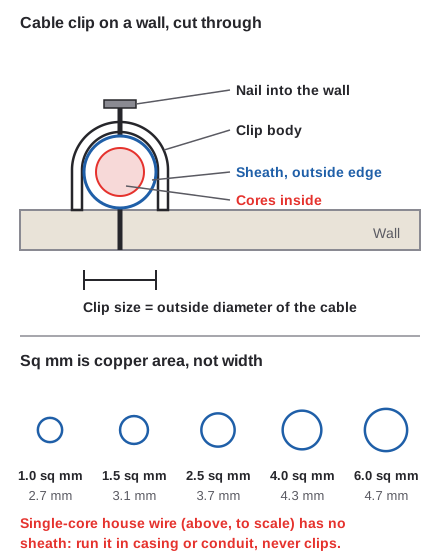
Drawn by us. Wire diameters are the approximate overall diameters printed in our wire table; single-core house wire runs in casing or conduit. Measure your own cable to be sure.
Our catalogue’s wire table shows the gap between the printed size and the width. The approximate overall diameter of single-core wire is 1.0 sq mm: 2.7 mm, 1.5 sq mm: 3.1 mm, 2.5 sq mm: 3.7 mm, 4 sq mm: 4.3 mm and 6 sq mm: 4.7 mm. The outside width is what a clip is sized to. But single-core house wire has no outer sheath, so it goes in casing or conduit, never in clips; measure the sheathed cable you are clipping instead. Our VIYONA wire is made for us by a partner; its full table and MRPs are on our house wire price list.
Clip size equals the cable’s outside diameter.
4 mm to 20 mm, codes 531 to 542.
Usually a 6 mm or 7 mm clip.
Straight runs, even spacing, hit the nail not the cable.
Which clip for which cable
Cables vary by make, so measure with a ruler or a vernier. As a guide to the common ones:
- 4–5 mm: bell wire, two-pair telephone cable, thin twin flex.
- 6–7 mm: LAN (data) cable and TV coaxial cable, which commonly measure around 6 to 7 mm.
- 8–10 mm: round three-core flexible cable for an appliance or an extension, CCTV cables with a power pair.
- 12–14 mm: heavier multi-core flexible cable for a geyser, a pump or a small machine.
- 16–20 mm: thick multi-core flexible cable indoors, in a workshop or on site.
Round clips are for round cable. A flat twin cable sits better in a clip one size up, laid flat. Our TV wall electrical points guide and the RJ45 and TV socket guide cover where TV and data cables end.
If the clip has to be squeezed shut over the cable, it is too small. It should close over the cable with the nail going in freely, without denting the sheath.
How to fix cable clips properly
- Run straight: horizontal along a skirting or ceiling edge, vertical down a corner. Diagonal runs look untidy and are hard to trace later.
- Even spacing: close enough that the cable does not sag between clips; on straight runs many electricians space them roughly 25 to 30 cm apart, closer on ceilings.
- A clip each side of a bend, and one near each end of the run.
- Nail straight in: tap the nail square to the wall so the clip sits flat; a crooked nail tilts the clip onto the cable.
- Never hammer the cable: strike the nail head only.
- Hard walls: on concrete, use a fine drill bit for a pilot hole rather than forcing the nail.
On a 10 m run with clips every 30 cm and one at each end, you need about 35 clips, which is why clips are sold by the box.
Clips, casing or conduit?
Clips are the lightest way to run a cable on a surface, but not always the right one:
- Cable clips: single TV, LAN, telephone and bell cables; an extra cable added after the house is built; cables inside lofts and false ceilings.
- PVC casing and capping: single-core power wires run on a surface, which need a cover against knocks and dust.
- Concealed conduit: the proper way to run house wiring in a new building, hidden in the wall.
Single-core house wire has no outer sheath, so it must run in casing or conduit; never clip it bare to a wall, where it has no protection from knocks, nails or children. Our types of wiring system guide compares surface, casing and concealed wiring, and our house wiring cost guide prices a 2BHK.
Do not clip power cables tightly together with TV or data cables over long runs. Keep a small gap, or run them on separate lines, to avoid interference on the signal.
Adding a TV, internet or CCTV cable after the house is built
Most cable clips go up long after the electrician has left: a new broadband line, a set-top box moved to another wall, a CCTV camera at the gate. A few habits make that run neat and safe:
- Follow the edges: run along the top of the skirting, the edge of a door frame or the line where wall meets ceiling, where a cable is least seen.
- Sleeve wall crossings: where the cable passes through a wall, use a short piece of pipe so the brick edge cannot cut the sheath.
- Leave slack at each end: a loop of 30 cm or so at the router or TV saves re-running the cable when the furniture moves.
- Stay clear of power points: do not run a new cable over a switch board or into a socket box.
- Drill with care: concealed power wires usually run straight up and down from boards and across at ceiling height; avoid drilling in those lines.
For a wall with a TV, router and set-top box, our TV wall points guide shows where sockets and data points should sit so fewer cables run loose in the first place.
Mistakes that damage cables
- Clip too small: squeezes the insulation; over time it can crack, and on a power cable that is a shock and fire risk.
- Nail through the cable: happens when the clip is too big and the cable shifts under the nail. Switch off and replace that length.
- Clip too big: the cable slides and sags, and the run looks untidy within a month.
- Clipping over a joint: a taped joint must not be clipped down or buried; use a junction box. See junction box vs concealed box.
- Damp or outdoor walls: on an exposed wall, plain clips and their nails can weaken; a closed casing or conduit lasts longer.
If old surface wiring is held up by brittle clips and the insulation is cracked, the cable is due for replacement, not new clips; see signs a house needs rewiring.
Pricing a job: clips against the rest
Clips are the smallest line on an electrical bill of materials. Our 4 mm clips (531): ₹35 MRP and 6 mm (533): ₹45 MRP, each packed 100 to a box, are small next to the cable, the boxes and the switches on the same job.
Sizes from 12 mm upwards step up in price with the clip’s size, from ₹112 for 12 mm to ₹205 for 20 mm. For a site or a workshop with heavy cable, choose the size by measuring the cable first; a wrong size is wasted, because a clip that does not fit cannot be used for anything else.
For the whole list of what a new flat needs, from clips to MCBs, see our electrical accessories list.
For electricians and dealers
Every size is packed 100 to a box, and we sell in full boxes. An electrician’s bag usually carries the 4 mm, 6 mm and 8 mm sizes, which cover bell and telephone wire, data and TV, and most flexible cables; the larger sizes are bought for a particular job.
Cable clips are part of our VIYONA accessories range, alongside PVC tape, capacitors and holders, so a counter that stocks one can order the others in the same delivery. See the VIYONA range and our VIYONA MCB boxes.
Where we supply
Everything on this page is made at our works in Marol, Andheri East and sold through dealers and distributors across Maharashtra and in many other states. See where we supply in Maharashtra and how we supply other states in India. Orders placed through our office are delivered all over India, in full boxes only. For a quotation, or the name of a dealer near you, contact our office.
FAQs
What size cable clip do I need for 1.5 sq mm wire?
Which cable clip is used for a TV cable?
What is the price of a cable clip?
How far apart should cable clips be?
Can I clip house wiring directly to the wall?
What sizes of cable clip do you make?
Why buyers choose Vinayak Electricals
- Made in our own works at Marol, Andheri East, Mumbai, since 1995.
- ISO 9001:2015 certified company; every code and MRP printed in our catalogue.
- Twelve clip sizes from 4 mm to 20 mm, from one maker.
- Part of our VIYONA range with holders, tape, capacitors and MCB boxes.
- Sold in full boxes through dealers and distributors across Maharashtra and in many states.
- Delivery all over India for orders placed through our office.
Need clips with a wiring order?
Send the sizes and quantities with the rest of your list for a quotation.
Contact us