TV Wall Electrical Points: What to Wire Behind the TV and Unit
TV wall electrical points are the sockets, signal points and cable routes behind a TV, and they are the points most often under-counted. Below we cover how many sockets a TV wall needs, which socket suits it, the set-top box and data points, how a wall-mounted TV is wired, when an HDMI socket is worth it and which circuit it sits on, with MRPs of the parts we make in Mumbai.
Key takeaways
- Sockets — four to six 6A sockets for a living room TV wall; two or three for a bedroom TV.
- Signal — a TV antenna socket and an RJ45 data point on the same board as the sockets.
- Wall-mounted TV — a small board behind the screen and a conduit inside the wall down to the unit.
- HDMI socket — worth ₹1,150 only where the cable must run concealed; otherwise a plain cable.
- Spike guards — a fallback for finished walls; never one plugged into another.
TV wall electrical points: the short answer
TV wall electrical points are the power sockets, signal sockets and cable routes planned behind and around a TV: sockets for the TV, set-top box, router, sound bar and any console, a TV antenna socket, a data point, and a conduit that carries cables between the screen and the unit without showing on the wall.
The TV wall is the board that most often ends up with a spike guard tucked behind the unit and a tangle of leads under it. That usually happens because the wall was planned for one TV and one set-top box, and the home then added a router, a sound bar, a streaming box and a games console.
So plan it from the devices you own now and the ones you are likely to add. This guide goes device by device: how many sockets, which signal points, how a wall-mounted TV is wired, which circuit it sits on and when an HDMI wall socket earns its price, with the MRPs of the parts we make at our works in Marol, Andheri East, Mumbai. Any wiring is a job for a licensed electrician, with the MCB switched off and the circuit tested dead first.
How many sockets does a TV wall need?
A living room TV wall commonly needs four to six 6A sockets: one each for the TV, set-top box and router, one for a sound bar or speaker, one for a streaming box or games console, and one spare, while a bedroom TV wall can usually manage with two or three sockets.
6A sockets a TV wall commonly needs
General practice by number of devices, not a rule or a test result. One spare socket is included in each figure.
List what will sit on the unit: TV, set-top box, router or fibre box, sound bar, console or streaming box. Each gets its own socket, plus one spare. A socket costs little at the wiring stage; a spike guard behind the unit is what a missing one turns into.
Count the plugs, not the devices. A sound bar with a separate subwoofer, or a router with a separate fibre box, needs two sockets.
| Point | What it serves | Usual type | Our example (MRP) |
|---|---|---|---|
| 6A sockets, 4 to 6 | TV, set-top box, router, sound bar, console | 6A 3 pin with shutter | KEMPS K192, ₹110 |
| TV antenna socket | Cable TV or DTH lead | Coaxial module | KEMPS K201, ₹102 |
| Data point | Smart TV, console, router | RJ45 jack | VIZA V1256, ₹189 |
| HDMI wall socket | Concealed HDMI run | HDMI module | KEMPS K206, ₹1,150 |
| Board behind screen | Wall-mounted TV | 1 or 2 sockets | KEMPS K192, ₹110 |
| Cable conduit | HDMI and signal leads | Separate from power | Not a product we make |
Which sockets suit a TV wall?
A TV wall suits 6A 3 pin sockets for most devices, because TVs, set-top boxes, routers and sound bars all draw small currents, with shuttered sockets on any point a child can reach and a universal 6 and 16A socket only where a larger plug, such as a room heater in winter, might be used.
KEMPS K192, a 6A 3 pin socket with shutter, is ₹110 MRP; in VIZA, V1269, a 6A 3 pin socket with shutter, is ₹85. Where two-pin plugs dominate, the VIZA V262 6A 2 pin socket with shutter is ₹78. These are 2M modules in most ranges, so six sockets alone fill a 12M plate.
A universal socket such as KEMPS K193 (₹205) takes both plug sizes, useful if the same wall serves a heater or a vacuum cleaner. Our 6A vs 16A socket guide explains which loads need 16A, and socket with shutter why low points benefit from one.
Four to six sockets for a living room TV wall, plus a spare.
TV antenna socket and RJ45 jack on the same board.
Cables pass inside the wall to a wall-mounted TV.
Wall sockets first; never one spike guard into another.
Where should the TV board go on the wall?
The TV board should go where the unit or the screen hides it: either low behind a closed TV unit, just above the top of an open unit or floating shelf, or behind a wall-mounted screen, with the choice made from the carpenter’s unit drawing and the TV bracket position before any box is fixed.
Three common layouts: low behind the unit, just above the unit and behind the screen. The common heights for each, in feet and millimetres, are in our switch board height from floor guide, so we do not repeat them here.
What matters for the points themselves is access. A board behind a closed unit needs a cut-out in the back panel big enough for plugs. A board above the unit should sit where the TV or a shelf hides it. Either way, the set-top box and router need to be reachable for a restart without moving furniture.
Ask the carpenter for the TV unit drawing before the electrician fixes boxes. The unit decides the board, not the other way round.
How is a wall-mounted TV wired?
A wall-mounted TV is commonly wired with a small board directly behind the screen holding one or two sockets, and a conduit running down inside the wall from behind the screen to the TV unit, so HDMI, antenna and data cables pass inside the wall and nothing hangs below the TV.
The board behind the screen sits inside the bracket’s footprint, so the TV covers it. It usually carries the TV’s own socket and a spare for a streaming stick. The cable conduit must be wide enough for HDMI plugs to pass through, and should have gentle bends rather than sharp elbows so cables can be pulled later.
Mark the bracket and screen size first. A 32-inch and a 65-inch TV cover very different areas of wall, and a board that peeps out below the screen is a common complaint. Keep the power cables and the signal cables in separate conduits, which is common practice to keep electrical noise off the signal.
Never pass a mains plug lead through the signal conduit or fix a socket loose inside the wall cavity. Power goes to a proper box on its own run.
Where should the set-top box socket go?
The set-top box socket goes beside the shelf where the box will sit, usually inside or just above the TV unit, with the TV antenna socket for the cable or dish lead on the same board, so the coaxial lead and the power lead both stay short and the box can be switched off and restarted easily.
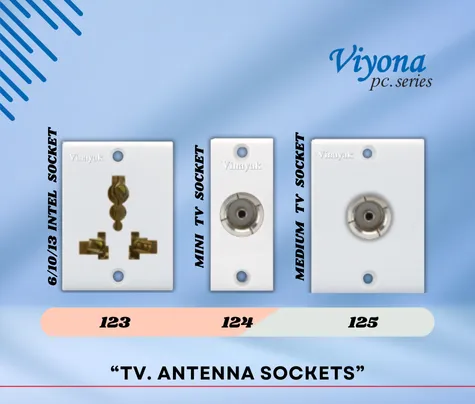
A set-top box needs one 6A socket and one TV antenna socket. KEMPS K201 is a TV socket at ₹102 MRP and VIZA V1252 a T.V. socket at ₹90; for a conventional board, VIYONA 124, a mini TV socket, is ₹44. The VIYONA TV antenna sockets page has photographs.
Plan the route of the DTH or cable lead from where it enters the flat to the TV board, in its own conduit. A coaxial lead stapled along the skirting is what an unplanned set-top box point usually looks like. Male and female sockets and the lead you need are explained in our RJ45 and TV socket guide.
Does a TV wall need a data point?
Yes, a TV wall is worth giving an RJ45 data point even in a home with Wi-Fi, because a smart TV, streaming box or console holds a steadier connection on a cable, and if the router itself sits at the TV unit, the data point is where the incoming fibre or broadband cable ends.
KEMPS K205 is a 2M RJ45 modem jack with shutter at ₹284 MRP; VIZA V1256, a 1M RJ45 one line jack, is ₹189. Both clip into the same plate as the sockets. The jacks, RJ45 versus RJ11 and the colour code, are covered in our RJ45 socket for switch board guide.
MRP of the TV wall modules we make
MRPs from our current catalogue, bars to scale with ₹1,150 as the full bar.
A router at the TV also needs its own socket and good ventilation; a closed cabinet traps heat.
Is an HDMI wall socket worth it?
An HDMI wall socket is worth it where an HDMI cable must run inside the wall, such as from a TV unit up to a wall-mounted screen or a projector, because each end then finishes in a neat plate; for a TV standing on its unit, a plain HDMI cable is simpler and cheaper.
KEMPS K206 is a T.V. HDMI socket at ₹1,150 MRP in white; the G.Grey K606 is ₹1,240. That is the priciest module on most TV walls, so fit it only where the cable must be concealed.
The catalogue does not state an HDMI version or the resolution the socket supports, so for a 4K or high refresh setup, ask your dealer for the specification of the code before ordering. An alternative is a wide empty conduit through which a good HDMI cable is pulled directly, which leaves room to change the cable as standards move on.
Which circuit should the TV wall be on?
The TV wall is commonly wired on the general socket circuit for the living room, or on a socket circuit of its own in a larger home, protected by an MCB in the distribution board and an RCCB as your electrician advises, with every socket earthed, since TVs and routers draw little power but stay plugged in all day.
A separate TV wall circuit has one practical benefit: a fault elsewhere in the hall does not cut the router. If the home has an inverter, the router and set-top box sockets are good candidates for backup; our inverter for home guide shows how backup circuits are split.
VIYONA 401 is a single pole 10 kA MCB, 6A to 32A, at ₹145 MRP. Earth leakage protection needs an RCCB, which we do not make. Ratings circuit by circuit are in which MCB for home.
Check the TV wall sockets have a working earth before the TV is mounted. Our guide to how to check earthing at home lists the safe checks.
Fixed sockets or a spike guard behind the TV?
Fixed wall sockets are the better choice behind a TV, because each device then has its own firm socket and nothing is daisy-chained, while a spike guard is the practical fallback for a finished wall with too few sockets, provided it is a single good unit plugged directly into the wall and never into another spike guard.
A fixed socket cannot be kicked loose or covered in dust behind the unit. A spike guard is fine for small electronics: our VIYONA Classic ABS spike guard 1×6 with a 1.5 m cord (297) is ₹495 MRP, and the 1×4 (291) ₹370.
What to avoid: spike guard into spike guard, heater on the TV guard and guard under a rug. Our multi plug vs extension board guide explains the difference between the options, and extension board burning what a hot one is telling you.
TV wall electrical mistakes to avoid
The most common TV wall electrical mistakes are too few sockets, a board placed where the unit blocks it, no conduit between a wall-mounted screen and the unit, signal cables in the same conduit as power, no data point, and a spike guard used as a permanent fix for all of these.
Each is cheap to avoid before plastering: too few sockets board behind closed panel no cable conduit signal in power conduit no RJ45 point chained spike guards.
For the rest of the room, see living room electrical points; for a TV in a bedroom, bedroom electrical points. The whole flat is planned in our house electrical layout plan.
If a socket behind the TV is warm, discoloured or smells of burning, unplug what you safely can, switch off at the MCB and call a licensed electrician.
FAQs
How many sockets are needed behind a TV?
Which socket is used for a set-top box?
How do you hide TV wires on the wall?
What is the price of an HDMI wall socket?
Should the TV and router be on a separate circuit?
Can I plug all TV devices into one spike guard?
Why buyers choose Vinayak Electricals
- Sockets, TV antenna sockets, RJ45 jacks and HDMI sockets that clip into one plate, made at our works in Marol, Andheri East, Mumbai.
- KEMPS K201 TV socket at ₹102 MRP and K205 shuttered RJ45 jack at ₹284.
- Conventional VIYONA TV sockets from ₹44 MRP for non-modular boards.
- VIYONA spike guards from ₹370 MRP for walls that are already finished.
- Sold through 500+ dealers with delivery across India; every MRP in our e-catalogue.
- Manufacturing in Mumbai since 1995; ISO 9001:2015 certified.
Plan the TV wall board
See KEMPS sockets, TV and data modules with their codes and MRPs, then order through a dealer or call us.
View KEMPS accessories