Is your glass switch board really glass? How to tell, and what it costs
A glass switch board gives a wall a deep, mirror-gloss face, but the plate may be real tempered glass, a glass-style moulding or acrylic, and each behaves differently. Real glass resists scratches; acrylic takes knocks better and weighs about half as much. Here is how they compare, how to tell them apart at a shop counter, and the price of a glass plate switch board at our catalogue MRPs, from ₹254 for a 1M CRISTAL plate.
Key takeaways
- Three materials — real tempered glass, glass-style moulded plates, and acrylic. All look alike on the wall.
- Scratches — glass (Mohs about 5.5) is harder than steel or brass; acrylic and polycarbonate scratch more easily.
- Knocks — acrylic has higher impact strength than glass; tempered glass is weakest at its edge.
- Price — our glass-look 1M plates run ₹254 to ₹361 MRP; a 4M board about ₹637 to ₹840.
- ⚠ Never — ammonia glass cleaner on a plate you are not sure is glass; it can craze acrylic.
Glass switch board: the short answer
A glass switch board is a modular switch board whose front plate has a deep, flat, mirror-gloss face. Some of those plates are a real sheet of tempered glass on a plastic frame. Others, including all of ours, are glass-style or acrylic: plastic plates finished to look like glass, with no glass sheet to break.
Both kinds look alike from across a room. They differ when a key scrapes the face, when a child swings a toy at the wall, and when you hold one in your hand at the shop counter.
We make three plates with this look at our works in Andheri East, Mumbai: KEMPS PEONY and VIZA GLASSO, which are glass-style, and VIZA CRISTAL, which is made of acrylic and polycarbonate. None of them is real glass, and we say so on this page so you can compare like with like.
Real glass, glass-style and acrylic: three materials, one look
Real glass: a tempered glass sheet, cut to shape and then heat-treated, fixed on a plastic carrier frame. Tempered glass is about 4× stronger than ordinary annealed glass, and if it does break it crumbles into small granular pieces rather than long shards.
Glass-style: a moulded plastic plate with a deep gloss face. Our KEMPS PEONY and VIZA GLASSO are in this group. No glass to crack, and the plate is light.
Acrylic: PMMA, the clear plastic sold as acrylic, is about half the weight of glass and has higher impact strength than glass, but it is softer and scratches more easily. Our VIZA CRISTAL plate is made of acrylic + polycarbonate; polycarbonate is the tough, impact-resistant plastic used in headlamp lenses.
How heavy each material is, g per cm³
Published densities from the encyclopedia entries for soda-lime glass and PMMA (sources listed by us). Bars to scale against 2.53. The same-size sheet of glass weighs roughly twice as much, which is the easiest test in the hand.
If a plate is sold as “glass”, ask which of the three it is and ask for it in writing on the bill or box. “Glass finish” and “glass” are not the same product.
| Point | Real tempered glass | Glass-style (PEONY, GLASSO) | Acrylic + polycarbonate (CRISTAL) |
|---|---|---|---|
| Face material | Glass sheet on a plastic frame | Moulded plastic, gloss face | Acrylic and polycarbonate |
| Weight in the hand | Heavier (glass about 2.5 g/cm3) | Light | Light (acrylic about 1.2 g/cm3) |
| Scratches | Harder than steel or brass | Can scratch with grit | Can scratch with grit |
| Knocks | Edge chips can crack it | No glass to break | Higher impact strength than glass |
| Ammonia glass cleaner | Tolerates it | Avoid | Avoid: can craze acrylic |
| 1M MRP from us | We do not make it | ₹335 to ₹361 (GLASSO), ₹350 (PEONY) | ₹254 |
| Plate warranty from us | Not applicable | 5 years | 5 years |
Which of our plates is glass-style and which is acrylic?
Three of our plate designs give the glass look. Here is what each one is, from our catalogue.
KEMPS PEONY, codes K381 to K389: glass-style. Our catalogue page for PEONY is written around “the power of glass”, but the plate itself is not glass. Colours: Pearl White Sky Blue Z Black Bronze Copper, one “all colour” MRP per size. See the PEONY plates.
VIZA GLASSO, codes V1181 to V1189: glass-style, priced in two lines, White and Silver. See the GLASSO plates.
VIZA CRISTAL, codes V471 to V479: listed as the “CRISTAL acrylic plate”, made of acrylic + polycarbonate, in nine colours from White and American Blue to Golden and Umber Brown. See the CRISTAL plates.
All three come from 1M upwards, are UV-protected so they do not turn yellow, and carry our 5-year plate warranty. Each fits the modules of all major modular switch systems, so you can put one over switches already in the wall. For a wider look at finishes, wood and metallic included, see modular plate finishes compared.
We do not make real glass plates, and we do not make touch switches. If a specification calls for a real glass front, ask us before ordering so nobody is surprised at site.
Real glass, glass-style or acrylic: ask for it in writing on the bill.
At about 5.5 on the Mohs scale, glass is harder than ordinary steel or the brass in most keys.
Acrylic has higher impact strength than glass; polycarbonate is tougher still.
Microfibre and mild soap; no ammonia glass cleaner on any glossy plate.
What is inside: a cut through each plate
Cut a switch board in half from the side. Behind both plates sit the same parts: the back box, the switch module and a base plate screwed to the box. Only the front changes.
Glass switch board cross-section: real glass plate vs glass-style plate
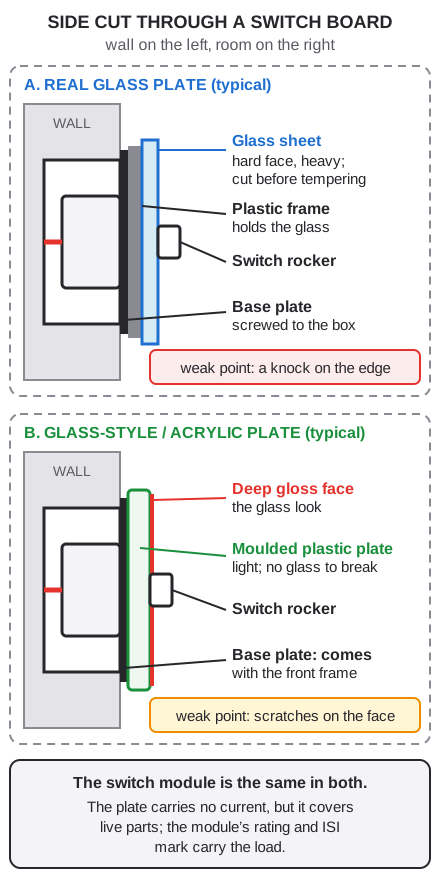
Drawn by us, simplified and not to scale. Panel A is a typical real glass plate; designs vary by maker. Panel B is the general build of a moulded glass-style or acrylic plate. Tap the diagram to open it full size.
In panel A, the glass sheet is the face and a plastic frame holds it. Glass is hard, so the face resists scratches, but its edge is the weak point. In panel B, a one-piece moulded plate carries the gloss face: nothing to shatter, but the surface is softer.
In both, the switch module carries the current. The plate carries none, but it covers the live parts, so it must be whole.
Always switch off at the MCB before you take a plate off. Behind it are live terminals. Our guide on removing a modular switch plate shows the safe way.
Scratches: where real glass wins
On the Mohs hardness scale, which ranks how easily one material scratches another, glass sits at about 5.5. Ordinary steel is about 4–4.5 and brass 3. In plain terms: a brass key or a steel coin is softer than glass, so dragged across a real glass plate it should not mark it.
Mohs hardness: what can scratch what
Values from the Mohs scale table (source listed by us). Bars to scale against 5.5. A harder material scratches a softer one; acrylic is not on this table, but it is softer and more easily scratched than glass.
Plastic faces are a different story. Acrylic is softer than glass, and polycarbonate has low scratch resistance despite its toughness. A glass-style plate stays glossy for years with soft-cloth cleaning, but grit, a ring or a set of keys can leave fine scratches that catch the light.
Where does that matter? On the board by the front door, where keys hang. On a shop or office board that strangers touch all day. On a kitchen board wiped with a gritty cloth.
Wipe a glossy plate with a clean microfibre cloth, never a kitchen sponge. Most scratches on gloss plates come from the grit in the cloth, not the cleaning itself.
Knocks and breakage: where plastic wins
Scratches favour glass. Knocks favour plastic. Tempered glass is strong across its face, but it is most likely to break from damage at its edge, and a chip made during fitting can lead to a crack later. Once tempered, it cannot be cut or drilled: a plate that does not suit the box cannot be trimmed at site.
When tempered glass fails, it breaks into small granular chunks: safer than shards, but it leaves an open board until a new plate arrives.
Plastic plates take the same knock differently. Acrylic has higher impact strength than glass, and polycarbonate is known for high impact resistance. A cricket ball, a toy car or a chair back may mark a glass-style plate, but it is unlikely to break it.
Which face to choose, by the risk on that wall (our guidance)
Our guidance from the material facts above, not a lab test. Bar length shows how strongly we lean towards the option named.
If any switch plate cracks, glass or plastic, switch that circuit off at the MCB and keep fingers away until the plate is replaced. A cracked plate can expose live parts.
How to tell real glass from glass-style at the shop counter
You are at an electrical shop, two black glossy plates on the counter, one quoted at twice the other. Five checks take a minute.
1. Weight. Pick up both. Glass is about twice as dense as acrylic, so the real glass plate feels noticeably heavier for its size.
2. The edge. Look along the edge of the face. Ordinary clear glass has a natural greenish tint from iron oxide, which shows most where you look through the thickness. Some plates use low-iron extra-clear glass with little green, so treat this as a hint, not proof; weight and the written material are surer.
3. Layers. A real glass plate is usually a glass sheet on a frame; you can see a seam. A glass-style plate is one moulded piece.
4. The box and bill. Look for the material in words. “Glass finish” or “glass look” is not glass. Ask for it on the bill.
5. The module behind it. Check the switches carry a genuine ISI mark with a licence number. Our guide on how to spot a fake ISI mark shows what to look for.
Do not do a scratch test on a shop sample. If the seller cannot tell you the material in writing, assume it is glass-style and judge the price on that basis.
Glass plate switch board price: our MRPs
A glass-look plate from us costs ₹254 to ₹361 MRP for a 1M plate, depending on the design and, for GLASSO, the colour line. For scale, our everyday VIZA CHERRY white 1M plate (V1151) is ₹65.
1M plate MRP, glass-look designs vs an everyday plate
Catalogue MRPs. Bars to scale against ₹361, rounded to 5%. Dealer prices may be lower than MRP; we sell in full boxes through dealers, not single pieces online.
Every size is tabled in our glass modular plates price guide.
We do not make real glass plates, so we quote no price for them. Compare any real glass quote with these figures only after you know the material, the module size, and whether the switches are included.
The plate size follows the back box in the wall, not the number of switches you want. Use our plate size calculator before you price a board.
What a full glass switch board costs: one worked example
Take a common 4-module board by a bed: two light switches and one 6A and 16A socket. The 16A side of that socket needs its own feed of 2.5 sq mm wire on a 16 A MCB; if the board is on a 1.5 sq mm lighting circuit, use a 6A socket (or have an electrician run a socket circuit) rather than a bigger MCB. Here it is priced at our catalogue MRPs.
PEONY board: two KEMPS K101 10AX one-way switches at ₹65 each, one K193 6A and 16AX universal socket (2M) at ₹205, and a PEONY 4M plate K384 at ₹505. Total ₹840.
GLASSO board: two VIZA V101 10A one-way PIANO switches at ₹56 each, one V270 6 and 16A universal socket (2M) at ₹130, and a GLASSO white 4M plate V1184 at ₹574. Total ₹816.
CRISTAL board: the same VIZA modules (₹242) with a CRISTAL 4M plate V474 at ₹395. Total ₹637.
For comparison, the same VIZA modules with a CHERRY white 4M plate V1154 at ₹98 come to ₹340. On a glass switch board, the plate is usually the biggest single cost. Our modular switch board price guide prices other layouts.
These are MRPs for one board. A whole flat multiplies them by every board, so many homes put glass-look plates on the living room and main bedroom and a plainer plate elsewhere.
Cleaning a glass switch board without damage
Real glass tolerates most household cleaners. Acrylic does not. Ammonia-based glass cleaner and most solvents can craze acrylic, leaving a web of fine cracks on the face. Unsure which yours is? Clean it as if it were acrylic.
Switch off at the MCB. Use a microfibre cloth, dry or barely damp with plain water or a drop of mild soap. Wipe, then buff dry. Never spray anything at the board: liquid runs behind the plate to live terminals.
Darker shades such as PEONY Z Black show thumbprints most under room light. Pearl White and Sky Blue hide them better on a busy board. Our switch plate cleaning guide covers every finish.
Never use acetone, thinners, scouring powder or an ammonia glass cleaner on a glossy plate unless you know it is real glass. On acrylic, the damage is permanent.
The plate is the look; the switch is the safety
A glass switch board is only as safe as the modules behind the plate. The plate carries no current, though it does cover the live parts. The switch, the socket and the wiring carry the load. A real glass front on an unmarked switch is still an unmarked switch.
Our switches are made under ISI licence IS 3854 CM/L-7567794, and our KEMPS PEONY switch range starts at the K101 10AX one-way switch, ₹65 MRP. We hold an IS 1293 licence for sockets. Choose the rating to the load: 6A or 10A for lights and fans, 16A for heavy plug-in loads such as an iron or a room heater, on a 2.5 sq mm circuit with a 16 A MCB; a geyser or AC belongs on its own circuit, sized by the electrician.
Any work on fixed wiring, even swapping a board, should be done by a licensed electrician with the circuit off at the MCB. Changing only the front plate is simple, but the switches behind it must stay tight in their terminals. For more on the switch material itself, see polycarbonate vs urea switches.
Spend on the plate for looks; never save on the modules behind it. A good module under a plain plate is safer than a cheap module under glass.
How to order a glass-look switch board from us
We sell through more than 500 dealers and distributors across India, with all-India delivery. We do not sell online, and we sell in full boxes: plates come 10 per box for most sizes.
Step 1: count the modules at each board and match the back box. Step 2: choose the plate: CRISTAL for the lowest MRP and impact resistance, PEONY or GLASSO for glass-style. Step 3: choose shades by how busy the board is. Step 4: ask a dealer, use the enquiry form, or visit our works in Andheri East.
Our full price list is in the e-catalogue. Test reports are available on request before you order, and returns are accepted within 15 days in the same condition.
Ordering for a whole flat or building? Fix one design and one colour per room type first. It keeps the box count simple and the replacement plates easy to match years later.
FAQs
Is a glass switch board made of real glass?
What is the price of a glass plate switch board?
Which is better, a glass or an acrylic switch plate?
How can I tell if my switch plate is real glass?
Can I put a glass-look plate on my existing modular switches?
Does Vinayak Electricals make real glass switch plates?
Why buyers choose Vinayak Electricals
- Three glass-look plate designs, PEONY, GLASSO and CRISTAL, from 1M upwards, labelled by material.
- UV-protected plates that do not turn yellow, with a 5-year warranty.
- Switches made under ISI licence IS 3854 CM/L-7567794, from the KEMPS K101 at ₹65 MRP.
- Making electrical accessories since 1995, today at our works in Andheri East, Mumbai; ISO 9001:2015 certified.
- MRPs published openly in our e-catalogue; test reports on request before an order.
- 500+ dealers and distributors and all-India delivery, in full boxes.
See the glass-look plates
Compare PEONY, GLASSO and CRISTAL in every colour, then order through a dealer or call us.
Vinayak Electricals is a modular switch manufacturer in Mumbai, supplying dealers, electricians and contractors across India by the box. Ask us for prices and stock.
View GLASSO plates WhatsApp for prices Download catalogue