Round or Square Panel Light? Choose by Your Ceiling
Key takeaways
- Same light: round and square panels of the same series and wattage give the same brightness and spread.
- Same price: every panel we list as round and square has one code and one MRP for both.
- Square suits straight coves, cabinets and grids; round suits curves, bathrooms and single fittings.
- Round cut-outs are easier: one hole saw pass, and the panel cannot sit crooked.
- Codes do not show the shape; write it on every order line.
Round vs square panel light: the short answer
Choose a round or square panel light by the shape of your ceiling, not by the light. At the same wattage and from the same series, a round panel and a square panel give practically the same brightness, the same colour and the same spread. What changes is how the fitting sits with the lines around it: the cove, the walls, the cabinets, the other fittings.
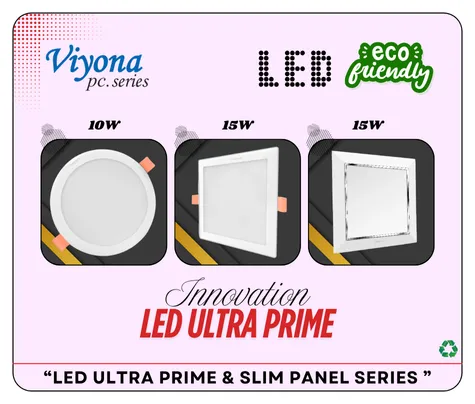
In our range the choice also costs nothing. Every VIYONA LED panel, surface light and down light we list as round and square carries one code and one MRP for both shapes, so a 15W panel is the same price whether it is a disc or a square.
So the real questions are design ones. Does the room have straight lines or curves? Will the panels sit in a row, a grid or a ring? How easy is it to cut a neat hole in your ceiling board? And will the shape match the fittings already in the flat? This page takes them one by one.
Does the shape change the light?
Not in any way you will notice. A panel’s light comes from its LEDs and its diffuser; the outline of the frame only decides where the glowing edge stops. A 15W round and a 15W square from the same series use the same driver band and give the same light on the floor.
There are two small practical differences. A square face has about a quarter more area than a round face of the same width (d² against 0.785 d²), but makers size each shape for its wattage, so this does not mean a brighter panel. And a square panel shows misalignment: if it is turned a few degrees, the eye catches it against the wall line. A round panel cannot be turned wrong.
Pick the wattage for the room first, then the shape for the ceiling. Doing it the other way round leads to the wrong panel in the right shape.
| Question | Round | Square |
|---|---|---|
| Light output | Same as square | Same as round |
| MRP in our range | Same code, same price | Same code, same price |
| Suits | Curves, bathrooms, single fittings | Coves, kitchens, rows and grids |
| Cut-out | Hole saw, quick | Marked and cut by hand |
| Alignment | Cannot sit crooked | Must be squared to the wall |
Our panels in both shapes: watts and price
These are the printed MRPs of our recessed panels that the catalogue lists as round and square. Each price applies to both shapes.
Recessed panel MRP, round or square
Printed MRPs from our current catalogue. Bars to scale; one price per code, round or square.
Every series is described on our LED panel light manufacturer page. The 15W slim panel (1025) is also ₹400, and our surface lights and down lights come in both shapes too. Sizes and cut-outs by wattage are covered in LED panel light size.
Quick to cut, forgiving, suits curves and single lights.
Lines up with coves, counters and grids.
One code and one price for both shapes.
The code does not show the shape; the order must.
Match the shape to the ceiling
Most Indian false ceilings are built around straight lines: a rectangular cove with a hidden strip, a step along a wall, a bulkhead over a wardrobe. Square panels set parallel to those lines look intended; round ones there can look dropped in.
Where the ceiling has a curve, such as a round dome over a dining table, an oval cove or a circular feature, round panels set in a ring echo the shape.
Square panels with a cove, round panels with a curve
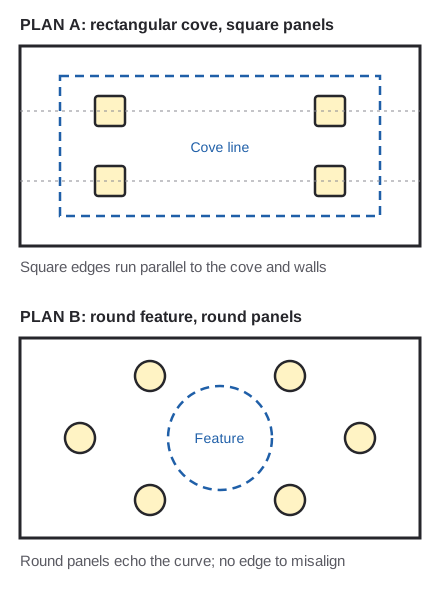
Drawn by us, not to scale. Square edges follow straight lines; round panels follow curves and cannot be misaligned.
If the ceiling is a plain flat board with no feature, either shape works; then match the other fittings in the flat.
Room by room: which shape
- Living room: square if the cove is rectangular; round around a round centre feature.
- Bedroom: either; square lines up with a wardrobe bulkhead.
- Kitchen: square, in a line along the counter and cabinets.
- Bathroom: round; a single small panel with no line to follow.
- Passage: round in a row reads as a dotted line; square in a row reads as a strip.
- Shop or office: square, lined up with shelves, counters and a grid.
In a flat with mixed rooms, many contractors use square in the living room and kitchen, where the ceiling has the most straight lines, and round in bathrooms and passages, where a single fitting has nothing to line up with. That works as long as each room stays with one shape.
For how many panels each room needs, see how many lights in a room.
Cutting the hole: round is easier
A round cut-out is made with a hole saw on a drill: one clean pass, the same size every time, and the panel can sit at any angle. That is why round panels are quicker for the ceiling contractor and more forgiving of a small error.
A square cut-out has to be marked, squared to the walls and cut by hand with a board knife or saw. Any twist in the marking shows as a panel that is not parallel with the wall, and a ragged corner can show past the rim.
Whatever the shape, take the cut-out size from the carton or measure the actual panel; a hole cut from memory or from a different series is the most common reason a panel will not sit right.
For square panels, mark every cut-out from one reference line, such as a wall or the cove edge, not from the previous hole. Errors add up along a row.
Spacing and layout: how each shape reads
Shape changes how a row or grid of panels reads from below. A row of square panels with equal gaps reads as a line, almost a broken strip light, which is why it suits a kitchen counter or a long passage. A row of round panels reads as a series of dots, softer and less formal.
In a grid of four or six panels, squares make a strong pattern that must line up in both directions; a grid that is off by a few centimetres is obvious. Rounds hide small errors better, because a circle has no edge pointing at its neighbour.
The spacing itself does not depend on the shape. As a rough guide, keep panels about evenly apart and the outer ones about half a gap from the walls, then adjust for furniture. A panel over a wardrobe door or the head of a bed is a mistake in either shape.
Before the ceiling is cut, mark the panel positions on the floor plan with the furniture drawn in. Moving a hole after the board is up means patching and repainting.
Grid ceilings and the 2x2 question
Offices, clinics and shops with a grid false ceiling of 600 by 600 mm tiles usually take a 2x2 panel, which is square because the tile is square and drops in where a tile would be. We do not list a 2x2 panel; our recessed panels run from 8W to 22W for cut-outs in a plain board.
So in a grid ceiling the shape question is really a question of fitting type. If you keep the grid, a 2x2 panel is the natural choice. If you are replacing the grid with a plain gypsum ceiling, any of our round or square panels can go in, with the layout set by the room rather than the tiles.
For a homeowner, the grid rarely comes up: Indian flats almost always have a plain gypsum or POP board. Our LED panel light size guide explains what 2x2 means in millimetres and how it compares with our wattages.
Mixing shapes in one flat
Shape consistency matters within a room more than across a flat. One room with a square panel next to a round down light looks careless; a square living room and round bathrooms do not.
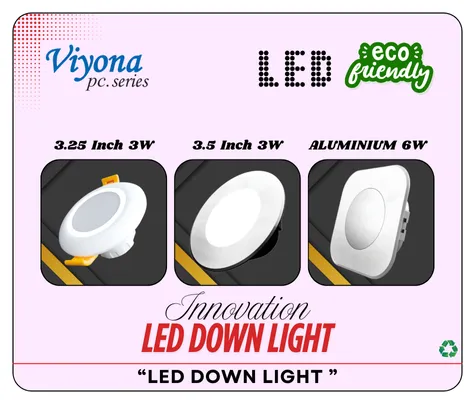
Our down lights come in round and square too: 3W ₹100 (1010), 5W ₹135 (1011) and the 6W aluminium body ₹160 (1012). So a room with panels for general light and down lights over a counter or a picture can keep one shape throughout. Our panel light vs downlight guide explains when to use each.
The same goes for 3 in 1 panels: our 15W super slim 3 in 1 (1035) comes in both shapes at ₹590, so a 3 in 1 in the living room can match plain panels elsewhere. See 3 in 1 panel light.
No false ceiling? Surface lights in both shapes
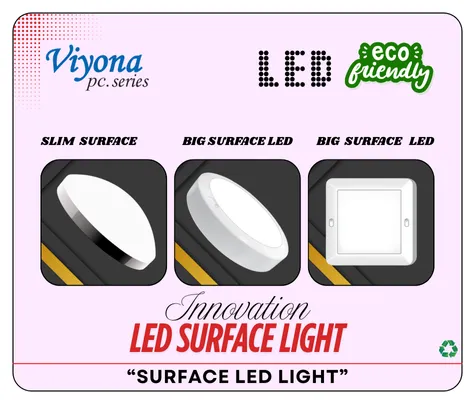
Without a false ceiling, the same choice applies to surface lights, which screw straight onto the slab. Ours come in round and square: the big surface light at 10W, 15W and 22W (₹360 to ₹700), the borderless at 15W and 20W (₹450 and ₹600), and the 6W concealed surface light at ₹160.
On a bare slab there is rarely a cove to follow, so the shape is chosen against the room and the other fittings. A square light on a ceiling with an exposed beam can line up with the beam edge; a round one suits a plain ceiling. Our surface panel light guide covers watts and fixing.
Ordering: write the shape on every line
Our codes do not change with the shape: 1033 is the 15W super slim panel, round or square. So an order that says “1033 × 20” does not say which shape you want, and a box of the wrong one is a wasted trip.
- Right: “1033 super slim 15W, square, 20 nos.”
- Wrong: “1033 × 20”
- Check: the carton before the ceiling contractor cuts.
Because the price is the same, nothing on the bill will flag the mistake. A bedroom with four 15W Ultra Prime panels (1022) costs ₹1,600 at MRP in either shape; a kitchen with three costs ₹1,200. Only the order line tells the shapes apart.
Where we supply
Every fitting on this page is made at our works in Marol, Andheri East, Mumbai, and sold through dealers across Maharashtra and in many other states. See where we supply in Maharashtra and how we supply the rest of India. Orders placed through our office are delivered all over India, in full boxes only.
From our catalogue: Ultra Prime and slim panels, LED down lights and surface LED lights.
For the whole range, see VIYONA LED lights and our LED light price list.
FAQs
Which is better, a round or square panel light?
Is a square panel light brighter than a round one?
Do round and square panel lights cost the same?
Which shape panel is best for a kitchen?
Can I mix round and square panel lights in one house?
Is a round cut-out easier than a square one?
Why buyers choose Vinayak Electricals
- Made in our own works at Marol, Andheri East, Mumbai, since 1995.
- ISO 9001:2015 certified; switches, MCBs, boxes and LED lights from one maker.
- Printed MRPs, code by code, in our current catalogue: no hidden list.
- Spare LED drivers and wall brackets listed alongside the fittings.
- Warranty of 5 to 10 years by product.
- Dealers and distributors across Maharashtra and in many states; delivery all over India for office orders.
Choosing panels for a whole flat?
Send the room list with shapes and wattages; we will quote in full boxes.
Contact us