Pooja Room Lighting Ideas That Are Warm, Calm and Safe
Pooja room lighting should be warm, calm and safe beside an open flame. Below we cover the best light for a pooja room, how to light the mandir, the puja room switch board, all-night lamps, foot lights, diya safety, wiring a wooden mandir and backup, with the MRPs of the small LED fittings we make in Mumbai.
Key takeaways
- Layers — room light, a small focused light on the idol and a soft background light, each on its own switch.
- Colour — warm white is commonly preferred; check the colour on the carton.
- Small and cool — 3W to 5W LED downlights in the mandir panel, from ₹100 MRP.
- All night — a 0.5W LED lamp (₹40) uses about 2 units a year at ten hours a night.
- Safety — switch board beside the door, never above the diya; no hot bulbs or taped joints in wood.
Pooja room lighting: the short answer
Pooja room lighting usually works best in layers: a soft general light for the room, a small focused light on the idol or picture, a gentle light behind or inside the mandir, and a low night light or foot light, all in a warm tone, on separate switches, with wiring kept well away from the diya and incense.
A pooja room or mandir corner is small, but its lighting does several jobs. It has to be bright enough for the morning and evening aarti, calm rather than glaring, flattering to brass and marble, and safe beside an open flame that may burn for hours. Many families also like a light that stays on all night.
This guide covers which light suits a pooja room, how to light the mandir itself, the puja room switch board, all-night lamps, foot lights, diya safety, wiring a wooden mandir unit and the circuit, with the MRPs of the small fittings we make at our works in Marol, Andheri East, Mumbai. We do not make electric diyas or LED strip lights, and we say so where it matters. Any wiring is a job for a licensed electrician, with the MCB switched off and the circuit tested dead first.
Which light is best for a pooja room?
A warm white light is commonly preferred for a pooja room, because its yellowish tone resembles lamplight, flatters brass, gold and marble, and feels calm, while a cool white light suits reading the scriptures better than the mood of the room, so many homes use warm light overall and a brighter switch for reading.
Think in three layers: a general light for the room, a focused light on the idol and a soft background light in or behind the mandir. Keep each on its own switch, so the room can be calm for prayer and brighter for cleaning.
Our catalogue lists most of our LED fittings by wattage without a colour temperature, so check the colour on the carton or ask the dealer before buying for a mandir. Warm versus cool light in each room of the house is compared in our warm white vs cool white guide.
A bright cool white tube over the mandir is the most common pooja room complaint we hear. One warm, small light on the idol usually looks better than a big one on the ceiling.
| Light or point | Where | Why | Our example (MRP) |
|---|---|---|---|
| Focused light on idol | Mandir top panel | Lights the idol softly | LED down light 3W (1010), ₹100 |
| Background light | Behind or inside the unit | Adds depth | VIZA V414 2M dome LED, ₹272 |
| All-night light | Holder or switch board | Low cost, low heat | VIYONA 1061 0.5W, ₹40 |
| Foot light | Threshold or step | Light for early puja | VIZA V412 4M, ₹380 |
| Socket | Room switch board | Electric diya, speaker | KEMPS K192, ₹110 |
| Switch board | Beside the door | Away from the flame | KEMPS K304 4M plate, ₹160 |
How should a mandir be lit?
A mandir is commonly lit with one or two small downlights or a spot in the mandir’s top panel aimed at the idol, a soft light behind or inside the unit for depth, and the room’s general light switched separately, using low-wattage LED fittings that stay cool beside flowers, cloth and wood.
MRP of small fittings for a mandir or pooja corner
MRPs from our current catalogue and LED price list, bars to scale with ₹380 as the full bar.
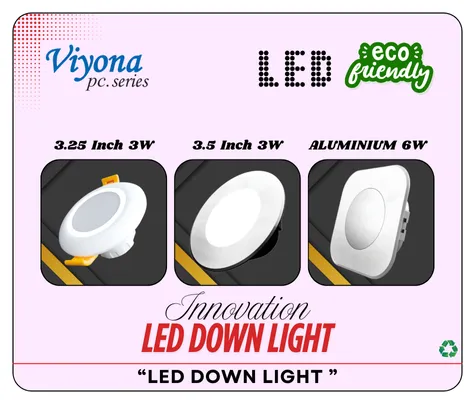
Our 3W LED down light (1010, 3.25 inch) is ₹100 MRP and the 5W (1011, 3.5 inch) ₹135, small enough for a mandir’s top panel. A downlight needs a cut-out in the panel, so tell the carpenter before the unit is made. Sizes are compared in our downlight size guide.
Room light, idol light and soft background light.
3W to 5W LED downlights beside wood and flowers.
A 0.5W lamp uses about 2 units a year.
No diya below a board, a fitting or a cord.
What should a puja room switch board carry?
A puja room switch board commonly carries a switch for the room light, a switch for the mandir or idol light, a switch for the night or background light, and one 6A socket for an electric diya, a small speaker or a bell, which fits a 4M or 6M plate beside the door.
From KEMPS, the K101 10AX 1 way switch is ₹65 MRP, the K192 6A 3 pin socket with shutter ₹110, and a 4M white plate (K304) ₹160. If you want a light that is visibly on, an indicator helps: KEMPS K217, a 6A red indicator, is ₹95.
A night light can sit in the board itself: KEMPS K216, a 2-module night lamp with 3 LEDs, is ₹280 MRP, and VIZA V406, an LED Dura night lamp (2M), is ₹275. Count these modules before choosing the plate; our plate size calculator does the sum. Board colour is a matter of taste covered in switch board colour for every room.
Can a light in the mandir stay on all night?
Yes, a low-wattage LED light can stay on in the mandir all night at very little cost and with very little heat: a 0.5W LED night lamp left on ten hours a night uses under two units of electricity a year, while an old 15W zero watt bulb uses around fifty-five units over the same hours.
Units a year for an all-night mandir light, 10 hours a night
Arithmetic from rated watts: W × 10 h × 365 ÷ 1,000, rounded; not a measurement. The zero watt figure is a typical draw for that kind of bulb.
Our VIYONA 1061, a 0.5W LED night lamp, is ₹40 MRP. Many families use a small LED lamp as a continuous light beside the real diya, which is lit only during puja. We do not make electric diyas; if you buy one, check it carries the maker’s details and a rating. Our night lamp guide works out the costs in rupees.
Where do foot lights help in a pooja room?
Foot lights help at the pooja room threshold, on a step up to a raised mandir platform and along a passage to the pooja room, because they light the floor for early-morning or late-evening puja without switching on the main light and waking the house, and their low, soft glow suits the room’s mood.
We make several 4-module foot lights: VIZA V412, a foot light listed as every colour premium, at ₹380 MRP; V411, the 4 module Royal foot light, at ₹485; and V1314, a 4-module premium foot light, at ₹460. Ask the dealer which colours each is available in.
A foot light sits in a box low on the wall, so it must be on the drawing before plastering. Our foot light guide covers placement on stairs and passages, and the VIZA Royal 4-module foot lights page shows the range.
How do you keep diyas and agarbatti safe near wiring?
Keep diyas, camphor and agarbatti well away from switch boards, sockets, cables and light fittings, never directly below a board or a fitting, and never on a wooden shelf that has wiring inside it, because heat and soot rise, and an oil lamp tipped over near a socket or a loose cord can start a fire.
The simple rules: no flame below a board, no cord near the diya, metal or stone under the lamp and board beside the door, not inside the mandir. Smoke also yellows plates over the years; our how to clean switch plates guide covers safe cleaning with the power off.
Flowers, cloth and paper decorations around the mandir dry out and catch quickly. Keep them clear of both the flame and any light fitting, and never leave a real diya burning unattended. Our electrical safety tips at home cover the rest of the house.
If a switch board near the mandir is scorched or smells of burning, switch off at the MCB, stop using it and call a licensed electrician.
How is a wooden mandir unit wired?
A wooden mandir unit is commonly wired by bringing a cable in conduit from a junction box on the wall to the fittings in the unit, with every joint inside a proper box rather than taped inside the wood, LED fittings only because they stay cool, and the switch outside the unit on the room’s board.
Three points to agree with the carpenter and electrician: the cable entry into the unit, the cut-out size for each downlight and an access panel so a fitting can be changed later. Avoid halogen or filament bulbs inside wood; they run hot.
A taped joint hidden behind a mandir panel is the kind of fault nobody finds until it overheats. Junction and concealed boxes are compared in our junction box vs concealed box guide.
Never run a plug-in light lead through the back of a wooden mandir into a socket behind it. Have the fitting wired properly with a joint in a box.
Should the pooja room light be on the inverter?
Yes, it is worth asking for the pooja room light on the inverter backup circuit when the house is wired, because evening aarti often falls at the time of day when power cuts are common, and the mandir light is a small LED load that adds almost nothing to the inverter’s burden.
The pooja room lights normally sit on the lighting circuit with nearby rooms. Asking for them on the backup circuit costs nothing extra at wiring time; our inverter for home guide shows how those circuits are split.
The circuit is protected by an MCB in the distribution board; VIYONA 401, a single pole 10 kA MCB from 6A to 32A, is ₹145 MRP. An RCCB adds earth leakage protection; we do not make RCCBs, so fit one where your electrician advises.
Pooja room lighting mistakes to avoid
The most common pooja room lighting mistakes are a bright cool white tube over the idol, one switch for every light, a switch board inside the mandir where the diya burns, hot filament bulbs inside a wooden unit, taped joints behind panels, and no low light for early-morning puja.
Each is simple to avoid on the drawing: cool white glare one switch for all board inside the mandir hot bulbs in wood taped joints plan a low light.
For the rooms around it, see living room electrical points and bedroom electrical points. Small LED fittings for the mandir are on our LED down light page.
FAQs
Which colour light is best for a mandir?
Which light is used inside a mandir?
Can I keep a light on in the pooja room all night?
Where should the pooja room switch board be?
Do you make electric diyas?
Is it safe to put lights inside a wooden mandir?
Why buyers choose Vinayak Electricals
- Small LED downlights, night lamps, dome lights and foot lights for a mandir, from our Mumbai works.
- 3W LED down light at ₹100 MRP and the 0.5W LED night lamp at ₹40.
- VIZA 4-module foot lights from ₹380 MRP for the pooja room threshold.
- Switch board night lamp modules in KEMPS and VIZA, from ₹275 MRP.
- We say plainly what we do not make, including electric diyas and LED strips.
- Manufacturing in Mumbai since 1995; ISO 9001:2015 certified; 500+ dealers across India.
Light the mandir softly
See our LED down lights, night lamps and foot lights with codes and MRPs, then order through a dealer or call us.
View LED down lights