Key takeaways
- Old tube — 36 W (T8) or 40 W (T12) on the tube, about 44–48 W at the meter with a copper choke.
- LED tube — 20 W replaces a 4 ft fluorescent; common sizes 6, 12, 20 and 40 W.
- Units — at 5 h a day, an old tube with choke uses 7.2 units a month, a 20 W LED 3.0.
- Room — about 2 W of LED tube per m² gives roughly 100 lux, on stated assumptions.
- Ours — 1051 6 W ₹160, 1058 12 W ₹180, 1059 20 W ₹200, 1060 40 W ₹600 (MRP).
On this page 12 sections + FAQs
Tube light watts: the short answer
A normal 4 ft fluorescent tube light is printed 36 W or 40 W, but with its copper choke the whole fitting draws about 44–48 W from the mains. An LED tube light used in its place is commonly 20 W, and our own LED tube fittings run from 6 W to 40 W. So when someone asks “tube light kitne watt ki hoti hai”, the honest answer is: 40 W on the old glass tube, nearer 48 W at the meter, and 20 W for the LED that does the same job.
We make LED tube fittings at our Marol works in Mumbai, so we also list ours with codes and MRPs. If you are deciding which tube suits which room, or T5 versus T8, our guide to the best tube light for home covers that; this page is about the watts.
Tube light watts list: old fluorescent and LED
Here is the list most people are looking for. The wattage printed on an old fluorescent tube is the tube alone; the choke adds more on top. An LED tube fitting has no choke; its printed wattage is what we use for the sums below.
Old fluorescent tubes: the thick T12 4 ft tube is 40 W and its 2 ft version 20 W. The slimmer T8 that followed is 36 W at 4 ft and 18 W at 2 ft. The thinner T5 fluorescent tubes are 14 W and 28 W, at slightly odd lengths of about 563 mm and 1,163 mm.
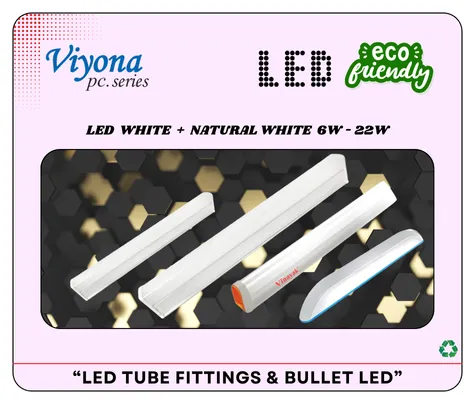
LED tube lights: common fitting sizes include 6 W, 12 W, 20 W and 40 W. Our own range is 1051, 6 W, 1058, T5 12 W, 1059, T5 20 W and 1060, T8 40 W. The catalogue does not print the lengths of our fittings, so the table below shows a dash there; ask us for them.
What the meter sees: one 4 ft tube light, watts from the mains
Old-tube figures: EMSD Hong Kong gives 48 W for a 36 W T8 on a conventional ballast; a Delhi discom’s (Tata Power-DDL) FAQ on the UJALA scheme counts a 36 W tube plus an 8 W ballast. Bars to scale against 48 W. LED figures are the rated watts of our 1059 and 1058 fittings.
Rule of thumb: a 20 W LED tube fitting is the usual swap for a 4 ft fluorescent tube that, with its choke, drew 44–48 W.
| Type | Length | Rated watts | Watts at the meter | Units a month |
|---|---|---|---|---|
| Old T12 fluorescent | 4 ft | 40 W | Around 50 W with a copper choke | About 7.5 |
| Old T8 fluorescent | 4 ft | 36 W | 44 to 48 W with a copper choke | 6.6 to 7.2 |
| Old T8 fluorescent | 2 ft | 18 W | About 30 W with a copper choke | About 4.5 |
| LED tube fitting (our 1060, T8) | — | 40 W | 40 W (printed rating) | 6.0 |
| LED tube fitting (our 1059, T5) | — | 20 W | 20 W (printed rating) | 3.0 |
| LED tube fitting (our 1058, T5) | — | 12 W | 12 W (printed rating) | 1.8 |
| LED tube fitting (our 1051) | — | 6 W | 6 W (printed rating) | 0.9 |
Where the watts go: choke, starter and driver
An old tube light is three parts in one batten: the glass tube, a copper choke (the ballast) and a small starter. The starter blinks the tube on; the choke limits the current once it is lit. That copper coil is never perfectly efficient, so part of what you pay for turns into heat in the batten and the familiar hum.
How much? Hong Kong’s energy department lists a 36 W T8 tube at about 48 W with a conventional ballast and 36 W with an electronic one, so the copper choke adds roughly 12 W. A Delhi discom’s (Tata Power-DDL) FAQ on the UJALA scheme counts it a little lower, a 36 W tube plus an 8 W ballast. Either way, the choke adds about a quarter to a third on top of the tube.
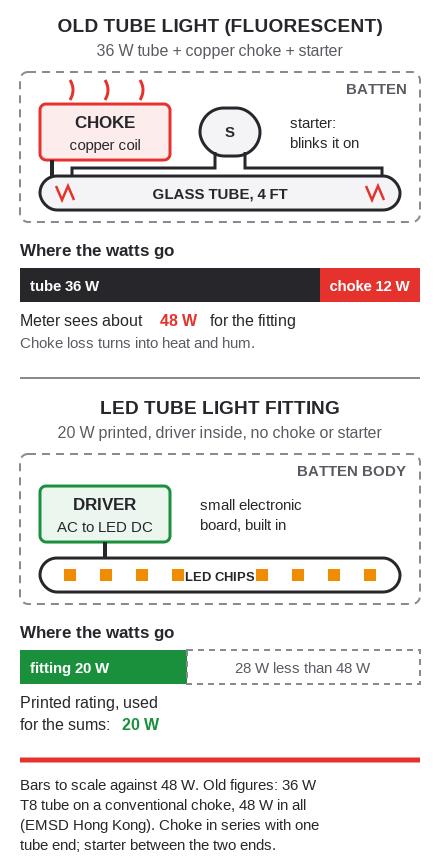
Simplified side-by-side. In the old fitting the choke is in series with one end of the tube and the starter is wired across both ends. Old-fitting figures from EMSD Hong Kong; the LED figure is the printed 20 W rating, as on our 1059.
An LED tube fitting replaces all three with a small driver inside the body, which turns 230 V AC into the low DC the LED chips need. There is no starter and no separate choke to add. Our page on the LED driver explains what that board does and why it is the part that usually fails first.
Tube with a choke? Count the choke. A “40 W” old tube light is not a 40 W load on your bill.
An old 36 W tube with a copper choke draws about 44–48 W from the mains.
A 20 W LED tube fitting is the usual replacement for a 4 ft fluorescent tube.
A 20 W tube on 5 hours a day for 30 days uses 3.0 units.
Lumens × 0.5 ÷ floor area in m² gives a rough average lux for a small room.
Normal tube light watt: why 40 W is not 40 W
When people say “normal tubelight” they usually mean the white 4 ft fluorescent tube in a batten with a choke, the kind still hanging in many older flats, shops and society staircases. Its tube says 40 W (thick T12) or 36 W (T8). The bill sees more, because the choke is in series with it, all the time it is on.
Picture a 1BHK in Kurla with three old tube lights: one in the hall, one in the kitchen and one in the bedroom. On paper that is 3 × 36 W = 108 W. At the meter, with copper chokes at EMSD’s figure, it is 3 × 48 W = 144 W. The extra 36 W lights nothing.
EMSD lists an 18 W T8 tube at 30 W with a conventional ballast against 20 W with an electronic one, so the choke adds two-thirds again on the small size. A thicker 40 W T12 tube on a copper choke draws a little more, around 50 W in all.
An old tube that flickers, blackens at the ends or takes several blinks to start is usually a starter or tube near the end of its life. The choke keeps drawing its share either way.
LED tube light watts: the common sizes and ours
LED tube lights are sold mostly as complete fittings, a slim batten with the LEDs, driver and diffuser built in, rather than as a bare tube. The wattage tells you the draw; it does not on its own tell you the brightness, which is in lumens on the carton (our lumens vs watts guide explains the difference).
Our four LED tube fittings, from the printed catalogue:
- 1051 LED tube fitting 6 W, MRP ₹160
- 1058 T5 LED tube fitting (PVC) 12 W, MRP ₹180
- 1059 T5 LED tube fitting (PVC) 20 W, MRP ₹200
- 1060 T8 LED tube fitting (PVC) 40 W, MRP ₹600
The catalogue lists them in the same section as our bullet LEDs, 1054, 9 W MRP ₹320, 1055, 12 W MRP ₹360, 1056, 15 W MRP ₹510 and 1057, 22 W MRP ₹560. They are sold in full boxes. For the full LED range with prices, see our LED light price list.
A 20 W LED tube fitting is the usual swap for a 4 ft fluorescent tube and its choke; our 20 W fitting is 1059 (MRP ₹200). Ask us for its length.
Units per month: the sums, worked out
One unit on your bill is one kilowatt-hour. The sum is always the same: units = watts × hours × days ÷ 1,000. Our guide on how to calculate an electricity bill walks through slabs and fixed charges; here we only need the units.
At 5 hours a day for 30 days:
- Old 36 W tube + choke at 48 W: 48 × 5 × 30 ÷ 1,000 = 7.2 units
- Same tube, choke counted at 8 W (44 W): 6.6 units
- LED 40 W fitting: 6.0 units
- LED 20 W fitting: 20 × 5 × 30 ÷ 1,000 = 3.0 units
- LED 12 W fitting: 1.8 units
- LED 6 W fitting: 0.9 units
Units a month, one tube light on 5 hours a day for 30 days
Units = W × hours × days ÷ 1,000. Bars to scale against 7.2 units, rounded to the nearest 5%. Your hours will differ: a kitchen tube may run 6–8 hours, a bedroom tube 3.
Per hour, a 20 W tube uses 0.02 units and a 40 W tube 0.04 units. Small numbers per hour; they add up over a year of evenings.
Rupees per month: what the extra watts cost
Tariffs differ by utility and slab, so take the rate off your own bill. For a worked example we use ₹8 per unit; that is our example rate, not any utility’s tariff.
At 5 hours a day for 30 days, an old 4 ft tube drawing 48 W uses 7.2 units and costs ₹57.60. A 20 W LED fitting uses 3.0 units and costs ₹24.00. The 28 W gap is 4.2 units, or ₹33.60 a month per tube; with the choke counted at 8 W, it is 3.6 units, or ₹28.80. At that rate our 1059 (MRP ₹200) covers its MRP in about 6–7 months (200 ÷ 33.60 = 5.95; 200 ÷ 28.80 = 6.94). These are estimates from the stated hours and rate, not a promise of any bill.
Every watt you cut saves 0.15 units a month at 5 hours a day (1 × 5 × 30 ÷ 1,000). Longer hours scale it up: a shop tube on 12 hours saves 2.4 times as much.
How many watts of tube light does a room need?
Watts tell you the bill; the room needs light, measured in lux (lumens landing on each square metre). So the sum runs backwards: decide the lux, work out the lumens, then the watts.
lux = lumens × utilisation ÷ floor area in m². The utilisation factor is the share of light that actually reaches the floor or table after walls, ceiling and the fitting take their cut. For a small room with light walls we assume 0.5; dark walls or a high ceiling lower it.
For lumens per watt, read the carton. Our catalogue does not print lumens for the tube fittings, so for the examples below we assume an LED tube giving 100 lumens per watt, so 20 W ≈ 2,000 lumens. If your carton says less, scale up.
What to aim for? India’s lighting standard, IS 3646 (Part 1), has no table for homes. Its nearest entries: hotel bedrooms 30–50–100 lux with local light at the bed head, corridors and stairs 50–100–150 lux, dining rooms 150–200–300 lux, and commercial food preparation and cooking 300–500–750 lux. Our guide to how many lights a room needs covers placing them.
With those assumptions, about 2 W of LED tube per square metre (roughly 1 W per 5 sq ft) gives about 100 lux. It is a starting point, not a design.
Worked examples: bedroom, hall, kitchen, passage
Same assumptions throughout: 100 lumens per watt, utilisation 0.5, 1 sq ft = 0.0929 m².
Bedroom, 10 × 12 ft = 120 sq ft = 11.15 m². One 20 W tube: 2,000 × 0.5 ÷ 11.15 = about 90 lux, inside IS 3646’s 30–100 lux band for hotel bedrooms. Add a reading lamp at the bed.
Hall, 12 × 15 ft = 180 sq ft = 16.72 m². Two 20 W tubes (or one 40 W): 4,000 × 0.5 ÷ 16.72 = about 120 lux. To reach the 150 lux low end of the dining-room band, you need about 5,000 lumens: a 40 W plus a 12 W gives 5,200 lumens and about 155 lux.
Kitchen, 8 × 10 ft = 80 sq ft = 7.43 m². One 20 W tube gives about 135 lux averaged over the floor; two give about 269 lux. Both are below the 300 lux low end IS 3646 gives for commercial food preparation and cooking, the nearest entry it has to a kitchen. For a working kitchen, plan two 20 W tubes plus light over the counter, or one 40 W and one 20 W: 6,000 lumens × 0.5 ÷ 7.43 = about 404 lux, inside the 300–750 band. Fix the tubes over the counter, not behind you, so the light lands where you cut.
Passage, 3 × 10 ft = 30 sq ft = 2.79 m². One 6 W fitting (600 lumens): about 108 lux, inside the 50–150 band for corridors.
Average lux in the worked examples
Our arithmetic, assuming 100 lm/W and a utilisation factor of 0.5. Bars to scale against 404 lux, rounded to the nearest 5%. The kitchen bars are judged against IS 3646’s 300 lux low end for cooking areas. Real results depend on wall colour, ceiling height and where the tube is fixed.
Why an LED tube draws less for the same light
Two reasons. First, there is no choke, so the 8–12 W lost in copper on an old fitting simply is not there. Second, an LED tube gives the light a room needs from fewer watts, which is why a 20 W LED fitting is the standard swap for a 36 W tube.
That swap is not our invention. India’s government-backed UJALA scheme sold a 20 W LED tube light in place of a fluorescent tube counted at 36 W + 8 W ballast. A Delhi discom’s (Tata Power-DDL) FAQ on the scheme puts the power saving at about 55%: (44 − 20) ÷ 44.
Same watts does not mean same light between brands. Compare lumens on the carton, not watts, when two tubes are side by side in a shop.
Changing an old tube fitting: what goes, what stays
The choke, starter and old holders all come out, and a complete LED batten connects straight to the switched phase and neutral at the light point. Switch off at the MCB and use a licensed electrician; whether the swap is worth it for your flat is covered in LED bulb vs tube light.
Old fluorescent tubes contain a little mercury: keep them whole and hand them in as e-waste, not in the household bin.
Never leave an old choke wired in behind a new LED fitting. A complete LED batten wants mains straight to its own driver.
Buying LED tube fittings from us
We have made electrical accessories in Mumbai for 30+ years, and our works at Marol is our only site. Our LED tube fittings, 1051, 1058, 1059 and 1060, are on the LED tube fittings and bullet LED page, and more detail on the range is in our LED tube light manufacturer guide.
Anyone can buy, homeowners included, in full boxes: send us an enquiry or visit the Mumbai office, or buy through one of our 500+ dealers across India. Returns are accepted within 15 days in the same condition, and the office confirms the warranty for any code before you order.
Electricians and contractors: if you are replacing a whole society’s staircase tubes, ask for the codes and box quantities in one enquiry so the order ships together.
FAQs
Tubelight kitne watt ki hoti hai?
A normal 4 ft fluorescent tubelight is 36 W or 40 W on the tube, and about 44–48 W in all with its copper choke; an LED tubelight that replaces it is usually 20 W. Smaller LED tubes come in 6 W and 12 W, larger ones in 40 W.
How many watts is a normal tube light?
A normal tube light, the 4 ft fluorescent kind, is rated 36 W (T8) or 40 W (T12), but the copper choke adds roughly 8–12 W, so the fitting draws about 44–48 W.
A 40 watt tube light is equal to how many watts of LED?
About 20 W of LED tube does the job of a 4 ft fluorescent tube; the government’s UJALA scheme used a 20 W LED tube to replace a 36 W tube plus its ballast. Check lumens on the carton to compare brightness.
How many watts is a 2 ft tube light?
An old 2 ft fluorescent tube is 18 W (T8) or 20 W (T12) on the tube, and an 18 W T8 draws about 30 W with a copper choke. An LED fitting in its place draws less; read the watts on the carton. Our smaller fittings are 1051 (6 W) and 1058 (12 W); the catalogue does not print their lengths, so ask us.
How much watt tube light is required for a room?
For a typical 10 × 12 ft bedroom one 20 W LED tube is enough for general light, about 90 lux on our assumptions of 100 lumens per watt and a utilisation factor of 0.5; a 12 × 15 ft hall needs about 40–52 W in total. See how many lights in a room.
Does an LED tube light need a choke?
No. A complete LED tube fitting has a small driver built in and needs no choke or starter; if you fit one in place of an old batten, the old choke should come out of the circuit.
Why buyers choose Vinayak Electricals
- Making electrical accessories in Mumbai for 30+ years, at our works in Marol, Andheri East.
- ISO 9001:2015 certified (certificate RAPL E2024049408).
- LED tube fittings from 6 W to 40 W with printed MRPs: 1051, 1058, 1059 and 1060.
- 500+ dealers and distributors across India, with all-India delivery.
- Anyone can buy direct in full boxes: send us an enquiry or visit the Mumbai office.
- Test reports on request before an order, and the office confirms the warranty for any code.
Published 26 Nov 2026
Who designed it & wrote this
@Team of:
Gaurang Parmar
Fractional C-Suite Executive
STRATEGIC SOLUTIONS