Spike Guard or Surge Protector? What Is Inside the Box
Spike guard vs surge protector: in Indian shops the two names are used for the same socket strip, but they are not the same thing inside. A real surge protector carries MOVs that divert a brief voltage spike and prints a joule rating and clamping voltage to prove it; a plain extension board, whatever its label, just carries power to more sockets. Below we show what is inside each, what the numbers mean, what no strip can stop, and when an extension board is all you need.
Key takeaways
- Same name, different insides — “spike guard” is a shop name; only a strip with MOVs and a printed rating is a surge protector.
- Read the box — look for a joule rating, a clamping voltage and a surge current figure. No figure, no surge claim.
- Limits — a strip clips brief spikes; it does not fix low or high voltage, power cuts, overload or a lightning strike.
- Wear — MOVs wear out with each spike, often silently; prefer a protection indicator and a thermal cut-off, plus a fuse or breaker for overload.
- ⚠ Never — heaters, irons, geysers or ACs on any strip, or one strip plugged into another.
Spike guard vs surge protector: the short answer
A spike guard and a surge protector are often the same thing sold under two names. In India, “spike guard” is the everyday word for a socket strip on a cord, and many have no surge protection part. A true surge protector contains components, usually metal oxide varistors (MOVs), that divert a brief voltage spike away from what is plugged in, and it says how much it can take as a printed rating.
So the answer to “spike guard vs surge protector” is: do not go by the name on the box. Go by what is printed on it. A strip with a joule rating and a clamping voltage is a surge protector. A strip with only sockets, a switch and a cord is an extension board, whatever it is called.
We make VIYONA spike guards, flex boxes and multi plugs at our works in Marol, Andheri East. Below: what is inside each type, what the numbers mean, and when a plain extension board is enough.
What is inside a plain extension board?
A plain extension board is three conductors and some sockets. The live, neutral and earth wires run from the plug, down the cord, to brass contacts behind each socket. Many add a switch and an indicator lamp. That is all.
Nothing in it sits across the lines to soak up a spike. An extension board gives you reach and more outlets. It does not give you protection, and it does not add capacity: everything still draws through one wall socket.
For a table lamp or a phone charger, reach is all you want; our multi plug vs extension board guide covers that choice.
A switch, an indicator lamp or a fuse on a strip is not surge protection. None of them acts on a spike lasting millionths of a second.
| Question | Plain extension board | Surge protector strip | SPD in the distribution board |
|---|---|---|---|
| What it does | Carries power to more sockets | Diverts brief spikes at the point of use | Diverts surges before they reach the circuits |
| Key parts | Wire, contacts, often a switch | MOVs, often a fuse or breaker and an indicator | Surge module rated for the supply |
| Printed surge rating | None | Joules and clamping voltage | Discharge current and protection level |
| Sustained high or low voltage | No | No | No |
| Power cut | No | No | No |
| Direct lightning strike | No | No | Part of a lightning protection plan, not the whole of it |
| Wears out | Contacts and cord, slowly | MOVs, with each spike | Ask the maker how to check it |
| Who fits it | You plug it in | You plug it in | A licensed electrician |
What a surge protector adds: the MOV
A surge protector adds parts that sit across the lines, between live and neutral and often to earth. The usual part is a metal oxide varistor (MOV). New Mexico State University’s safety office calls the MOV “the heart of surge suppressors”: its job is to divert surge current.
Inside a plain extension board vs inside a surge protector
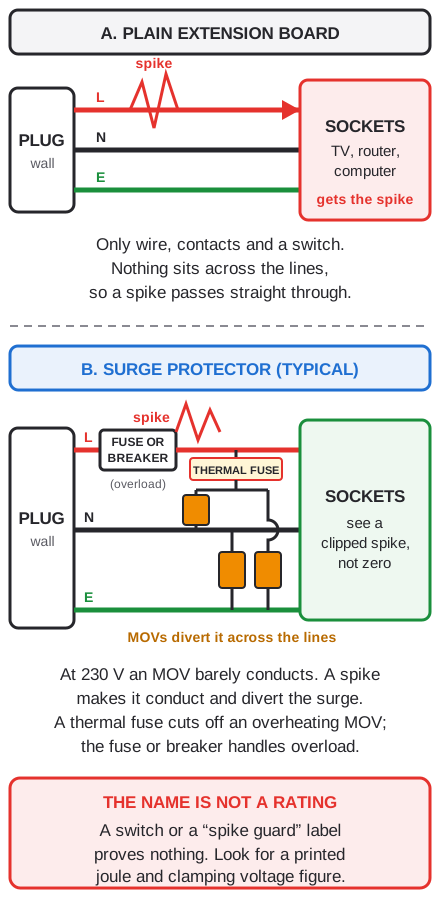
Drawn by us, simplified, showing a typical design and not any one product. Real strips vary in how many MOVs and thermal fuses they carry. Tap the diagram to open it full size.
At normal mains voltage an MOV has a very high resistance and barely conducts. When a spike drives the voltage well above normal, its resistance drops quickly and it carries the surge current away from the sockets. Your equipment still sees a clipped spike, up to about the clamping voltage, not none at all.
Surge parts are described by mode: line to neutral, line to earth and neutral to earth. A strip whose design diverts to earth needs a sound earth at the wall socket to do that part of its job; our guide on how to check earthing shows the safe checks.
An extension board passes a spike on; a surge protector diverts most of it. Only a printed rating tells you which you hold.
Reach and more outlets. No surge parts inside.
MOVs divert brief spikes; a printed joule and clamping figure proves it.
Each spike uses some up. An indicator lamp tells you when they have gone.
Unplug sensitive equipment before a storm arrives, not during it.
Joules, clamping voltage and the other numbers on the box
Two numbers describe a surge protector: the joule rating, which is how much energy it can absorb before it fails, and the clamping voltage, roughly the peak voltage the strip lets through to your equipment during a standard test surge. A higher joule figure is more capacity. A lower clamping voltage is better protection.
Joule ratings: what one university safety guide calls a minimum and better
From New Mexico State University’s safety guidance. Bars show the lower end of each band against 600 J; a strip with no printed rating cannot be placed on the scale at all. Joule figures from different makers are not always tested the same way.
The same NMSU guide quotes the US UL 1449 clamping levels of 330 V, 400 V and 500 V. Those are for the US 120 V supply, not our 230 V, but the idea holds: the lower clamping voltage lets less through.
In India the standard for surge protective devices on low voltage systems is IS 16463 (Part 11), which BIS adopted identical to IEC 61643-11:2011. Ask what a product claiming surge protection was tested to.
Compare clamping voltage before joules. A big joule number with a high clamping voltage still lets a large spike through to your equipment.
Why “spike guard” on the box is not a rating
In Indian shops the words spike guard, spike buster and surge protector are used loosely. NMSU’s guide makes the same point about the US market: many listed power strips “have no surge protection components at all” and are listed only as extension cords. A name or a safety mark on the strip does not tell you it diverts spikes.
Turn the box over at the shop counter and look for three things printed as figures: a joule rating, a clamping voltage (sometimes called let-through voltage or voltage protection level), and a maximum surge current in kA. If none of them is there, assume the strip is an extension board with a good name.
Ask the dealer for the datasheet. The same rule applies to our own boxes in our e-catalogue, as we explain below.
Do not buy surge protection on the word “spike”, a lightning-bolt logo or a red switch. If there is no printed surge figure, there is no surge claim you can hold anyone to.
What no plug-in spike guard can stop
A surge protector handles brief spikes, lasting millionths of a second. It does not handle anything that lasts longer.
Sustained high or low voltage: an MOV clamps peaks, it does not regulate. Worse, a long overvoltage, such as a broken neutral that pushes a 230 V socket far above normal, can overheat the MOVs themselves; that is when a thermal cut-off earns its place. For supply that sags or rises for minutes, see our voltage stabiliser guide. Power cuts: a strip does nothing when the supply goes off; a desktop PC that must not lose work needs a UPS, explained in UPS vs inverter. Overload: a strip carries no more than the wall socket behind it.
Lightning is the big one. The US National Weather Service says plainly that “typical surge protectors will not protect equipment from a lightning strike”. If you want to unplug sensitive equipment, do it before the storm arrives, not during it, when touching cords is itself a risk.
During a thunderstorm, do not reach behind the TV to pull plugs. Unplug when you hear the forecast or see the clouds build, and leave cords alone once lightning starts.
MOVs wear out, quietly
Every spike an MOV diverts uses up some of its life. NMSU’s safety office puts it bluntly: MOVs wear out with use, there is no forewarning or visual indication, and a failing MOV can reach very high temperatures and start a fire.
Worse, most carry on working as a plain power strip after the MOVs have gone. Nothing tells you the protection has gone, so the next spike reaches the equipment.
Two features help. A protection indicator that shows whether the surge parts still work; check the manual for what the lamp means. And a thermal cut-off next to the MOVs, so a failing MOV is disconnected before it overheats, plus a fuse or breaker for overload. A line fuse alone will not open for the small current a failing MOV draws.
Replace a strip that has taken a big hit. If any strip gets hot, smells of plastic or shows brown marks, unplug it and read our guide on an extension board burning.
Write the purchase month on the underside of a surge protector with a marker. After a storm season or a known surge, you will know how old it is.
Surge protection at the distribution board: Type 1, 2 and 3
A plug-in surge protector is the last layer, not the only one. Surge protective devices (SPDs) are grouped by where they are installed. A Type 1 device sits at the service entrance and takes high-energy external surges. A Type 2 device is fitted in the main or sub distribution board. A Type 3 device sits close to sensitive equipment; a good plug-in surge strip belongs here.
They are meant to work as a layered chain. A Type 2 SPD in the DB takes the bulk first and leaves the strip a smaller job.
A DB-mounted SPD is fixed wiring work. It needs the right rating, its own protective device and a short, sound earth connection, so it is a job for a licensed electrician, with the main switched off at the main MCB first. We do not make SPDs, so we name no ratings here.
For a home office or a shop with a billing PC, ask your electrician about a Type 2 SPD in the DB plus a rated strip at the desk. Two layers beat one big number on one box.
When a plain extension board is enough
An extension board is enough for loads a spike is unlikely to hurt: a table lamp, a pedestal fan, a phone charger, a decorative light string for a festival.
Pay for printed surge protection where the equipment is expensive, holds data, or is connected to more than one cable that a surge can arrive on: a desktop PC and monitor, a smart TV with a set-top box, a Wi-Fi router and modem, a billing counter in a shop. See home office electrical points and TV wall electrical points for where those sockets belong.
Never use any strip, protected or not, for a geyser, room heater, induction cooktop or AC; they need a fixed 16 A or 20 A point of their own (see 6A vs 16A socket). Plug an iron straight into a wall socket too: heating loads run for long stretches and are what overheat strip contacts. For a fridge or washing machine, read can we use an extension board for a fridge first.
Heaters and irons do not need surge protection; they need a proper wall socket.
Our VIYONA spike guards: what the catalogue says
We make three VIYONA spike guard lines, all with ABS bodies, in 1.5 m, 3 m and 5 m cords: Classic ABS socket spike guard (codes 291–299, in 1×4, 4×4 and 1×6 layouts), Classic with two USB (301–306) and Royal ABS spike guard (311–316), which the catalogue marks 6 A. They pack 10 to a box and sell in full boxes through our dealers.
VIYONA spike guard MRPs, 1×4 layout, by cord length
Catalogue MRPs, bars roughly to scale against ₹780. The Royal 6 A strips 311, 313 and 315 carry the same MRPs as Classic 291, 293 and 295.
Our catalogue lists these by layout, cord length and MRP. It does not print a joule rating or clamping voltage for them, so we make no surge rating claim on this page. If you need rated surge protection ask us or your dealer for the specification and a test report before you order. Sizes, layouts and prices for each line are on our VIYONA spike guard prices and sizes page and the VIYONA spike guard range.
Want reach rather than outlets? Our VIYONA flex boxes wind a 4 m or 8 m cord onto the body, from MRP ₹285 for the V2 271.
Using any spike guard safely
A spike guard draws everything through one wall socket. A 6 A socket at 230 V is about 1,380 W in total, shared by every outlet on the strip.
Do not daisy-chain: never plug one strip into another, or into a multi plug or flex box. Plug straight into a wall socket that has a working earth and fits the plug firmly; a loose socket heats, as our loose socket guide explains.
Keep strips off wet floors and away from the kitchen sink, the bathroom and an open balcony in the monsoon.
If a strip sparks, buzzes or feels warm at the plug, switch off at the wall and unplug it by the plug body. Do not keep using it to “see if it settles”.
Spike guard or surge protector: a buying checklist
1. What is it for? Lamp, charger, fan: an extension board will do. PC, TV, router, billing: look for a printed surge rating. 2. Is a surge figure printed? Joules, clamping voltage, surge current. No figure, no claim. 3. Is there a protection indicator? It tells you when the MOVs have gone. 4. Thermal cut-off and fuse? The first disconnects a failing MOV; the second handles overload.
5. Socket rating and count: match it to the plugs you use and remember the wall socket’s limit. 6. Cord length: buy the shortest that reaches, so there is no coil to heat. 7. USB: useful at a bedside or desk. 8. Paperwork: an MRP, the maker’s name and address, and a warranty you can use.
Our extension board brand guide covers what to compare between makers, and our contact page reaches the works if you need a quantity or a datasheet.
Of two identical-looking strips, the one with a printed joule figure, clamping voltage and indicator is the surge protector.
FAQs
What is the difference between a spike guard and a surge protector?
Spike guard aur extension board me kya fark hai?
How many joules should a surge protector have?
Does a spike guard protect against lightning?
Do VIYONA spike guards have a surge rating?
Can I run a geyser, heater or AC on a spike guard?
Why buyers choose Vinayak Electricals
- VIYONA spike guards in 1×4, 4×4 and 1×6 layouts with 1.5, 3 and 5 m cords, from MRP ₹370 (291).
- Classic spike guards with two USB ports, codes 301 to 306, from MRP ₹650.
- VIYONA flex boxes, multi plugs and plug tops for the rest of the portable range.
- Making electrical accessories since 1995, today at our works in Marol, Andheri East, Mumbai; ISO 9001:2015 certified.
- Test reports on request before you order; MRPs published openly in our catalogue.
- All-India delivery through 500+ dealers and distributors, in full boxes.
VIYONA spike guards and flex boxes
See the full VIYONA spike guard range, then order through a dealer or ask us for the specification.
Vinayak Electricals is a spike guard and extension board manufacturer in Mumbai, supplying dealers, electricians and contractors across India by the box. Ask us for prices and stock.
View VIYONA spike guards WhatsApp for prices Download catalogue