15 Watt LED Bulb: Kitchens, Big Bedrooms and Price
Key takeaways
- A 15W LED gives about 1,350 to 1,500 lumens (typical; check the carton), a little less than a 100W bulb.
- In a kitchen, fit it over the front edge of the platform, not in the centre of the ceiling.
- One 15W lights an 8 × 10 ft kitchen to about 75 to 95 lux and a 12 × 12 ft bedroom to about 45 to 55 lux.
- On 8 hours a day it uses 3.6 units a month, against 24 for a 100W bulb.
- Ours is code 1067 at ₹212; the 18W (1068, ₹268) is the closer 100W match.
Where the 15W LED bulb belongs
A 15 watt LED bulb is the lamp for rooms where you work rather than rest: the kitchen above all, then the larger bedroom, the utility area where clothes are ironed, and the small shop counter. At the efficiency typical of household LED lamps it gives roughly 1,350 to 1,500 lumens, close to an old 100W filament bulb but a little short of it.
Ours is the VIYONA LED lamp 15W, code 1067, at ₹212 MRP, with a B22 cap and ten to a box. This page is mostly about kitchens, because that is where a 15W is bought most and fitted wrong most: a bright lamp in the middle of the ceiling still leaves the worktop in your own shadow. We also cover the light it puts into a 12 × 12 ft bedroom, the running cost on a kitchen’s hours, and when the 18W is the better choice.
If you are lighting a bedroom of 10 × 12 ft or less, a 12W is usually enough and costs less; our 12W guide covers that room.
Brightness: close to a 100W bulb
At 90 to 100 lm/W, a 15W lamp gives roughly 1,350–1,500 lm. An old 100W filament bulb gave about 1,600 lumens, so the 15W is a near match, not an exact one. If the old lamp was a 100W and the room felt just right with it, the 18W (1068) at about 1,620 to 1,800 lumens is the closer swap.
Our catalogue lists the 1067 by watts and MRP and does not print lumens, so the carton is the place to check. The lumens vs watts guide has the full old-bulb-to-LED table; this page sticks to what the 15W does in real rooms.
Lumens class of our lamps around 15W
Typical figures at 90 to 100 lumens per watt, not measurements of our lamps; bars use the middle of each range.
| Room | Size | Light from one 15W | Verdict |
|---|---|---|---|
| Kitchen | 8 × 10 ft | About 75 to 95 lux | Good, placed over platform |
| Bedroom | 12 × 12 ft | About 45 to 55 lux | Fair main light |
| Living room | 12 × 16 ft | About 30 to 40 lux | Dim; add a second light |
| Utility | 6 × 8 ft | About 130 to 160 lux | Bright; a 9W may do |
Where to put a 15W in a kitchen
In most Indian kitchens the cooking platform runs along one or two walls and the ceiling point sits in the middle of the room. Stand at the platform and that centre lamp is behind you: your head and shoulders throw a shadow exactly where you are chopping. A brighter lamp only makes the shadow sharper.
The fix is position, not watts. Put the lamp over the platform edge, about a foot out from the wall cabinets, so the light falls on the worktop in front of you. In an L-shaped kitchen, one lamp near the corner of the L covers both arms.
Where the wall cabinets are deep and the worktop under them stays dark even with the lamp moved, add a short tube fitting under the cabinets. Our 6W tube fitting (1051) at ₹160 is the smallest of our tube fittings and suits that strip of worktop the ceiling lamp cannot reach; check its length against the cabinet before buying. Wire it to its own switch on the kitchen board so it can be used alone for a late-night glass of water.
Kitchen, side view: centre lamp vs lamp over the platform
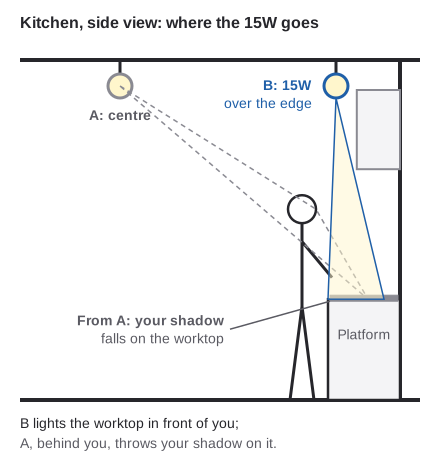
Drawn by us, not to scale. Moving the point over the platform edge is a small wiring change at construction or renovation time.
Keep any lamp at least 2 ft clear of the gas hob, and never directly above it, where rising heat and grease will shorten its life.
Over the platform edge, not the centre of the ceiling.
About 1,350 to 1,500 lumens; the 18W is the closer match.
A month at 8 hours a day, against 24 for a 100W bulb.
Our 1067 lamp, B22 cap, ten to a box.
How much light in a kitchen and a big bedroom
Taking roughly 40 to 50% of a lamp’s lumens as reaching the floor (a utilisation of about 0.4 to 0.5, often less in a small room), one 15W of about 1,425 lumens gives:
- 8 × 10 ft kitchen: 7.4 m², about 75 to 95 lux overall
- 12 × 12 ft bedroom: 13.4 m², about 45 to 55 lux
- 12 × 16 ft living room: 17.8 m², about 30 to 40 lux
A kitchen worktop wants more than the room average, and a lamp placed over the platform delivers more at the worktop than the sum suggests. For a living room, one 15W is a soft light at best; pair it with a tube fitting on a wall or a second lamp. Our how many lights in a room guide works the method in full.
The bigger bedroom and the living room
Outside the kitchen, the 15W earns its place in rooms just too big for a 12W. A master bedroom of 12 × 12 ft or 12 × 14 ft is the common case in newer flats: a 12W there gives a dim 30 to 45 lux; a 15W lifts it to roughly 35 to 55 lux, a soft evening light that works well with a bedside lamp for reading.
Living rooms are different. A hall of 12 × 16 ft or larger needs more light than any single household lamp gives from one point, and it is used for longer, with guests, television and reading. The usual pattern is a 20W tube fitting on the long wall for the general light, plus one 15W lamp in a ceiling holder or pendant over the seating. Our LED tube light range lists the fittings, and our LED bulb vs tube light guide shows how the two spread light differently.
If the living room has a false ceiling, recessed panels or downlights usually replace the lamp altogether; our panel light vs downlight guide covers that choice.
Units per month on a kitchen’s hours
A kitchen light is on early in the morning and again from evening to dinner, often longer than any bedroom light. For 30 days:
One 15W LED lamp: units per month
Calculated as watts × hours × 30 ÷ 1,000. Bars to scale.
On 8 hours a day the 15W uses 3.6 units a month against 24 units for a 100W bulb on the same hours, a saving of more than 20 units a month from one lamp. Our electricity bill guide converts units to rupees on your tariff.
15W, 18W or two 9W lamps?
Three ways to get roughly the same light into a kitchen, at printed MRP:
- One 15W (1067): ₹212: about 1,425 lm from one point, 15W.
- One 18W (1068): ₹268: about 1,710 lm from one point, 18W.
- Two 9W (1065): ₹140: about 1,700 lm from two points, 18W.
Two 9W lamps are cheapest and spread light best, one over each arm of an L-shaped platform, but they need two holders. With one point over the platform, fit the 15W; if the kitchen is large or has dark tiles, the 18W. The difference between 15W and 18W on 8 hours a day is under one unit a month, so choose on light, not on running cost.
Dark granite, dark cabinets and dark tiles absorb light. A kitchen finished in dark colours may need the 18W where a pale kitchen of the same size is happy with the 15W.
Heat, shades and holders
A 15W lamp has a larger globe than the 9W and makes more heat in its neck, where the driver sits. Two things shorten its life:
- A closed glass shade with no air around the lamp, especially in a hot kitchen.
- A tired holder: a loose terminal or a burnt cap contact heats the lamp from the base.
An open batten holder on the ceiling, or a ventilated fitting, is the right home for it. Before buying, check the globe size on the carton against any decorative shade. Our LED bulb fuses quickly guide covers the other causes of early failure, and our batten holder guide lists replacement holders.
Price and code: 1067
Our 15W LED lamp is code 1067 at ₹212 MRP, ten to a box: ₹2,120 a box at MRP. It is printed with IS 16102 (Part 1) and registration R-71026514 like our other lamps from 3W to 30W.
A flat usually needs one or two 15W lamps, for the kitchen and perhaps a living room holder, alongside 9W lamps for the small rooms and 12W lamps for bedrooms. The whole range is on our LED bulb range page; the 9 watt and 12 watt guides cover the smaller rooms, and our LED light price list has every LED code.
A kitchen that already has a tube fitting on the wall may only need the 15W for the platform corner. Count what is already there before buying.
Mistakes people make at 15W
- Centre of the kitchen ceiling: bright room, shadowed worktop. Move the point over the platform.
- Directly over the hob: heat and grease; keep it to one side.
- Expecting a full 100W match: the 15W is a little dimmer; the 18W is closer.
- Cool white over the table: cool light suits the worktop, warm light the table; see warm white vs cool white.
- Right over the sink: keep the fitting out of splash range.
Plan the kitchen sockets at the same time as the lights; our switch board wiring diagram shows how a kitchen board is connected.
Where we supply
Everything on this page is made at our works in Marol, Andheri East and sold through dealers and distributors across Maharashtra and in many other states. See where we supply in Maharashtra and how we supply other states in India. Orders placed through our office are delivered all over India, in full boxes only. Shops that sell our switch boards can add the 1067 to the same order. For a quotation, or the name of a dealer near you, contact our office.
FAQs
How many lumens is a 15 watt LED bulb?
Is a 15W LED equal to a 100W bulb?
Which LED bulb is best for a kitchen?
How many units does a 15W LED bulb use?
What is the price of your 15W LED bulb?
Can a 15W LED bulb go in a closed shade?
Why buyers choose Vinayak Electricals
- Made in our own works at Marol, Andheri East, Mumbai, since 1995.
- ISO 9001:2015 certified company; every code and MRP printed in our catalogue.
- Switches, sockets, MCBs, boxes, regulators and LED lights: 2,000+ products from one maker.
- Warranty of 5 to 10 years by product.
- Sold in full boxes through dealers and distributors across Maharashtra and in many states.
- Delivery all over India for orders placed through our office.
Planning a kitchen or a flat?
Send us the room list; we will suggest lamps and quote in full boxes.
Contact us