
Key takeaways
- Types — 1 way, 2 way, bell push, indicator, DP switch, fan regulator and dimmer; most boards use three or four.
- Ratings — 6–10 A for lights and fans; 16 A sockets on 2.5 sq mm wire and a 16 A MCB for AC, geyser and washing machine.
- Build — modular for new flats and changeable plates; conventional for repairs and tight budgets.
- Check — the rating printed on the switch, the ISI mark and CM/L number on the exact product, spare modules, warranty in writing.
- ⚠ Never — a 16 A socket on a 20 A MCB, or a geyser on a 10 A switch.
On this page 12 sections + FAQs
Switches for home: the short answer
Switches for home come in two build types and about seven jobs. The build is either modular, where each switch is a small unit that clips into a frame behind a cover plate, or conventional, where the switch sits on its own fixed plate. The jobs are the 1 way switch, the 2 way switch, the bell push, the indicator switch, the DP switch for heavy appliances, the fan regulator and the dimmer.
Most of a home runs on 10 A switches for lights and fans. Sockets for an AC, a geyser or a washing machine need a 16 A socket, wired in 2.5 sq mm on a 16 A MCB, usually with a DP switch in front. Get that one pairing right and the rest of the choice is looks and budget.
We make switches at our works in Marol, Andheri East, Mumbai: KEMPS and VIZA modular, and VIYONA conventional. Below we go through each type, the rating each point in a home needs, a room-by-room list, and a bedroom priced line by line from our printed MRPs. If you want to compare brands rather than switches, our list of the top 10 switch brands in India covers that.
The switch types a home actually uses
A typical Indian flat uses seven kinds of switch, and most boards need only three or four of them.
1 way turns one light or fan on and off from one place. It is most of the switches in any home. 2 way controls one light from two places, such as the bedroom door and the bed, or the top and bottom of a staircase; our 1 way vs 2 way switch guide shows the difference. Bell push only makes contact while you press it, for the door bell. Indicator switches have a small lamp that glows when the point is on, which is useful for a geyser or a pump you cannot see.
DP switch cuts both the live and the neutral together, and is the usual choice in front of a geyser or AC socket. Fan regulator sets fan speed. Dimmer sets light level, but only for lamps marked dimmable.
What each switch type costs, VIZA (MRP)
Current catalogue MRPs, bars to scale against ₹360 and rounded to 5% steps. V225 is 2 modules wide; the rest are 1 module.
A plain 1 way switch is the cheapest line on any board. The money goes on regulators, DP switches and the cover plate.
| Room | Switches | Sockets | Also |
|---|---|---|---|
| Bedroom | 3 to 4 one way, 1 two way pair (door and bed) | 1 to 2 of 6 A; 16 A for an AC | 1 fan regulator |
| Living room | 4 to 6 one way | 2 to 3 of 6 A at the TV wall; 16 A for an AC | Regulator per fan; dimmer for dimmable lamps |
| Kitchen | 1 one way per socket, plus lights | 3 to 5 of 16 A | Exhaust fan switch |
| Bathroom | 1 one way for light, 1 for exhaust | None near the shower | 32 A DP with indicator for the geyser, outside the door; RCCB upstream |
| Entrance | 1 to 2 one way | Optional 6 A | Bell push outside |
| Balcony | 1 one way | Optional 6 A, away from rain | RCCB upstream |
Which rating at which point in your home
Match the switch to what it controls, and match the wire and the MCB behind it to each other. That is the whole rule.
Lights and fans: a 6 A or 10 A switch, on 1.5 sq mm wire and a 6–10 A MCB. An LED tube or a ceiling fan draws well under one amp, so a 10 A switch has plenty in hand.
Heavy plug-in loads: an AC, a geyser, a washing machine, a microwave or an iron goes on a 16 A socket, wired in 2.5 sq mm on a 16 A MCB. A 32 A DP switch in front is common, so both wires are cut when you switch off. Our 6A vs 16A socket chart lists which appliance takes which plug.
Bigger fixed loads that need a 20 or 25 A circuit get 4 sq mm wire, sized by the electrician with an outlet rated for it. See wire size for AC and geyser.
Never put a 16 A socket on a 20 A MCB, and never run a 16 A point on 1.5 sq mm wire. The MCB is there to protect the wire. It carries its rated current indefinitely and trips only on a sustained overload above it or on a short circuit, so an oversized MCB lets the wire overheat first.
Bathrooms, balconies and outdoor points also need a 30 mA RCCB upstream; RCCB vs MCB explains why both are needed.
A 6 or 10 A switch on 1.5 sq mm wire covers every light and fan point.
AC, geyser and washing machine: 16 A socket, 2.5 sq mm wire, 16 A MCB.
Check the ISI mark and CM/L number on the exact switch you buy, not just the box.
Two-place switching needs an extra wire run before plastering.
What 10AX and 20A printed on a switch mean
The number printed on a switch is the current it is rated to switch. The letters after it say what kind of load the rating covers.
A plain A rating, such as 20 A, covers ordinary loads. An AX rating, such as 10AX, means the switch is also tested at that current on fluorescent lamp loads, which draw a surge at switch-on. For a large LED load, check the switch maker’s LED rating rather than reading the AX figure as an LED rating. Our KEMPS switches are marked this way: the Orchid K141 is a 10AX 1 way at MRP ₹65.
On VIZA and VIYONA you will see plain ratings such as 6 A, 10 A, 16 A, 20 A or 32 A instead. In a home, read the number first and treat it as the ceiling. A 10 A switch is fine for any light or fan circuit; it is not fine in front of a geyser.
If a switch has no rating printed on it at all, do not fit it. The rating and the maker should be readable on the body of the switch itself, not only on the box. If you are buying an ISI-marked switch, check the mark and CM/L number on that exact product.
Modular or conventional switches for home?
Modular switches are the norm in new flats; conventional switches still make sense for repairs, surface wiring and tight budgets.
With modular switches each unit is 1 or 2 modules wide and clips into a frame. You can swap one switch, add a USB charger in a spare slot, or change the cover plate later without touching the wiring. Our modular ranges are KEMPS and VIZA.
With conventional switches the switches and sockets sit on a fixed plate or board. They cost less per point. Our VIYONA range is conventional: the 101 6 A 1 way switch is MRP ₹22, the 102 2 way MRP ₹36, the 103 bell push MRP ₹30, and the 16 A 151 1 way switch MRP ₹74.
The build type does not decide safety. The contact, the rating and the licence do. Our modular vs normal switch guide compares the two in detail, and the VIYONA switches and sockets price list shows the conventional range.
Mixing is fine. Many homes put modular boards in living rooms and bedrooms and keep conventional fittings in a store room or a terrace shed.
A typical home board, module by module
A bedroom door board shows how the types and ratings fit together. Here is a 6-module board and the separate AC board beside it.
A typical bedroom board and what each module feeds
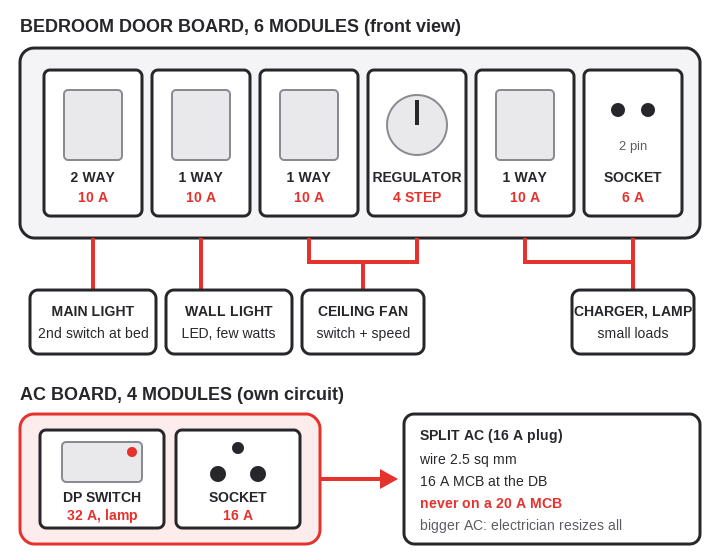
Drawn by us, simplified: wiring behind the plate is not shown. The 2 way switch has a partner at the bedside. Tap the diagram to open it full size.
Read it left to right. A 2 way switch for the main light, with its pair at the bed. Two 1 way switches, one for a wall light and one for the fan. A 4-step regulator for fan speed. A 1 way switch and a 6 A socket for a phone charger or a lamp.
The AC gets its own board on its own circuit: a 32 A DP switch with an indicator lamp, and a 16 A socket, fed in 2.5 sq mm from a 16 A MCB. Keeping it separate means the bedroom lights stay on if the AC circuit trips. For how the modules connect behind the plate, see our switch board wiring diagram.
Decide on 2 way switching before the walls are plastered. It needs an extra wire run between the two points.
Room by room: what each board needs
Each room needs a different mix, and the rating question is mostly settled by whether the room has a heavy appliance.
Bedroom: 1 way switches for lights and fan, a 2 way for the main light, a regulator, one or two 6 A sockets, and a 16 A point if there is an AC. See bedroom electrical points.
Living room: more 1 way switches for scene lighting, a dimmer if your lamps are dimmable, a regulator per fan, and 6 A sockets at the TV wall. See living room electrical points.
Kitchen: mostly 16 A sockets for the fridge, microwave, mixer and RO, each with its own switch. See kitchen electrical points.
Bathroom: a 32 A DP switch with indicator for the geyser, fixed outside by the door, clear of the shower, with the circuit behind a 30 mA RCCB. See bathroom electrical points and which geyser switch.
Entrance: a bell push outside and a master light switch inside.
Count the points room by room on paper before the electrician starts. The room-by-room table near the top of this guide gives the usual mix; adding a point later means chasing a wall.
Modern switches for home: colours and finishes
“Modern” in a switch mostly means the plate and the rocker, not the mechanism behind them.
Most homes still choose white: it is the cheapest plate and matches any wall. A VIZA Cherry 6M white plate (V1155) is MRP ₹140, and a Slim 6M white (V1165) MRP ₹150. For colour and texture, the Aqua Cherry 6M metallic (V1175) is MRP ₹231. For a glass look, the Glasso 6M white (V1185) is MRP ₹748. No plate we make is real glass: Glasso and KEMPS Peony are glass-style.
For dark walls, VIZA switches come in silver grey and matt black, with matt black plates to match. KEMPS switches come in white and grey.
Our plates are UV-protected, do not turn yellow, carry a 5-year warranty and fit all major modular switch systems, so you can change the look later and keep the switches. For layouts and photos, see switch board design ideas; to size a plate, use the plate size calculator.
Gloss and glass-style plates show fingerprints at a busy board, such as the one by the main door. A matt or textured finish hides them better.
A bedroom priced from our MRPs
At our printed MRPs, the switches, sockets and plates for one bedroom with an AC come to ₹1,674 in VIZA with Cherry white plates, before boxes, wire, MCBs and labour.
One bedroom, three boards, VIZA with Cherry white plates (MRP)
Current catalogue MRPs, bars to scale against ₹825. Modules and plate only; back boxes, wire, MCBs and labour are extra. Dealers may sell below MRP.
Door board, 6M: V542 2 way ₹79 + 2 × V541 1 way ₹112 + V278 regulator ₹360 + V541 for the socket ₹56 + V262 6 A socket ₹78 + V1155 plate ₹140 = ₹825.
AC board, 4M: V225 32 A DP switch ₹295 + V263 16 A socket ₹160 + V1154 4M plate ₹98 = ₹553.
Bedside board, 3M: V542 2 way ₹79 + V541 ₹56 + V262 ₹78 + V1153 3M plate ₹83 = ₹296.
The regulator is the dearest module on the door board. For whole-board prices from 1M to 12M, see our modular switch board price list.
What to check when you buy switches
Five quick checks at the shop counter; our how to choose a switch board guide has the full checklist.
ISI mark: look for IS 3854 and a CM/L number on the exact product, not only the box. Our catalogue prints “ISI MARK” against the VIYONA 151 and 152; our ISI-marked switches are made under licence CM/L-7567794, and the office confirms which codes carry it. See spotting a fake ISI mark.
Rating printed on the body, matching the point.
Spare modules: the same range in stock, so one broken switch can be matched.
Warranty in writing: ours runs 5–10 years by product (plates 5); the office confirms it per code.
Feel: a firm click and no wobble in the frame.
Fitting or changing a switch on fixed wiring is a job for a licensed electrician. Turn the circuit off at the MCB first, and test it dead before touching a wire.
Fan regulators and dimmers: match the load
A fan regulator and a dimmer look alike on a board but do different jobs, and neither should be swapped for the other.
A step regulator sets an ordinary ceiling fan to fixed speeds. The VIZA V278 1M 4-step is MRP ₹360, the KEMPS Tiny EME 4-step (K213) MRP ₹405, and the VIYONA 137 mini 4-step MRP ₹215. Our fan regulator types guide covers 4-step against 5-step. A BLDC fan usually comes with its own remote and may not suit a wall regulator; see BLDC fan regulator.
A dimmer sets light level and has a watt rating: the VIZA V271 Tiny is 450 W at MRP ₹240, the KEMPS K211 Tiny 450 W at MRP ₹275. Use one only with lamps marked dimmable.
A non-dimmable LED on a dimmer can flicker or buzz. Check the lamp box first; our dimmer switch for LED lights guide explains what works.
Where our switch ranges fit, and how to buy
We make three switch series at our Mumbai works, and you can buy any of them direct or through a dealer.
KEMPS is modular, in Peony, Orchid, Daisy, Vinca and Aster switch lines, white or grey; a 10AX 1 way such as K141 is MRP ₹65. VIZA is modular, with many switch designs, from Piano and Mirchi to Sumo and Air, and plates from Cherry to Glasso. VIYONA is conventional, from MRP ₹22 a switch. All three are compared side by side in KEMPS vs VIZA vs VIYONA.
We sell in full boxes only, never single pieces, and we do not sell online. Homeowners can buy direct: send us an enquiry or visit the Mumbai office. Or buy through one of our 500+ dealers across India.
Once you know which switches you need, the plate and the board are the next decision; the switch board checklist linked above covers that part.
Test reports are available on request before an order, and the office confirms the warranty for any code you choose.
FAQs
What switches are used in a home?
Seven kinds: 1 way switches for lights and fans, 2 way switches for a light controlled from two places, a bell push for the door bell, indicator switches that glow when on, a DP switch for the geyser or AC, fan regulators and dimmers. Most boards use three or four of them.
Which amp switch is used for home?
A 6 A or 10 A switch for lights and fans, and a 16 A socket for an AC, geyser, washing machine or microwave, usually with a 32 A DP switch in front. The 16 A point needs 2.5 sq mm wire on a 16 A MCB, never a 20 A MCB.
Are modular switches better than normal switches for home?
Modular switches let you replace one switch, add a module or change the plate without rewiring, so they suit new flats. Normal (conventional) switches cost less per point and suit repairs and surface wiring. Safety depends on the rating and the build quality, not the build type; check the ISI mark and CM/L number on the exact product.
Which switch is used for an AC or a geyser?
A 16 A socket with a 32 A DP switch in front, on its own circuit in 2.5 sq mm wire with a 16 A MCB. For a geyser, fix the switch outside the bathroom and protect the circuit with a 30 mA RCCB. A larger load on a 20 A circuit needs 4 sq mm wire and an outlet rated for it, sized by a licensed electrician.
What does 10AX mean on a switch?
It means the switch is rated for 10 A and is also tested at that current on fluorescent lamp loads, which draw a short surge at switch-on. For a large LED load, check the maker’s LED rating. A plain A rating, such as 20 A, covers ordinary loads.
Can I use a 10 A switch for a geyser?
No. A 10 A switch is for lights and fans. Put a geyser on a 16 A socket with a 32 A DP switch with indicator in front, on 2.5 sq mm wire and a 16 A MCB, behind a 30 mA RCCB, with the switch fixed outside the bathroom. A licensed electrician should size the circuit.
Why buyers choose Vinayak Electricals
- KEMPS and VIZA modular, and VIYONA conventional switches, all made at our works in Marol, Mumbai.
- Our ISI-marked switches are made under licence IS 3854, CM/L-7567794 (the office confirms which codes carry it); ISO 9001:2015 certified.
- VIZA switches from MRP ₹45 and VIYONA from MRP ₹22, with MRPs printed in our catalogue.
- Plates that are UV-protected, do not turn yellow and carry a 5-year warranty.
- Buy direct in full boxes, or through 500+ dealers and distributors across India.
- Making electrical accessories for 30+ years; test reports on request before an order.
Published 26 Nov 2026
Who designed it & wrote this
@Team of:
Gaurang Parmar
Fractional C-Suite Executive
STRATEGIC SOLUTIONS


