Housing Society Common Area Lighting in Mumbai: Stairs, Compound and the Meter
Housing society common area lighting in Mumbai runs on one meter that every member pays for: the staircase, lift lobbies, compound, gate, parking, terrace and pump room. Done well, it keeps people safe at night and costs far less than the old tubes and halogen floods it replaces. Below we go area by area with LED fittings and MRPs from our catalogue, work out a common-meter saving with the assumptions shown, and cover timers, MCBs, earthing, the monsoon and how a committee gets comparable quotations.
Key takeaways
- Map it — walk the society at night and list every common point by area, wattage and hours on.
- Right fitting, right place — T5 tubes or surface lights inside, street and flood lights outside, enclosed PVC bulkheads in parking and the pump room.
- Savings — our 36-fitting example drops from 653 to 275 units a month: about ₹4,775 if the lights share a meter with lifts and pumps (Tata Power’s ₹12.64 top slab), about ₹4,440 on a lights-only meter.
- Wiring — common lights on their own MCBs in a DB, a 30 mA RCCB for outdoor circuits, earthed poles and floods.
- ⚠ Before June — IP65 or better outdoors, glands down, drip loops, sealed junction boxes.
Housing society common area lighting: the short answer
Housing society common area lighting is everything the society pays for on its common meter: staircases and landings, lift lobbies, the entrance, the compound and driveway, parking, the gate, the terrace, and the pump room by the water tank. In many Mumbai co-operative housing societies it shares a meter with the lifts and pumps; in others the common lights have a meter of their own. Either way, much of it burns every night of the year.
The short version for a committee: replace old tubes, bulbs and halogen floods with LED fittings of the right type for each place, put the outdoor ones on a timer or photocell, give the common lights their own MCBs in a proper distribution board, check the earthing before June, and buy against a written list so quotations can be compared line by line.
We make LED street lights, flood lights, bulkhead lights, tube fittings and panels, plus the MCBs and boxes they hang off, at our works in Andheri East. Below is a room-by-room plan, a worked saving on the common meter with every assumption shown, and the questions to ask before the committee signs.
What a Mumbai society actually has to light
Walk the building at 9 pm with a notepad before anyone asks for a quotation. Committees that do this usually find points nobody remembers fitting. The drawing below is a typical single-building society in the suburbs: one G+7 block, a compound wall, a driveway from the gate, open parking along one side and a pump room over the underground tank.
Society site plan with light positions
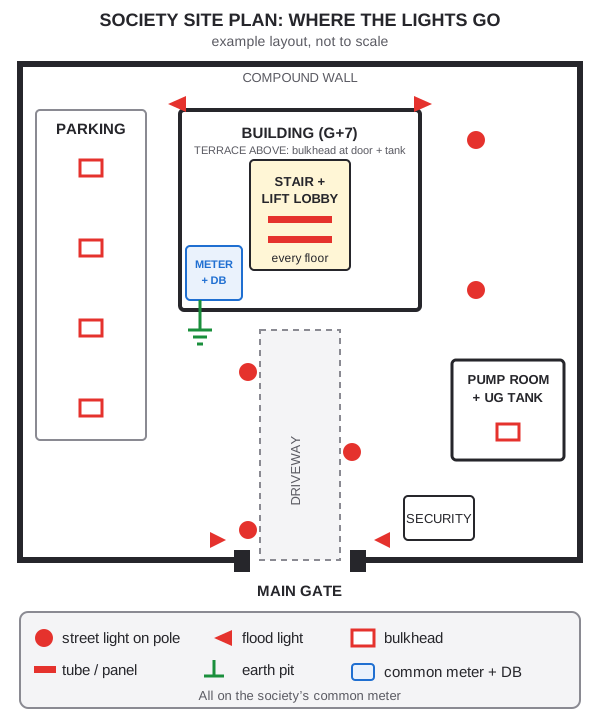
Drawn by us as an example layout, not to scale. Your society’s plan will differ; count your own points. Tap the diagram to open it full size.
Group the points by what the place needs, not by floor. Inside: staircase and landings, lift lobbies, entrance lobby. Outside: compound and driveway, gate, parking. Rarely visited but essential: pump room, water tank, terrace door.
Note which lights stay on all night and which only need to come on when someone is there. That one column decides most of the saving later.
| Area | Points | Old fitting (assumed) | LED option (code) | MRP each |
|---|---|---|---|---|
| Staircase and landings | 16 | 40 W tube | T5 LED tube fitting 20 W (1059) | ₹200 |
| Lift lobbies | 8 | 40 W tube | Big surface LED light 15 W (1004) | ₹450 |
| Compound and gate | 4 | 150 W halogen flood | LED flood light 50 W (1087) | ₹1,450 |
| Parking | 6 | 40 W tube | PVC LED bulkhead 20 W (1047) | ₹480 |
| Pump room and tank | 2 | 40 W tube | PVC LED bulkhead 12 W (1046) | ₹330 |
| Driveway (if poles exist) | As needed | Old street light | Ultra Prime street light 24 W (1079) | ₹650 |
How much light each area needs
Indian guidance gives ranges, not a single number, and the ranges are lower than most people guess. The National Building Code table reproduced in the GRIHA manual lists three figures for each space: low, recommended and high.
Illuminance ranges for common areas (lux)
From NBC 2005, Part 8, Section 1, Table 4, as reproduced in the GRIHA manual (Vol. III). These are NBC 2005 values; the current code is NBC 2016, which a lighting designer will use. Bars to scale against 300 lux, using the top of each range. A lighting designer can check your actual levels with a lux meter.
The pattern is what matters. The entrance lobby wants the most light because people judge the building there. Stairs need even light on every tread, so a dark landing between two bright ones is worse than a slightly dimmer staircase that is even. Parking needs surprisingly little on the floor, but more at entrances, exits and ramps, where cars and people cross.
Watts do not tell you light. Compare fittings by lumens on the test report; our lumens vs watts guide explains how. For counting fittings room by room, see how many lights in a room.
Too bright is a cost too. A lobby lit like a showroom wastes units every night and glares into ground-floor flats.
Count every common point by area and hours before asking for a price.
Tubes and surface lights inside, street and flood outside, bulkheads where it is damp.
A photocell or timer saves units that LED alone cannot.
Own MCBs, a 30 mA RCCB outdoors, and earthed metal poles.
Staircases, landings and lift lobbies
Many older staircases still carry 40 W tube lights or bare bulbs on a batten holder. Swapping them for a T5 LED tube fitting is the simplest job on the list: our 1058 12 W fitting is MRP ₹180 and the 1059 20 W is MRP ₹200. For more light, the 1060 T8 40 W fitting is MRP ₹600.
Lift lobbies usually have no false ceiling, so a recessed panel does not fit. A surface LED light screws straight to the slab: 1003 10 W at ₹360, 1004 15 W at ₹450, or the 1007 border-less 15 W at ₹450. If the lobby does have a ceiling, the 1025 slim panel 15 W is ₹400. Our surface panel light page compares them.
For the bottom steps and dark corners, a low foot light on the wall helps older residents without lighting the whole stairwell. Our VIZA V411 4-module royal foot light is ₹485 and the V412 is ₹380; see foot light height and wiring.
Each landing light switched from two places needs proper two-way wiring. Our 2 way switch wiring diagram shows the staircase connection.
Compound, driveway and the gate
Outside, the job changes. Light has to reach the ground from height and the fitting has to live through four months of rain. Along a driveway, a pole-mounted street light spreads light in a long strip, which suits a path. Our Ultra Prime street lights start at 1078 15 W, MRP ₹550, and 1079 24 W, ₹650. The standard range starts at 1071 18 W at ₹850; the 1073 30 W is ₹1,200.
For the gate and building corners, a flood light throws a wider beam over the compound. Small ones suit a gate pillar: 1080 10 W at ₹490 and 1081 15 W at ₹550. A larger compound takes the 1086 30 W at ₹1,100 or the 1087 50 W at ₹1,450. Wall brackets are 1082 at ₹90 and 1083 at ₹180.
Aim floods down at the ground, not across at the building opposite. Our guides on street light pole height and spacing and installing a flood light cover heights and angles; prices are collected in the flood and street light price list.
A flood light aimed at a neighbour’s window is the fastest way to a complaint at the next general body meeting. Tilt it down and check from the street at night.
Parking, pump room, water tank and terrace
These are the places nobody looks at until something goes wrong. They are also damp, dusty and sometimes splashed, so an enclosed PVC bulkhead light suits them better than an open tube. Our PVC bulkheads come in two sizes: 1046 12 W at MRP ₹330 and 1047 20 W at MRP ₹480. The bulkhead light guide explains 12 W vs 20 W.
In stilt or open parking, mount bulkheads on columns or the slab between bays, not directly over a car roof where a lift-gate will hit them. In the pump room, keep the light and its switch away from the pump’s splash zone and the sump. On the terrace, one fitting at the door and one near the overhead tank lets the plumber work after dark.
The pump itself is a separate circuit with its own protection; see MCB for a water pump. Do not hang the pump-room light off the pump starter.
Ask for the IP rating of any fitting going outdoors or into a pump room, in writing, before the order. Our catalogue does not print IP ratings, so ask us for the test report.
The common meter: a worked saving, with every assumption
Assumptions for the society in the drawing (an illustration, not a quotation): 16 staircase points, 40 W tube to 20 W T5 (1059). 8 lobby points, 40 W tube to 15 W surface light (1004). 4 compound floods, 150 W halogen to 50 W LED (1087). 6 parking points, 40 W tube to 20 W bulkhead (1047). 2 pump-room points, 40 W to 12 W bulkhead (1046). All on 12 hours a night, pump room 2 hours a day, 30 days a month. Old tubes taken at rated watts, ignoring choke losses. We assume the LED fittings give enough light for each area; check lumens on the test report and lux on site before you finalise wattages.
Units saved a month, by area (example society)
Worked arithmetic: watts saved × hours × 30 ÷ 1,000. Bars to scale against 144 units. Example only; your counts and hours differ.
What the saving is worth on the society bill
Old load 653 units a month, new load 275 units, so 378 units saved. On Tata Power’s residential tariff for FY 2026-27 (LT I(B), which MERC applies to housing society common lighting, lifts and pumps), the slab above 500 units is ₹10.24 energy plus ₹2.40 wheeling, or ₹12.64 a unit, before duty, tax and fuel adjustment. If your lights share a meter with the lifts and pumps and it stays above 500 units, every saved unit comes off the top slab: about ₹4,775 a month, roughly ₹57,000 a year. If the lights have their own meter, the saving is smaller, about ₹4,440 a month, because part of it falls in the lower slabs. The 36 fittings come to ₹16,140 at MRP, before labour.
BEST, Adani Electricity and MSEDCL each have their own approved tariff. Read the rate on your own society bill; our electricity bill guide shows how.
Timers, photocells and who switches the lights off
LED fittings cut the watts. Controls cut the hours, and in a society the hours are often the bigger leak, because nobody owns the switch. The watchman turns the compound on at dusk and forgets it at dawn, or the staircase runs all day because the switch is behind a locked meter cabinet.
Three common controls, in general terms. A photocell senses daylight and switches the outdoor lights on at dusk and off at dawn, with no one involved. A timer switches at set times, useful for turning off half the compound floods after midnight. A motion sensor lights a landing or pump room only when someone is there. Each needs to be rated for the load it switches; your electrician checks that.
Leave escape routes out of any cost cutting: the staircase must never go fully dark while people use it. A sensor that turns a landing to dim, not off, or a timer that keeps one light per floor on all night, keeps the building safe.
In our example, switching off two of the four compound floods from 1 am to 5 am saves another 12 units a month: 2 × 50 W × 4 h × 30 days. Small, but it is free once wired.
MCB box, circuits and earthing for common areas
Common lights should not share circuits with the lift or pumps. Give them their own distribution board, with separate MCBs for staircase, lobbies, compound and parking, so one fault does not black out the whole building. Where the common supply is three-phase, spread the lighting circuits across the phases, but keep each area and each switchboard on one phase, so no single board has two phases in it.
From our VIYONA range at catalogue MRP: the 387 4-way TPN double-door board is ₹2,620, the 388 6-way is ₹3,050 and the 389 8-way is ₹3,350. The 401 single pole MCB, 6 to 32 A, is ₹145; the 411 double pole is ₹350. See TPN MCB box sizes.
Lighting circuits typically run on 1.5 sq mm wire with a 6 to 10 A MCB. The MCB protects the wire: it carries its rated current and trips on sustained overload or a short circuit. Outdoor circuits also need a 30 mA RCCB against earth leakage. We do not make RCCBs; your electrician will source one.
Every metal pole and flood light body needs a sound earth. Have the earth pit tested; see how to check earthing.
Any work on the common wiring is for a licensed electrician, with the MCB off first. Not the watchman, not a resident with a tester.
Monsoon-proofing before June
Outdoor fittings in a Mumbai compound get four months of monsoon: weeks of wind-driven rain, plus salty air near the sea. Water finds every gap a fitting or junction box leaves open.
Check the IP rating. The first digit is dust, the second is water: IP65 means dust-tight and protected against water jets, and IP66 against powerful jets. For an exposed compound, ask for IP65 or better in writing; see IP ratings for lights.
Then the details that let water in anyway. Cable glands pointing down, not up. A drip loop in the cable before it enters a fitting. Junction boxes with intact gaskets, not taped joints. A spare LED driver in the office: our 1043 18–24 W street and flood driver is ₹240, the 1044 30–36 W ₹360, the 1045 50 W ₹400. Our LED driver guide explains why drivers fail first.
If water has entered an outdoor fitting or junction box, switch off that circuit at the MCB and leave it off until an electrician has dried and checked it.
Getting quotations the committee can compare
Three quotations that each list different fittings cannot be compared. Write the list first, from your walk round: area, number of points, fitting type, wattage, and hours. Ask every contractor to price the same list, with brand and code for each line, labour shown separately.
Then ask each one for the same four things: the BIS registration for LED products, the IP rating for outdoor fittings, the warranty in writing, and who replaces a failed fitting. Our LED lamps are registered under IS 16102, R-71026514, down lights and panels under IS 10322, R-71026476, and LED drivers under IS 15885, R-71026310.
Compare against MRP. A rate far below MRP for a branded fitting is worth a question. We sell in full boxes through dealers, with test reports on request before the order; see the e-catalogue or contact us. Thane-side societies can also read our Thane, Kalyan and Dombivli page.
Record the chosen list in the committee minutes. When a fitting fails in two years, the next committee will know exactly what was bought and where.
FAQs
What lights should a housing society use in common areas?
How much can a society save by switching common lights to LED?
How much light does a building staircase need?
Is the society common meter billed at residential or commercial rate in Mumbai?
Which IP rating do outdoor lights in a Mumbai society need?
Does Vinayak Electricals supply housing societies directly?
Why buyers choose Vinayak Electricals
- LED street, flood, bulkhead, tube and panel fittings for stairs, lobbies, compound, parking and pump rooms, with MRPs published in our catalogue.
- LED lamps registered under IS 16102 (R-71026514), down lights and panels under IS 10322 (R-71026476), drivers under IS 15885 (R-71026310).
- VIYONA 10 kA MCBs made under IS/IEC 60898-1 licence CM/L-2544151, plus SPN and TPN boards for the common DB.
- Making electrical accessories since 1995, today at our works in Andheri East, Mumbai; ISO 9001:2015 certified.
- Test reports on request before you order, so the committee can check what it is buying.
- Sold in full boxes through 500+ dealers, with all-India delivery.
LED fittings for your society’s common areas
See our VIYONA LED street lights, flood lights, bulkheads and tube fittings, then order through a dealer or call us.
Vinayak Electricals is an LED light manufacturer in Mumbai, supplying dealers, electricians and contractors across India by the box. Ask us for prices and stock.
View LED lights WhatsApp for prices Download catalogue